JAY AND THE AMERICANS – Wax Museum – (United Artists) – 1970

Wax Museum - album cover

I am going to use a lot of shorthand here and copy what I said back in "What Frank is Listening to #77" and elsewhere in relation to the magnificent Jay & The Americans album "Try Some of This":

A great underrated US pop band from the 60s. It baffles me that pop groups like Jay and the Americans, Gary Lewis and the Playboys, Dino, Desi and Billy, The Four Seasons,  are often referred to disparagingly whereas all the Merseybeat bands are lauded. When it comes to sublime pop the Brill building  type bands had it all over Merseybeat (with one notable exception) . The trouble is perhaps that in1967, the summer of love, and the evolving psychedelic scene a Spectorsish wall of sound vocal group was "perhaps" dated. I use "perhaps" intentionally because it may have been dated but the music stands up surprising well today especially compared to a lot of the psychedelica or hippy tunes of the day.

New Yorks Jay and the Americans (John "Jay" Traynor, Howard Kane (né Kirschenbaum), Kenny Vance (né Rosenberg) and Sandy Deanne (né Yaguda)) were discovered by Leiber & Stoller ( of Elvis song writing fame – if you don't know them shame on you) in the late 1950s. They were recording by 1961 and notching up 4 top10 hits, and many top 40s ( they even had a #6 late in the piece in 1969 with the magnificent "This Magic Moment"). Like many other bands of their ilk they were a singles band and never really had much chart action with their albums, which is a pity as the albums are professionally put together and contain many hidden gems.

The group started off as a white doo wop band, heavy on semi operatic teen dramas and laments of unrequited love …. and they never really moved far from that. And there is nothing wrong with that – as the recording techniques improved the sound necessary to create these mini pop operas improved accentuating the drama of the song. Forget the rock operas of the 70s there is much more rock "opera" in any 2 minutes of Jay and The Americans or The Four Seasons .

Generally with a band like this the vocals are always infinitely superior and the music is nothing short of lavishly produced…. Whilst the singles  are usually tailor made for the band, the albums succeed or die according to the strength of the covers chosen.

This is their next to last album and the exquisite pop symphonies they had created in the early to mid 1960s were definitely out of place in 1970. Their audience would have been middle-America not happy with psychedelica, hard rock, singer-songwriter, country rock or the various other music cross breeds that were being churned out at the end of the 60s and early 70s.

This album reflects that move to MOR, though there was always a danger their albums could be MOR as they had certainly flirted with the safe and predictable in the past. Certainly, this album is as "safe and predictable" as they come – it is an album of covers of big pop hits. I suppose it sounds funny to refer to an album of "covers" from a band who never wrote any material, but their earlier albums had tracks specifically written for them with the odd cover thrown in. So, here,  I assume they were trying to give their audience something familiar … I also suspect they were finding it harder to get good quality material written for them now that they were not as big as they once were.

Having said that I have no problems with a "covers" album as long as it hits the mark. The trouble is that in 1969 Jay & the Americans released a good album of covers, "Sands of Time", which hit the aforesaid "mark". Unfortunately, they perhaps used up all the good songs they knew on that one. That album had done pretty well (#51, which is actually their highest album placing) and the single from it, "This Magic Moment", went to #6.

It would have made perfect sense to follow it up with more of the same but the results didn't follow..

Whereas "Sands of Time" bridged nicely their beautiful pop of the early 60s with late 60s pop excesses this album veers more to cabaret and MOR.

That's not to say it isn't well sung, it is, but apart from a few tracks it is not particularly distinctive or inspired. Apparently the band complained that United Artists released the album before they could lay down the finished tracks and these are only "reference vocals".

The Tracks (the best in italics)

  • Walkin' in the Rain – Mann, Spector, Weil –  co- written by maverick genius Phil Spector and an excellent cover of the Ronnettes 1964 hit. It went to a respectable #19 on the US singles charts for Jay et al.

  • Lover's Question  – Benton, Williams –  the Brook Benton track … nothing added to the original.

  • Message to Martha (Kentucky Bluebird)  – Bacharach, David –  as recorded by Jerry Butler in 1963.

  • Room Full of Tears  –P omus, Shuman – The old Drifters classic and very much in the Pomus and Shuman style – Elvis recorded a truck load of their songs in the 60s and this could have been one of them …

  • Let It Be Me – Becaud, Curtis, Delanoe – the oft covered big ballad – Elvis, Everly Brothers etc … maudlin, emotional and hopelessly romanti, but it works.

  • Lonely Teardrops – Carlo, Fuqua, Gordy – the Jackie Wilson classic which would be very hard to top even if the whole point of the song wasn't missed. The song is turned into pure cabaret and is probably the least satisfying cover on the album.

  • Do I Love You? – Andreoli, Poncia, Spector – another Ronettes track and above average.

  • I Don't Want to Cry – Dixon, Jackson – Chuck Jackson's 1961 hit.

  • Some Kind of Wonderful – Goffin, King – another Drifters classic and another track that misses the mark.

  • You Were on My Mind  – Fricker – the Ian & Sylvia folk song from 1964 … though "We Five" had a hit with it in 1965 (#1 US). Jay et al harmonies work for this type of song.

  • Johnny B. Goode – Berry– at first I thought how does this rock 'n' roll classic fit in … Jay et al have slowed it down and made it fit in . Having said that it doesn't do anything for the song.

  • This Is My Love  – Smith – a 50s song by Brooklyn doo-wop band The Passions. Pretty, though very cabaret and very MOR.

And …

So, this is not the best Jay and the Americans album but it has its fair share of good moments and I have the rest of their albums so … I'm keeping this.

Chart Action

The album reached #105 on the US charts.

Sounds

Walkin' in the Rain

attached


Lover's Question 

http://www.youtube.com/watch?v=KBQmBi326Jk

Let It Be Me 

http://www.youtube.com/watch?v=-wU_zPTPidg

oldies cabaret style (I'd go see them at the RSL)

http://www.youtube.com/watch?v=CUYurIPWBrg

Lonely Teardrops 

http://www.youtube.com/watch?v=d7caIFsDtt0

Some Kind of Wonderful 

http://www.youtube.com/watch?v=MMG7peZzKNQ

You Were on My Mind 

http://www.youtube.com/watch?v=i-ceCwjRTVw

Bio

http://en.wikipedia.org/wiki/Jay_and_the_americans

Website

http://www.jayandtheamericans.net/

Further Research:

Brill Building

http://en.wikipedia.org/wiki/Brill_Building

Leiber and Stoller

http://en.wikipedia.org/wiki/Leiber_and_Stoller

Trivia

  • The original lead singer of this quintet was John "Jay" Traynor. After he left the group in late 1962, David Blatt assumed the name Jay Black and became the new lead singer. The original band split in 1970. Later on, Jay Black as well as Jay Traynor have travelled with a band of "Americans" due to a court settlement that allows them both to make a living off the name.

Other Comments

what Frank is listening to #123

what Frank is listening to #77    

(originally posted: 26/12/2009)

Posted in Pop Rock | Tagged | Leave a comment

THE BEAU BRUMMELS – Bradley’s Barn – (Warner Brothers) – 1968

The Beau Brummels are a bit of a cause célèbre for fans of 60s US rock. They had a number of hits, made some great records but are largely forgotten by contemporary audiences. This is a pity because when they were good they were great, and arguably they were one of the best groups of the 60s, on either side of the Atlantic.

Allmusic: "While they only had two big hits, the Beau Brummels were one of the most important and underrated American groups of the 1960s. They were the first U.S. unit of any sort to successfully respond to the British Invasion. They were arguably the first folk-rock group, even predating the Byrds, and also anticipated some key elements of the San Francisco psychedelic sound with their soaring harmonies and exuberant melodies. Before they finally reached the end of the string, they were also among the first bands to record country-rock in the late '60s".

By the time of this album's recording The Beau Brummels had been reduced to two: Sal Valentino on vocals and Ron Elliott on guitars. But that doesn't matter as they were always the nucleus of the Beau Brummels and here they have lined up some of the greatest session men of the time to join them.

"Bradley's Barn" is also their exploration of country music in a rock setting, and, at that, it's quite early in the trend … it would be another year before it became truly fashionable to inject country attitude and mood into rock tunes. Perhaps this was a natural progression from their folky, jangly mid-60s sounds or perhaps they were influenced by Gram Parson's experiments with The Byrds on "Sweethearts of the Rodeo" (though admittedly the Brummels had some small country influences on their preceding mini masterpiece of an album, 1967s "Triangle"), but either way they packed up and headed to Nashville and recorded this in Owen Bradley's studio (hence "Bradley's Barn") which had recorded many country acts as well as crossover acts like Ian & Sylvia and Bob Dylan.

Assisting them are the aforesaid greatest session men of the time, all from Nashville where if you weren't better than good you would starve. Jerry Reed on guitar (yup that Jerry Reed who would go on to become a solo country star in his own right and wrote "Guitar Man" and "Tupelo Mississippi Flash"), Wayne Moss, Harold Bradley, and Billy Sanford also on guitars, Norbert Putnam on bass, David Briggs on keyboards and Kenny Buttrey on drums.

By way of a "he is everywhere side note": Reed, Bradley, Putnam, Briggs and Buttrey had all played on various Elvis session in the 60s and into the 70s.

Elliott and Valentino (California born and bred) wrote all but one of the songs solely or together and  have managed a very contemporary (1968) country sound with a twist. It's not Nashville and it's not authentic country like Parson's was injecting into The Byrds. It is country by a west coast rock/pop act, specifically San Franciscan, and it channels Bob Dylan as well as a less hoarse, more tuneful Lee Hazlewood. As far as I am concerned, that can't be a bad thing.

That said, the album is nowhere near as country-ish as I thought it would be as there are none of the usual country instruments: no fiddles, pedal steel guitars etc. It is basically a stripped down, roots album with an emphasis on country-pop or country-folk rather than country-rock.

Cleanly produced by Lenny Waronker who also produced the "Triangle" LP the album is easy on the ears and creates a rather world weary, slightly cynical mood across both sides. The only fault is perhaps that, despite the abundance of good songs, there is no one classic track on the album. Some come close though.

Tracks (best in italics)

  • Turn Around – a perfect start to the album – a good song which is not quite country rock but rather rock with country overtones

  • An Added Attraction

  • Deep Water- cosmic country or country soul …

  • Long Walking Down to Misery- a very Lee Hazlewood tune

  • Little Bird

  • Cherokee Girl – again country out of left field and especially well sung.

  • I'm a Sleeper

  • Loneliest Man in Town – a country theme if there ever was one.

  • Love Can Fall a Long Way Down – more Lee Hazlewood channelling and a great song.

  • Jessica

  • Bless You California – the only non-original, a song by Randy Newman … and unsurprisingly very "Newman quirky".

And …

Never really an album act anyway this didn't make the charts and they broke up shortly thereafter, though there was a reunion for a one off album in 1975.

Maybe not the lost classic it's meant to be but certainly a superior album … I'm a keepin'.

Sounds

Turn Around

attached


Deep Water

attached


Love Can Fall a Long Way Down

attached


Reviews

http://en.wikipedia.org/wiki/Bradley%27s_Barn

http://www.allmusic.com/cg/amg.dll?p=amg&sql=10:diftxql5ldae

Bio

http://www.allmusic.com/cg/amg.dll?p=amg&sql=11:kifrxqw5ldse~T1

http://en.wikipedia.org/wiki/Beau_brummels

Website

http://www.beaubrummels.com/

(originally posted: 20/12/2009)

Posted in Country Rock, Garage, Surf and Frat | Tagged | Leave a comment

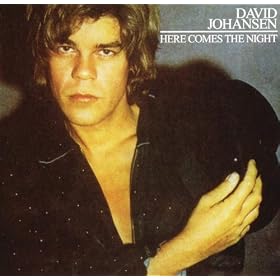
DAVID JOHANSEN – Here Comes the Night – (Blue Sky) – 1981

Here Comes The Night

Way back in "what Frank is listening to #49" in relation to Johansen's "In Style" album from 1979 I said this:

I suppose no musical biography of Johansen is necessary but I will copy this from allmusic.com as a chameleon like quality applies to this LP:

Best known for his tenure fronting the hugely influential New York Dolls, David Johansen was a true chameleon; throughout the course of a career which saw him transform from a lipstick-smeared proto-punk hero into an urbane blue-eyed soul man and finally into a tuxedo-clad lounge lizard, he remained a rock & roll original, an unpredictable iconoclast and a true cultural innovator.

I was particularly interested in this as I have Johansen's first solo LP and even some of the Buster Poindexter albums which are patchy … "In Style" was Johansen's second album and grab for some mainstream success which unfortunately eluded him.

This album was Johansen's last try for the "big time", under his own name. The sound is big, loud and clean and the rock is "hard", occasionally "new wave", and mostly conventional. He comes across as a New York variation on Springsteen at his most bombastic or perhaps Bob Seger at his most urban or even "Quiet Riot" at their most serious. But, and this is a big "but", this is David Johansen and I suspect the guy is not normal. This much is clear, he cant help himself. The album like a lot of Johansen's solo work is schizophrenic though here the battle is between "going for the $" and Johansen's clearly twisted personality. If this is him selling out and he thinks this album is "mainstream" then he is a nut job.

Johansen the "nut job" is the albums redeeming feature and indeed that's why Johansen is so great. Much like Kim Fowley on the west-coast Johansen plundered the rock of his youth and recast it in his own vision.

So, does Johansen fail here?

Yes.

But, any individual vision regardless of successful outcome must be more valuable than proficiency and success with the safety net of mediocrity.

There are enough quirky moments amongst the lure of riches to make this a mildly likeable album.

His sideman and co-writer here is South Africa-born guitarist/ multi-instrumentalist/vocalist Blondie Chaplin who has been a sideman for The Beach Boys, The Band and The Rolling Stones.

Best Tracks

  • Bohemian Love Pad – Johansen, Sylvain – an ode to Beatnik ways done to an updated Ronettes type sound.

  • My Obsession – Chaplin, Johansen – Johansen's idea of a love song.

  • Marquesa de Sade –  Blain, Johansen – Latin samba meets French decadence. Weird.

  • Suspicion – Chaplin, Johansen – any song that name checks "Vincent Price" cant be all bad.

  • Heart of Gold – Johansen – a raggedy big ballad.

And …

A keeper … because I have some of his other albums … and it's not far from here to Johansen's Buster Poindexter persona.

Chart Action

This bid for riches stalled at number #160 on the US charts.

Sounds

My Obsession 

attached


Heart of Gold

attached


and just in case you have forgotten ….

http://www.youtube.com/watch?v=Ctg5FCS1wCM

Review

http://www.allmusic.com/cg/amg.dll?p=amg&sql=10:g9frxq95ld0e

Bio

http://www.allmusic.com/cg/amg.dll?p=amg&sql=11:kifqxqe5ldse

http://en.wikipedia.org/wiki/David_Johansen

(originally posted: 16/12/2009)

Posted in Punk and New Wave | Tagged | Leave a comment

ROD McKUEN – New Ballads – (Warner Brothers) – 1970

Rod McKuen is an acquired taste.

His detractors would say he is pretentiously poetic, maudlinly romantic, ponderously repetitious, slightly narcisstic, boringly middle aged, full of middlebrow banality and  with a voice somewhere just below Bob Dylan on the dulcet tone scale. To me this is all true but how you take it depends on where you stand.

He certainly is poetic (and has published volumes of poetry to prove it), unashamedly romantic, thematically consistent, always world weary with an old mans (or a wise mans)  attitude even when he was young, and with a voice that sounds as if it had lived.

How did I get into McKuen?

Very simple – when I started op-shopping in the 1980s his records were everywhere and he was very unhip (and still is whereas Serge Gainsbourg isn't – go figure). His records made such a large dent in the rop shop ecord bins because in the 60s and 70s he sold well over 100 million albums mainly to "adult" and "older" people …  people our age now. He was venerated by the middle aged masses, covered by the adult pop entertainers like Sinatra, MOR pop singers like Oliver, Terry Jacks, Scott Walker and Glen Yarbrough and country singers like Johnny Cash and Waylon Jennings. It's hard to explain how popular he was, just accept he was.

Read the bios linked below.

Unfortunately for McKuen he hit it big at a time when the mainstream, and less thoughtful "serious" rock critics at Rolling Stone etc, were dismissing everything before The Beatles with that overweening pretentiousness that became part and parcel of "rock criticism". McKuen was savaged by them as a relic of another time, and maybe he was, but that was part of his charm. He refused to compromise his taste or his values (though apparently there is a disco album in there somewhere which I haven't heard, but otherwise he has been consistent), but his biggest problem with the taste makers is that, if you are going to be "introspective" and "tortured" you have to be cynical or dark. McKuen is uber introspective and very melancholy but relentlessly upbeat and positive and rarely angry despite a world of imperfect humanity that tests him. 

You would never mistake him for Henry Rollins in either his music or his spoken word, though there are similarities. He could also pass for a less country Lee Hazlewood. Apart from Rollins and Hazlewood, thematically he is also not that far removed from Brian Wilson or Ray Davies of the Kinks. He and they are out of step with the world and don't mind being so, and they are also relatively upbeat.

Though, even if the music intelligentsia could see all that, the lush MOR strings all but sinks him in their eyes . 

Again I direct you to his bio links but in short McKuen was born in California in 1933, never knew his father, was abused by his stepfather, hit the road early, was a lumberjack, DJ, cowboy, did some acting in the 50s and appeared in some films, wrote poetry with the Beats, read poetry with Kerouac and Ginsberg, sang upmarket folk, then jazz, sang with Lionel Hampton's band, wrote songs (1500 apparently), covered many songs, put out vocal albums, hung out and wrote songs with Jacques Brel, lived in all the usual American expatriate places in the world, sold 65 million books of poetry, put out many spoken word albums, sold out spoken word concerts, sold out musical concerts, composed film music, composed orchestral suites, conducted orchestras, was a quiet radical, won many humanitarian awards … so give him a break.

The music here is a lush MOR pastiche of jazz, lounge, MOR, and occasionally exotica all held together by his gruff voice and his world view. The album was arranged and conducted by Don Costa (of Frank Sinatra fame).

I love McKuen – and I often play his compilations though from what I have so far I don't have one great album. This album certainly is better than some of the others I have, though I should say I only have about 14 of his 50 or so vocal albums. The music is still MOR but a little zippier with Don Costa 's arrangements. The harpsichord and strings never drown out Rod so he has a lot of space to ruminate … and he does ruminate, on lost love, found love, and missed love. All at the age of 37!

Tracks (the best in italics):

  • Statement: Before I Loved No one – a poem.

  • As I Love My Own 

  • Thanks You For Christmas 

  • And Tonight – a throwback to the 40s and 50s very much like something that Maurice Chevalier or Charles Boyer would put out … lushly romantic and the lyric gives you the general idea …

            Because you smell like yesterday

            I thought I'd come here once again, and stay

            The night

            Because my arms have ached to long

            I thought I would rest them here where, they belong

            Tonight

  • I Looked At You A Long Time 

  • I'm Not Afraid – a musical theatre piece with an obvious joyous carnival atmosphere (Fellini would love it):

            What about You

            What about me

            Two years from now where will we be

            each of us gone our separate ways

            lost in the headlong passage of days

            Maybe we might

            give a love a try

            extending the moment

            before goodbye

            and for a gentle moment in time

            we will take what pleasure people can find

  • Resolution: Before I Loved No One 

  • Rock Gently – covered by Rock Hudson on his album of McKuen covers, "Rock Gently" from 1971, which was also produced by McKuen. I have always been partial to Rock's films so to get him "singing" was a bonus. He is very musical you know … I'm not musical at all. Sinatra also did a whole album of McKuen songs, "A Man Alone" from 1969 as did Glen Yarborough, "Each Of Us Alone", 1968 (as an aside I have all of those albums and they are good).

  • Philadelphia

  • Gone With The Cowboys – oddly a song that Rod wrote with Rock Hudson in mind … they had known each other since the 50s when Rod was a contract player at Universal studios and Rod was one of it's biggest stars. Very much a melancholy tone piece

  • Tomorrow And Today – "silence can be loud even in a crowd"

  • In Someone's Shadow 

  • Hit' em In The Head With Love – "Im gonna get up and hit em in the head with love" … I did say he was upbeat.

  • A While More With You – "Please let me share a smile more with you, Let Me stay a while more with you"

And …

I'm keeping this … mainly cause it is occasionally brilliant and I have quite a number of other McKuen albums. I wouldn't mind if Rick Rubin "discovered" him.

So, maybe, rather than being on the "cutting edge and searching out the next new group of 20 year olds, or waiting with baited breath for the next new line up of The Stooges, we should grow old gracefully with McKuen re–runs … and if you don't agree go out and buy a copy of Iggy Pop's "Preliminaires".

Chart Action

The album went to #126 of the US Hot 100.

Sounds

I'm Not Afraid
attached


Gone With The Cowboys

attached


Others:

http://www.youtube.com/watch?v=4-l0o3tOXw0

http://www.youtube.com/watch?v=QnG7o92gYk4

http://www.youtube.com/watch?v=rfziQHKQpfc

http://www.youtube.com/watch?v=soy91R2j1kM

and an early one:

http://www.youtube.com/watch?v=0Y9Q11wIVkw

covers:

http://www.youtube.com/watch?v=NHl1eW-qcA4

http://www.youtube.com/watch?v=10HnrkPXXlk

http://www.youtube.com/watch?v=6P2j5YGcuYc

Bio

http://en.wikipedia.org/wiki/Rod_mckuen

http://www.allmusic.com/cg/amg.dll?p=amg&sql=11:hpfqxqt5ldde~T1

And yes he may be gay, bi, tri or straight … not that there's anything wrong with that.

Let him speak for himself:

http://www.mckuen.com/flights/290604.htm

Website

http://www.mckuen.com/index.htm

(originally posted: 13/12/2009)

Posted in Popular & Crooners | Tagged | 2 Comments

JAY AND THE AMERICANS – Come a Little Bit Closer- (United Artists) – 1964

Come a Little Bit Closer - album cover

I am going to use a lot of shorthand here and copy what I said back in "What Frank is Listening to #77" in relation to the magnificent Jay & The Americans album "Try Some of This":

A great underrated US pop band from the 60s. It baffles me that pop groups like Jay and the Americans, Gary Lewis and the Playboys, Dino, Desi and Billy, The Four Seasons,  are often referred to disparagingly whereas all the Merseybeat bands are lauded. When it comes to sublime pop the Brill building  type bands had it all over Merseybeat (with one notable exception) . The trouble is perhaps that in1967, the summer of love, and the evolving psychedelic scene a Spectorsish wall of sound vocal group was "perhaps" dated. I use "perhaps" intentionally because it may have been dated but the music stands up surprising well today especially compared to a lot of the psychedelica or hippy tunes of the day.

New York's Jay and the Americans (John "Jay" Traynor, Howard Kane (né Kirschenbaum), Kenny Vance (né Rosenberg) and Sandy Deanne (né Yaguda)) were discovered by Leiber & Stoller ( of Elvis song writing fame – if you don't know them shame on you) in the late 1950s. They were recording by 1961 and notching up 4 top10 hits, and many top 40s ( they even had a #6 late in the piece in 1969 with the magnificent "This Magic Moment"). Like many other bands of their ilk they were a singles band and never really had much chart action with their albums, which is a pity as the albums are professionally put together and contain many hidden gems.

The group started off as a white doo wop band, heavy on semi operatic teen dramas and laments of unrequited love …. and they never really moved far from that. And there is nothing wrong with that – as the recording techniques improved the sound necessary to create these mini pop operas improved accentuating the drama of the song. Forget the rock operas of the 70s there is much more rock "opera" in any 2 minutes of Jay and The Americans or The Four Seasons .

Generally with a band like this the vocals are always infinitely superior and the music is nothing short of lavishly produced…. Whilst the singles  are usually tailor made for the band, the albums succeed or die according to the strength of the covers chosen.

This is their third album and is sometimes listed as a compilation. It's not really. The album is a collection of all their (then) recent singles wrapped around the title tune that was riding high in the charts. This was not really that unusual for pre-Beach Boys/Beatles artists. In any event all of the songs bar one ("This is It") have the second Jay on vocals (see trivia at end regarding the "Jays") and all the tracks are produced by Leiber & Stoller or for Leiber & Stoller by a staff producer. So there is a consistent sound in there.

Having said that there are individual moments of genius but the album doesn't hold together like some of their later pop rock opera masterpieces. Still, those individual moments are sheer joy … and there is not a track over three minutes.

The Tracks (the best in italics)

  • Come A Little Bit Closer – Boyce, Hart, Farrell – one of the best pre-Beatles 60s pop songs … from the faux Latin rhythms down to the narrators pleading of the title this song is a winner. Co–written by the great Boyce & Hart who wrote for The Monkees – classics like "(I'm Not Your) Stepping Stone".

  • She Doesn't Know It – Kronfeld, Keller.

  • Strangers Tomorrow –  McCoy.

  • What's the Use – Meade, Robinson.

  • Only in America – Leiber, Stoller, Weil, Mann –  A great song. On face value the song can be taken as an unmitigated statement of faith in America. But Leiber & Stoller, who were always quite cynical, lay it on so thick that it becomes ironic. Initially it was intended to be sung by the Afro–American The Drifters but their version was shelved to avoid controversy. I assume the intent for Leiber, Stoller, Barry Mann and Cynthia Weill was apparently a "straight" protest song. Jay and the Americans version, may be cleaner,"white-er", and more ambiguous but the irony still comes through (though it wasn't always taken that way). For more discussion on the track … http://geocities.com/spectropop/hleiberstoller.html#only

  • Look in My Eyes Maria – Bacharach, David – a beautiful mid tempo ballad in the special Burt Bacharach – Hal David way.

  • To Wait For Love – Bacharach, David – Very Gene Pitney … but that's not a bad thing.

  • Friday – Powers, Greenwich.

  • This Is It – Powers, Greenwich.

  • Come Dance With Me – Powers, Maurer – reminds me of "Save the Last Dance for Me" but not as distinctive.

  • Tomorrow -Daryll, Richards.

  • Goodbye Boys Goodbye (Ciao Ragazzi Ciao) – Tepper, Bennett, Mogol, Del Prete, Celentano – A big uptempo ballad obviously aimed at the Italian–American market written by Italians and with English lyrics by Elvis soundtrack songwriters, and experts in this, Tepper and Bennett.

And …

On first blush it seems JAATA are the 1960s equivalent of the "boy band" of today but that would be wrong, and anyway, as I have said in the past … if you are going to pick MOR pop to listen to, pick it from the 60s.

I'm a keepin'.

Chart Action

The album peaked at #131 on the US Charts … don't forget they were a singles group.

 1963  Come Dance With Me   The Billboard Hot 100 #76
 1963  Only In America   The Billboard Hot 100 #25
 1964  Come A Little Bit Closer   The Billboard Hot 100 #3

Sounds

Come A Little Bit Closer 
http://www.youtube.com/watch?v=tM-QsTqPpNE

http://www.youtube.com/watch?v=bu9ZepcV0CM

attached


Only in America
http://www.youtube.com/watch?v=Lc7wVFWGaW8

http://www.youtube.com/watch?v=BWrCRPldVZk

Goodbye Boys Goodbye (Ciao Ragazzi Ciao)
http://www.youtube.com/watch?v=KPIdCVP_pN4

Others:

Cara Mia

http://www.youtube.com/watch?v=1sFy5_kmEi4

Review

 http://www.allmusic.com/cg/amg.dll?p=amg&sql=10:hzfyxqqsldde

Bio

http://en.wikipedia.org/wiki/Jay_and_the_americans

http://www.history-of-rock.com/jay_and_the_americans.htm

Website

http://www.jayandtheamericans.net/

Further Re-search:

Brill Building

http://en.wikipedia.org/wiki/Brill_Building

Leiber and Stoller

http://en.wikipedia.org/wiki/Leiber_and_Stoller

Trivia

  • The original lead singer of this quintet was John "Jay" Traynor. After he left the group in late 1962, David Blatt assumed the name Jay Black and became the new lead singer. The original band split in 1970. Later on, Jay Black as well as Jay Traynor have travelled with a band of "Americans" due to a court settlement that allows them both to make a living off the name.

(originally posted: 12/12/2009)

Posted in Pop Rock | Tagged | Leave a comment

MICKEY NEWBURY – Rusty Tracks – (ABC Records) – 1977

I commented on Newbury back in "what Frank is listening to #78" in relation to his "His Eye is on the Sparrow" album from 1978.

I said this back then: "It is Newbury's subtlety and thought that put him at the forefront of "progressive country". "Progressive Country" roots lie in traditional country, roots music, folk, Americana, regional rock n roll and was largely comprised of younger country songwriters writing country music with naked honesty, which is no mean feet as country music generally is "nakedly honest" ( think Hank Williams, Patsy Cline).  What they did do was write incredibly personal songs much like their "singer-songwriter"relatives in the pop field with an ear to the past. The other thing they did was sing their own material regardless of the quality of the voice. Consequently, they have put out many albums and are well respected but their songs are often associated with other singers. Think Townes Van Zandt, Danny O'Keefe, Kris Kristofferson, Willie Nelson, Terry Allen, John Hartford, Billy Joe Shaver, Butch Hancock, Gene Clark, Tom T. Hall, John Prine, Jimmie Dale Gilmore, Guy Clark Dennis Linde, etc. Some of those artists moved into the more up-tempo "outlaw country" whilst the rest continues on and eventually became the cornerstones of "alt country" in the 80s and 90s".

Newbury, born 1940 in Houston Texas (died 2002) put out his first album in 1968.

This is his 9th album.

This album is more "country" than others of his I have heard, though it still is "country folk". It is certainly more stripped back than some of his others. The first side was produced by country singer Bobby Bare and side two was produced by Ronnie Gant. Backing him is, amongst others, Norbert Putnam, Bobby Emmons, Bobby Wood, Johnny Christopher, Reggie Young, and an astounding array of backing vocalists including Larry Gatlin, Bergen White (the unknown genius), Buzz Cason and Janie Fricke.

As usual the album contains deeply personal and intimate songs bathed in darkness, or, here, in more darkness than usual. And yes, there is a lot of sadness, regret, and loneliness. He doesn't dwell on these things like some tiresome new wave singer-songwriter but rather the moods seem to grow organically from the narrative of the song.

Best Tracks

They are all good … seriously. But the best are in italics:

  • Leavin' Kentucky – Newbury –  an achingly sorrowful song about unreciprocated love despite some country schmaltz instrumentation.

            God knows I loved her 
            Too much I can see 
            Much more than she 
            Could have ever love me 
            If I was the last man 
            In East Tennessee

            God I'm just one man 
            I wish I was three 
            Take a forty-four pistol to me 
            Put one in my brain for her memory 
            One more for my heart 
            And then I'd be free

  • Makes Me Wonder If I Ever Said Goodbye – Newbury –  another song of lost love, this one is straight country.

            Yes she always says hello the way she used to 
            But my God she only said goodbye one time 
            Heaven knows I live in hell 
            Yes a bar room is my cell 
            Makes me wonder if I ever said goodbye 
            Makes me wonder if I ever said goodbye

        Do you see a theme developing . For his sake I hope he's talking about one girl rather than a number, otherwise he is startlingly unsuccessful in love.

  • Bless Us All  – Newbury –  Newbury's philosophy in one song? Excellent and quite dark … the "losers", "winners", "dreamers" and "old ones" are all "huddled". Everyone is "huddled".

  • Hand Me Another of Those – Fry, Newbury –  #94 US Country. The dominant theme returns.

            Hand me another 
            I'll swallow that mother 
            Soon I'll be higher 
            Than the sun ever rose 
            We've had a shown-down 
            I'm feelin' mighty low down 
            Hand me another one of those

            Hey there bartender 
            I sure ain't no winner 
            But I ain't lookin' 
            For no sympathy 
            Just some way of forgetting 
            How long I been letting that woman 
            Make a poor fool out of me

  • People Are Talking  – Newbury –  A excellent Kristofferson like song with beautiful wordplay … though I think Newbury influenced Kristofferson..

            Are we pretending to know more than nothin'

            Are we supposing what we know to be true 
            We die every day that we live in 
            And we live every day that we do

  • Tell Him Boys – Newbury –  the most country MOR song on the album and with an upbeat message (of sorts) that's not in line with the rest of the album.

The next four songs form a suite much like Newbury did with "American Trilogy" (Battle Hymn of the Republic, Dixieland, All My Trials). Unlike "American Trilogy" the songs here are complete so they can be listened to separately but it is clear from the instrumentation linking one to another that this was meant to be a suite. Also, quite noticeably here, Newbury's suite lends itself to dramatic bombast unlike his "American Trilogy" which would lead me to believe he picked up the idea from Elvis' "dramatic" 1972 cover of his low key original version of "American Trilogy". (The song was a Elvis live staple of the 70s and also appeared on a number of live albums). The suite here is audacious but it works and is incredibly moving if you have any knowledge of American history … it takes me back to the US of my youth ( I watched a lot of American TV as a kid).

  • Shenandoah – trad –  one of the greatest of all country folk song songs as well as of one of the greatest of all songs about "home". Here, Newbury has arranged it into a big ballad – strings, drama, whistling (whistling in country songs always cues loneliness), much as he did on "American Trilogy". In fact I could see Elvis giving this the 70s bombastic treatment. Still, it's one of the best versions of this song I have heard.

  • That Lucky Old Sun (Just Rolls Around Heaven All Day) – Gillespie, Smith – a beautiful old song that also became the central piece to Brian Wilson's 2008 album of the same name.

  • Danny Boy – Weatherly – yep … the old war horse … this must be one of the most recorded songs of all time. Its drama and sadness fits in perfectly with this suite. Elvis' version (another Elvis aside) is from 1976 (though you can also get rough versions from 1959 and 1968).

  • In the Pines – trad – a very old Appalachian folk song which has been recorded by everyone in a number of guises (Nirvana, Pete Seeger, Bill Monroe, Leadbelly, Gene Clark). A hauntingly beautiful song.

            In the pines 
            In the pines 
            Where the sun never shines 
            We shiver when the cold wind moans

            Little girl 
            Little girl 
            What have I done 
            That has made you treat me so

Allmusic had this to say about the suite: "Mirroring his own "American Trilogy" of half a decade before, Newbury strings together — once more without seams — four pieces of classic Americana with breathtakingly gorgeous arrangements: "Shenandoah," "That Lucky Old Sun," "Danny Boy," and "In the Pines." On this set, the orchestra appears and Newbury's singing is as good as anybody's ever was. He doesn't merely sing these songs — he is them, a part and parcel of the fabric of the notes themselves and what they represent. Just when Americans were trying to forget who they were by embracing European disco and punk rock as well as dumbed-down versions of both country and jazz, Newbury reveals — much to his own commercial detriment — who and what we are as a nation. There is no more stunning finish to a Newbury record — maybe anybody's record".

I agree, the suite is magnificent though cynical punkers are advised to avoid. People who would like to hear Brian Wilson doing Americana step right up.

And …

A keeper.

Chart Action

The album didn't chart.

Sounds

Leavin' Kentucky
http://www.youtube.com/watch?v=T6hNjjdL2ks

Makes me Wonder …
http://www.youtube.com/watch?v=Zz6Rdd9uNCY

Bless us all

attached


Hand me another of those
http://www.youtube.com/watch?v=m9qCx2mTEzk

People are Talking
http://www.youtube.com/watch?v=OZCXIxqNb0w

Shenandoah
http://www.youtube.com/watch?v=9FLXsNNgcUs

and attached


In the Pines
http://www.youtube.com/watch?v=oAcIUpqmiK4

Mickey's most famous song:

"An American Trilogy"

MN

http://www.youtube.com/watch?v=dbk-hXjSTgM

EP

Hawaii

http://www.youtube.com/watch?v=moUifEmOcbU&feature=related

or, given the recent anniversary of Elvis's passing

http://www.youtube.com/watch?v=gZ3MOyCn66w

Danny Boy by EP

http://www.youtube.com/watch?v=Dk80G6MnwlE&feature=related

Website

http://www.mickeynewbury.com/

Bio

http://www.allmusic.com/cg/amg.dll?p=amg&sql=11:hifrxql5ldde~T1

http://en.wikipedia.org/wiki/Mickey_Newbury

The guy has been well covered:

http://www.mickeynewbury.com/pdf/MicklistPrint.pdf

Kenny Rogers and the First edition covered one of his best songs " Just Dropped In" ( To see what condition my condition was in). …youtube it.

(originally posted: 06/12/2009)

Posted in Alt Country | Tagged | Leave a comment

HENSON – Henson – (UA) – 1974

 
Another LP which has been sitting around for ages. I remember looking for background on this guy some years back and not finding much. Nothing has changed. It was even an effort finding out his Christian name as he seems to go by "Henson" only.
 
aaah …"Tim" in case you're wondering.
 
If cover art alone were an indicia it would be fair to think that Henson is a introspective singer-songwriter. After a partial listen it would be fair to conclude that he is a sometime singer-songwriter and a particularly MOR and slick one. Though he was only involved with writing three of the ten songs here he does play piano, organ, clavinet, melodica, trumpet, moog, harpsichord and electric piano. Smells like a session musician making his own album. Brilliant Sherlock? Yes, quite. And, right. The liner notes indicate he was from Arkansas and moved to Alabama to work at the legendary Muscle Shoals studios where he backed Mac Davis, The Osmonds,  Clarence Carter etc.
 
That's about all the bio I have … till now … remember I write this contemporaneously mainly. After much searching I found this by another punter in search of background:
 
In my final round of internet searches on Tim Henson, I came across someone who knew him, and through him I got some actual information. It seems that shortly after Tim had been made an official member of the prestigious Muscle Shoals Sound rhythm section, he took his own life. There was evidently a lot of pressure being a studio musician, in both quality of performance and the amount of work one would have to take on just to make ends meet. I guess if he was also trying to make it as a solo artist, the pressure would be that much greater. So yeah, this tale does not have have a happy ending, and we see yet another talented musician who becomes little more than a footnote in rock history. For me, this song always had a melancholy vibe to it, and knowing what I now know, it always will. http://recordrobot.blogspot.com/2005/12/take-meh-shake-meh.html
 
There is some suggestion on the same site that Henson may have been murdered, for reasons unknown.
 
In any event Henson was a Fame Studios session keyboardist. Many  classic recordings were made at Rick Hall's Fame Studios, home of the "Muscle Shoals Sound." The studio was especially popular in the 70s with country, country soul (both black and white), and roots acts. It is still used today – Drive By Truckers, Band of Horses and others have recorded there. The studios were staffed by highly skilled session musicians and you couldn't be a slacker to get a job there and Henson had a job there.
 
So this was Henson's shot at the big time. Rick Hall even produced the album. Unfortunately for Henson, the album, and the singles "Do Me Wrong" and "God Only Knows" all tanked.
 
The music on the album, as can be expected, is tight and well played and Henson can sing but with one exception nothing really stands out. The sound is slick and there are even strings arranged by the legendary Jimmie Haskell no less. A fair bag of the obvious 70s influences are in here: mix equal parts Dylan, singer-songwriter, The Eagles, light country, strings and add a dash of introspection and you end up with a southern MOR Eagles album with gentle country funk overtones which couldn't be more 70s if it tried. For lovers of clean, 70s country-ish MOR this is a must.
 
Best Tracks
  • Do Me Wrong, But Do Me – very slick and very MOR. The lyrics by Alan O'Day are hilarious and so not PC. But in its own ham-fisted way the song is catchy.
  • God Only Knows – yep the Beach Boys classic (and IMHO one of the greatest songs of all time). Can anyone stuff this song up? Maybe, but Henson doesn't. That doesn't mean it's great though. Henson takes the song in a different direction in a different way and makes it very 70s … though the keyboards are worth the price of admission. The almost existential rapture of the original has been subdued into a countryish ballad. It could fit well into a soundtrack for a bad 70s romantic drama.
And …
 
Don't get me wrong the album isn't bad it's just not for me.  Did I mention it's very "70s"?  I will tape a couple of tracks and sell.

Sounds

Do Me Wrong, But Do Me

attached
 
God Only Knows
attached
 
Bio
 
Muscle Shoals
 
(originally posted: 05/12/2009)
Posted in Singer Songwriter, Soft Rock | Tagged | Leave a comment

ARTHUR LYMAN – The Shadow of Your Smile – (Hi Fi) – 1966


I love Arthur Lyman.
 
But, he put out a lot of albums and I only have just over a half, and one quater of those are unlistened to. So, with that it mind, and with an insatiable appetite to hear more Lyman I have dug into the "pile" to pull out this slab of exotica.
 
To recap from my earlier posts … refer back to "What Frank is listening to #67":
 
To some this is "exotica", to others it is "lounge music", "popular", "muzak", "mood music", "background music", "easy listening", "instrumentals" – these are all terms which can be applied, though those terms also define specific and distinct styles under the general banner of "lounge music". The term "Exotica" is best applied to Denny as most of his career he spent re-interpreting native ( Polynesian, African, Hawaiian, Caribbean etc sounds) ….. it's not folk music as it is distinctly western with a hint of jazz but what Denny did was take the "mood" of those "exotic" sounds and fuse them in with his western upbringing. To enhance the effect ( or mood)  he would use "strange" instruments or sound effects.
 
The same applies to Lyman though Lyman stuck mainly to all things Hawaiian and exotic as he was born and bred there ( native, Portuguese, French etc).
 
Hawaii was the perfect launching pad fro Lyman and  the cacophony of nature sounds ( the birds, winds, sea etc) that make up a lot of "exotica". Those natural sounds really must have impressed Lyman's ears from his childhood on, and better than most he manages to tap into the feel of the islands. Having said that he never looses the 50s slightly cool jazz and even adds a touch of Latin which was starting its ascent to popularity in 1959 ( as well as a little Caribbean – which was popular then too). The other thing I like is the sense of "drama" he brings to a tune, there is danger out there in the wilds amongst the wonder. Where's my Stones Green Ginger wine …
 
Exotica was going through a crisis in 1966 I suspect … where was its market?
 
Lyman addresses that by covering all bases on this LP. There are pop tunes (The McCoys, Beatles, Don Ho), Broadway tunes (Sound of Music), traditional Hawaiian, Hawaiian pop, popular standards, soundtrack songs (Zorba), and continental numbers (Spanish Eyes). It is a tribute to him that most of it is not hokey. The playing once again is faultless … and even though the exotica sound effects are restrained there is quite a vibe going on.
 
Tracks (best in italics)
  • I'll Remember You – Lee – the much covered Kui Lee song but most famously covered by Elvis for the "Aloha from Hawaii" concert in 1973, which was the first live music broadcast via satellite around the world. It went to 40 countries across Asia and Europe and was watched by over one billion people (yes… one billion … about 1.5 billion they reckon actually). I remember it, even though I was a little bitty boy. (sorry about the digression)
  • Zorba the Greek – Theodorakis  – a great song by Mikis Theodorakis – great film also with a brilliant Quinn performance and a great soundtrack … everybody should own a copy of that. Lyman's version adds nothing new but is still good.
  • Moon Over Naples (Spanish Eyes) – Kaempfert – a big hit for Al Martino in 1966 (and done by Elvis in the 70s)
  • E Lei Ka Lei Lei (The Beach Party Song) – Ho – an up-tempo Don Ho song (aren't they all?) … a good one for all you Don Ho fans out there … I don't mind a bit of Ho.
  • Sound of Music medley: The Sound of Music/My Favourite Things/Do Re Mi/Climb Every Mountain – Hammerstein-Rodgers – just what it says and not as bad as it sounds, with a strange interlude of Brubecks "Take 5" used to bridge a couple of the tunes.
  • Marobi – Gerstlauer  – full exotica with all the genre touchstones and sound effects … if you turn it up you sometimes find yourself ducking under a non-existent low flying bird.
  • Imua Kamehameha – trad – a Hawaiian exotic stomper
  • Yesterday – Lennon, McCartney  – I've said it before I'll say it again ... who hasn't done this song? Nicely restrained and not at all mawkish – maybe cause the lyrics have been removed?
  • The Shadow of Your Smile – Mandel, Webster  – The great popular standard – and it really swings.
  • Kamalani O Keaukaha – Machado  – another traditional.
  • Hang on Sloopy – Farrell, Russell  – The McCoys big hit … and quite catchy
And …
 
Not the best Lyman but he is still head and shoulders above everyone else … I'm a keepin.

Chart Action

No chart action .

Sounds

E Lei Ka Lei Lei (The Beach Party Song) 

attached


Marobi
attached
 
Review
 
A good review of the LP:
 
Bio
 
 
Trivia
  • The material was later released on LP again under the title "Cast your Fate to the Wind" (1965)
(originally posted: 03/12/2009)


Posted in Lounge & Exotica | Tagged | Leave a comment

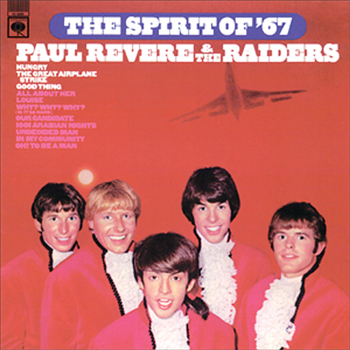
PAUL REVERE & THE RAIDERS – The Spirit of ’67 – (Columbia) -1966

My comments here are a little "bitty" as I did them late at night with a glass of red …
 
It's only in the last few years I have been really getting into Paul Revere and the Raiders. Back in the 80s I got their two greatest hits compilations (yes, two – they had a truck load of hits) after foolishly selling some of their earlier albums off at a record fair. Cest la vie .
 
What I like most about PRR is the fact that, though they have been influenced and inspired, sometimes clearly and with an eye on sales by other bands, they managed to incorporate other styles and trends into their own sound without affecting that sound greatly. Though not always great, their work sounds individual, and when they get it right they are magnificent.
 
From allmusic: "One of the most popular and entertaining groups of the 1960s, Paul Revere & the Raiders enjoyed seven years of serious chart action, and during their three biggest years (1966-1969), sold records in numbers second only to the Beatles and the Rolling Stones. And their hits "Steppin' Out," "Just Like Me," "Hungry," "Him or Me-What's It Gonna Be," and "Kicks," in particular, are now seen by compilers as bold, unpretentious pieces of '60s rock & roll with a defiant, punk edge. Paul Revere was born on January 7, 1938 in Harvard, NE. He learned to play the piano as a boy, and developed a keen appreciation for the work of Spike Jones & His City Slickers. He joined his first real band while in his teens, and was later joined by 16-year-old Mark Lindsay (b. March 9, 1942), a singer/saxman who ended up replacing the group's vocalist. Called the Downbeats, they were popular at local dances, and cut a demo for Gardena Records in Los Angeles, where the company's owner was interested in issuing a record, but only if they changed their name. Revere's given name was such a natural as a gimmick that they became Paul Revere & the Raiders".
 
The key to their success was their commitment to upbeat rock 'n' roll whilst acknowledging change, and they weren't precious about it as evidenced by the fact that sometimes they were "influenced" by bands that post dated them. They did, as I have said, keep their original sound, but unlike a slavish imitator or someone just jumping the bandwagon. Also, they did this even through line-up changes though Paul Revere (the keyboardist) and Mark Lindsay (the vocalist) were the nucleus of the group which was lucky as Revere knew where to take the group and Lindsay could sing anything.
 
This album comes from their big hit making period and is very 1966 – lots of twangy guitars punctuated with a bit of 60s punk, more than a nod or two to the Beatles, and some introspection creeping in. This album is their garage version of "Revolver" though with some thought to future musical innovations. "The Beach Boys" and "The Beatles" may have been  the high water mark on innovation but PPR were only just behind and they were more forward thinking than say The Rolling Stones (if not as consistent). Produced by the legendary Terry Melcher (Doris Day's son, band member in the Rip Chords, and friend and /or producer to The Byrds, The Beach Boys etc), who knew (and got) what he wanted – which was rock, hard edged ballads, and frantic garagy punk but with a clean sound. (Melcher also produced a number of other PPR albums).
 
Tracks (best in italics)
  • Good Thing – Lindsay, Melcher  3:03  – This song is a "good thing". Ha ha …yes that's lame, but the song isn't. Very much a typical type of PRR song and what they did best.
  • All About Her-  Gerhardt, Lindsay, Melcher  3:01 – hmmm
  • In My Community – Volk  2:09  – A great track … it reminds me of something I can't put my finger on … maybe a touch of The Beatles "Glass Onion". There is quite a bit of the Beatles in here and it sounds a little like "Glass Onion" (which came out in 1968!)
  • Louise  – Kincaid-  2:08  – Perfect mid 60s US guitar based rock with poppy overtones – this could have been something coming out of Brisbane in the mid 80s …
  • Why? Why? Why? (Is It So Hard) -Volk  2:57  – Again, a near perfect up-tempo beat ballad
  • Oh! To Be a Man – Lindsay, Revere  3:02  – a cynical, questioning ballad not surprising given Revere was a conscientious objector (in 1960), a little obvious but then aren't all protest songs?
  • Hungry – Mann, Weil  2:57 – much the same as their earlier hit (and bona fide rock classic) "Kicks" which is not surprising as it was written by the same writers, Barry Mann and Cynthia Weil.
  • Undecided Man – Lindsay, Revere  1:48  – "Eleanor Rigby" by another name and another gender. 
  • Our Candidate – Smith  2:49 – another cynical up-tempo ballad.
  • 1001 Arabian Nights – Lindsay, Melcher  4:25  – a good example of early Eastern influences in rock …
  • The Great Airplane Strike – Lindsay, Melcher, Revere  3:07 – a nod to the R&B rhythm of The Rolling Stones with the lyrics of Dylan … nice.
And …
 
This is one of their best albums I have heard thus far and most definitely a keeper.

Sounds

In My Community

http://www.youtube.com/watch?v=c8H80aNxpZ8

Louise 


Why? Why? Why? (Is It So Hard) 
attached
 
Our Candidate
Posted in Garage, Surf and Frat | Tagged | Leave a comment

DONNA FARGO – All about a Feeling – (Dot) – 1974

A preliminary note: Country music has been labelled reactionary, racist, prejudiced, sexist and all manner of other things. Of course these elements exist in country but they also exist in rock, blues, reggae and all forms of popular music. The one thing that can't be levelled against country is that it is a male domain. I cannot think of another form of music where female singers / songwriters are as equally revered as males. Females in rock you can count on one hand and they tend to be minor or a caricature of femininity itself whilst in country, female singers hold as dominant a position in the industry as male singers. By way of example, and just off the top of my head  … Patsy Cline, Loretta Lynn, Dolly Parton, Tammy Wynette, Lynn Anderson, Kitty Wells, Tanya Tucker,  Barbara Mandrell, Reba McEntire, Rita Coolidge, Anne Murray, Emmylou Harris, Skeeter Davis, June Carter Cash, Allison Krauss, Crystal Gayle, Rosanne Cash, The Judds, The Dixie Chicks, Bobbie Gentry, Juice Newton, Linda Ronstadt, Jeannie C Riley, Kitty Wells, Wanda Jackson. If you don't know country you may not know any of the songs sung by these women but even a casual rock listener has heard their names before which says something in itself. I concede it wasn't always this way but this list does go back to the late 1950s. Rock certainly cant display the same calibre of female stardom or adoration received as country female vocalists receive.*
 
OK so the lyrics the country females mouth may be (arguably) quite "sexist" and designed to "keep women in their place" on occasion, but there is more than enough "in your face" female attitude and naked emotion in country as well.
 
The fact that they have such a large voice in country music is a question I will leave to the cultural anthropologists.
 
I know (knew) Donna Fargo by name only.
 
Donna Fargo was born in North Carolina in 1945.
 
allmusic had this to say: "In the early '70s, Donna Fargo was an unusual country star for a couple of reasons. She was one of the few female country singers to write her own material, and one of the few country singers of any sort to cross over to the pop charts in a big way, which she did in 1972 with "The Happiest Girl in the Whole U.S.A." (number 11) and "Funny Face" (number five). She never made the pop Top 40 again, but placed over a dozen more singles in the country Top Ten in the '70s, most written by herself. As an artist, she was squarely in the mainstream, her slightly lisping voice delivering upbeat, sweetly produced homilies to romance, home, and America".
 
Ms Fargo's music is otherwise "country-pop" or "countrypolitan" but at least the regional accents are alive and well as opposed to later country pop like Shania Twain which is totally devoid of any regional accent or even any individuality. To my ears Ms Fargo sounds like a less ballsy Bobbie Gentry, but the music is well played and generally inoffensive. There are a couple of good tracks and a couple of awful schmaltzy ones (as only country can make 'em).
 
Best Tracks
  • It Do Feel Good – a good up-tempo number about falling in love (naturally). #7 Country, #98 pop.
  • I'll Try A Little Bit Harder –  #6 country. A country weepie (as only country can make them) – Lyrics:
            I'll try a little bit harder if you will
            And if you think we're worth trying to save
 
            We were happy once I know we were where where did we go wrong
            We were on the same side one time weren't we
            Why would we how could we we could not pretend for so long
            But I don't want to prolong this mis'ry if you're leavin' 
            And I don't think I'd beg you to stay
            But I'll try a little bit harder if you will and if you think we're worth trying to save
  • Just A Friend Of Mine
And …
 
Tape a couple and sell …
 
Chart Action
 
The album went to #5 on the Country charts (which is a substantial percentage of the market in the US)
 

Sounds

It Do feel Good

attached

 
Just A Friend Of Mine
 
Her big hit from 1972:
 
Bio
 
 
Website
 
 
* "Pop" can but thats a different discussion altogether.
 
(originally posted 28/11/2009)


Posted in Country | Tagged | Leave a comment