GARY LEWIS & THE PLAYBOYS – She’s Just My Style – (Liberty) – 1966

 
Is this a Gary Lewis fixation?
 
… not quite … I bought a bundle of his albums cheap and I must admit I am getting off on them. It's pop rock and it's well done. Though as I have said in the past, a couple of wines adds to the groove.
 
In the past I have said on 3 occasions:
 
"Most of his albums were 1/2 originals( some written by him) and 1/2 covers of recent(ish) hits. Regardless, whether original or cover, Lewis seemed to have hit after hit. I suspect cause the records are well recorded, tightly played pop rock with a consistent musical personality throughout all …… Gary had a limited vocal range and was a bit gawky looking – like some sort of uber nerd but what he had was sass and good backing. He does what he does best, allows his voice to be pushed into the background or chorused with backing vocals or a multitude of instruments. The result is a romantic, lush pop rock with lyrics that are very mid 60s California – fun, sun, happy and optimistic"
 
This "romantic, lush pop rock with lyrics that are very mid 60s California – fun, sun, happy and optimistic" is the Lewis sound.
 
But here Gary is getting more involved. It's a Snuff Garrett "production" (again) and it's arranged by Leon Russell (again) but Gary Lewis and Dave Pell actually produced the album. Lewis also co–wrote a few of the tunes and at least one is one of the best tracks on the album! Maybe he always had the "goods" but they were buried under commercial considerations, or, maybe if you surround yourself with enough talent some will rub off. Either way this is probably the best all round Gary Lewis album I have heard thus far.
 
The sound is part US big pop, part British Beat and part 50s ballad. Gary was always pretty good at covering all these bases but it works especially well here. At worst on some of the tunes Gary and the Playboys sound just like a glorified cover band but more often than not the songs are arranged to Gary's mid 60s pop sensibilities and they are definitely toe tapping.
 
The album went to #71 in the US charts. "She's Just my Style" went to #3 in the US singles charts.
 
Tracks (the best in italics)
  • She's Just My Style – Lewis/Russell/Leslie/Capps – one of the best tracks on the album. A ball tearer pop song. There's quite a bit of the early Beach Boys in there but the song holds its own.
  • Lies – Randall/Charles – there's a bit of the Beatles in here mainly because this is a Knickerbockers song (#20 1966 US) and they did a pretty good Beatles impersonation, despite the fact they are from New Jersey. Lewis steers it away from the Beatles and puts his stamp on it … and eliminates some of the rough edges. He's a pop star after all.
  • All I Have to Do Is Dream – Boudreaux/Bryant – The great Everly Brothers tune (#1 1958 US) – Lewis adds nothing to the original but the song fits in perfectly on this album.
  • You've Got to Hide Your Love Away – Lennon/McCartney – hello, it's a great Beatles song. Lewis does not shame himself but then again how can you when the song is that good. Beatles purists may complain but their worth as knob–ends is substantial.
  • I Won't Make That Mistake Again – Lewis/Leslie/Russell – Another co–write for Lewis and another winner. An excellent mid tempo ballad. Very mid 60s American and very safe but hard to resist.
  • A Hundred Pounds of Clay – Elgin/Dixon/Rogers – the magnificent Gene McDaniels hit (#3 1961 US) has been totally reworked by Lewis (or Leon Russell) to suit his style.
  • Run For Your Life – Lennon/McCartney – another great Beatles tune which Lewis again stamps with his own style and which he makes "dirtier" than the Beatles version.
  • Take Good Care of My Baby – King/Goffin – Gerry Goffin and Carole King were songwriters par excellence and this track is certainly testament to that. A beautiful slice of teen melodrama from the early 60s. Frivolous and fun. This was a #1 for Bobby Vee in 1961 but was also covered  by Dion, the Lettermen, Bobby Vinton and other popsters. It's the type of cover that suits Lewis perfectly. Oh, and did I mention The Beatles also covered it.
  • Down in the Boondocks – South – Joe South's up-tempo ballad (a hit for Billy Joe Royal – #9 1965 US) about class distinction and a kid from the wrong side of the tracks doesn't really suit Lewis – musically or image wise.
  • You Didn't Have to Be So Nice – Sebastian/Boone – the great Lovin Spoonful hit (#10 1966 US). Less folk rock and more pop rock but Lewis captures the romantic innocence of the original.
  • Someone I Used to Know – Levitt/Pockriss – a throwback to the late 50s. Pleasant but not especially memorable.
  • Heart Full of Soul – Gouldmann – Who would have thunk it – a credible version of The Yardbirds classic (#9 1965 US) written by Graham Gouldman (future 10CC)

And … 

This is probably the best allround Lewis album I have heard thus far … 'm a keepin'. 

Sounds

She's Just My Style

http://www.youtube.com/watch?v=Y9ntCcf9Ewk

Lies

attached
 
You've Got to Hide Your Love Away
attached
 
I Won't Make That Mistake Again
 
Run For Your Life
 
Take Good Care of My Baby

attached

Other:
Beatles
Take Care of My Baby

Review

they agree with me (for all that's worth)

http://www.allmusic.com/cg/amg.dll?p=amg&sql=10:jvfixqq5ldae

Website

 
Bio

Other Comments

what is Frank Listening to #22

what is Frank Listening to #72

what is Frank Listening to #88

what is Frank Listening to #96

what is Frank Listening to #108

what is Frank Listening to #131

Trivia

  • It seems that some of you have become Gary Lewis fans … this one you can get on a 2fer CD on Amazon …
 
(originally posted: 28/01/2011)


Posted in Pop Rock | Tagged | Leave a comment

UPP – Self Titled – (Epic) – 1975

I had no idea who this band was when I inserted hand in pocket looking for that elusive $1 coin.
 
Allmusic has very little on them though luckily some punter is into them enough (or into their "producer") to do an entry on them.
 
Indeed I doubt if this band would even receive a footnote if not for the fact that this, their first album, was produced by Jeff Beck. To add to it's collectability is the fact that Beck plays guitar on the album, though he is not credited. This apparently was not known till subsequently though I find it hard to believe as UPP were a 3 piece consisting of keyboards, bass and drums … and there is guitar all over this album. Any punter could put 2 + 2 together …
 
The entire wikipedia entry reads as: "Upp was a British rock-jazz fusion band, active in the 1970s. The group was originally going to be called 3 UPP, and consisted of Stephen Amazing (bass guitar), David Bunce (guitar), Andy Clark (keyboards) and Jim Copley (drums).
 
The group's debut album, Upp, was released in 1975. Jeff Beck produced and also played guitars on this LP, although there was no mention of him playing in the liner notes. Upp released its next album a year later, titled This way Upp. Beck again produced this album and played guitar solos on "Dance Your Troubles Away" and "Don't Want Nothing to Change." This album was recorded at CBS Studios, London.
 
The group backed Beck on the 1970s BBC One special Four Faces Of Guitar, which also featured Julian Bream. They played two songs, which were "Get Down In The Dirt" and Beck's arrangement of The Beatles' song "She's a Woman", with an interview about Beck's instrumentation as an intermission between the two.
 
A BBC radio recording was broadcast on BBC Radio 1 circa 1976.
 
The group's track "Give it to you" contains one of the most-sampled breakbeats of all time, and is featured in the Ultimate Breaks and Beats series".
 
I note that the guitarist mentioned in the wikipedia entry wasn't added till the second album.
 
Generally the band are referred to as a jazz-rock fusion band and I suppose that is technically correct though only "just" as the "jazz" elements are minimal (it does not sound like genre defining bands Return to Forever, The Mahavishnu Orchestra etc) … there are, however, overwhelming funk and 70s sweet soul elements. So properly speaking this album is a "jazz-funk" album … well as "jazz-funk" as a bunch of pastie faced kids from England can get …
 
Prejudices aside though (and I have a lot … funk from England – get real) this album is really well played – Beck (arguably one of the greatest rock guitarists to come out of England – along with Jimmy Page, Chris Spedding, Dave Edmunds and Alvin Lee) is not playing in his usual style though some of his later solo albums touched on funk and he had played with Stevie Wonder. The guitar work is up front and in your face and nothing short of brilliant and, surprisingly , it's not the usual cock in hand 70s bombastic guitar excesses you would expect. The rest of the band are equally impressive – moog, mellotron, clavinet, drums, bass – they are really tight and quite "white" funky. The singer (the keyboardist I think) is adept at both blues shouting as well as sweet soul where he come across as convincing Isaac Hayes type.
 
There are some "prog rock" tendencies but thankfully they are subsumed under the jazz-funk-soul. Which means the potential for "prog" pompousness is simply not there … well not to my ears at least.
 
Think of a science fiction blaxploitation soundtrack with Isaac Hayes fronting a slowed down O'Jays with quirky rock overtones and more guitar and you may have this.
 
Tracks (best in italics)
  • Bad Stuff – 7 min 19 sec of gentle white guitar funk … once upon a time I would have reached for a razor if you told me I had to listen to that but there are enough quirky elements here, as well as inspired playing, to make this a winner …
  • Friendly Street – the keyboards go off … this certainly is advanced for its time.
  • It's a Mystery – a smooth soul song – well sung in a high register.
  • Get Down in the Dirt – Dirty (sic) , funky and very "black"!
  • Give It to You – what starts out as a sweet soul song to a 70s blaxploitation film mutates into an trippy electro organ driven funk song … like a prog rock fantasy song but with no references to dancing gnomes, piccolos or "Lord of the Rings" (thank God)
  • Jeff's One – sweet soul with Jeff backing like a black JJ Cale.
  • Count to Ten – futuristic and trippy.
And …

You rarely see this style of music being played convincingly by white Americans and you never see it in a convincing form coming out of England. So this album is surprising on that level alone. 

Look, this is music that punk killed off … and rightly so … but every now and then an album transcends (or epitomises) its genre and I think UPP do that. And they are from England (again) … who would have thunk? 

Destined to be a cult classic – if it isn't already. 

Sorry punkers, I will have to keep this ( for now) 

Sounds

Bad Stuff
 
Friendly Street
attached
 
 
Get Down in the Dirt
 
Give It to You
 
Count to Ten
 
Review
 
 
Bio
 
 
(originally posted: 24/01/2010)
Posted in Jazz Rock Fusion | Tagged | Leave a comment

THE FRANKIE MILLER BAND – The Rock – (Chrysalis) – 1975

I had never heard of Frankie Miller before. I bought the album on the strength of the sleeve which indicated some sort of roots Americana music. It, in fact, is southern soul rock, though done by a Scotsman.
 
Wikipedia: "Frankie Miller (born Francis John Miller, 2 November 1949) is a Scottish rock singer-songwriter and vocalist  who had success in the 1970s. Miller was raised at Colvend Street, Glasgow with his parents, Kathy and Frank, and elder sisters Letty and Anne. He attended Sacred Heart Primary school. He was an altar boy in Sacred Heart Chapel. He also played football for the school team and Harmony Row Boys Club. He wrote for and performed with many influential recording artists and is best known for his album Full House, the single Darlin' and his duet on Still in Love with You, with Phil Lynott. In an article published in Rolling Stone magazine in 1978 Bob Seger remarked that Miller, "was a huge influence" on him".
 
Obviously he is a Catholic and the whole Catholic vs Protestant thing in Scotland (Glasgow vs Edinburgh generally, but within Glasgow specifically, between the soccer clubs, the mighty Celtic F.C. and the other club, Rangers F.C. and their supporters) is interesting but not relevant to this comment. I digress. For those interested: http://en.wikipedia.org/wiki/Sectarianism_in_Glasgow.
 
On further reading I discovered that I probably should have heard of Frankie Miller, even as a footnote in rock, as he has been covered  by, amongst others, Johnny Cash, Ray Charles, Lou Ann Barton, Rod Stewart, Cher, Bob Seger, The Bellamy Brothers, Ray Charles, Southside Johnny and the Asbury Jukes, Travelling Willburys, Chris Farlowe, Clint Black, Kim Carnes, Waylon Jennings, The Proclaimers, Peter Frampton, Shakin Stevens, Don Williams, Climax Blues Band, Bonnie Tyler, Oak Ridge Boys, Roy Orbison, UFO, Quireboys, Johnny Hallyday, Etta James, Joe Cocker,Paul Kossoff, Robin Trower, Joe Walsh and The Eagles.
 
He is also a legend in Scotland generally and Glasgow specifically.
 
The music is (at least on this album) horn driven southern rock 'n soul and it's not bad for a Scotsman. You can hardly tell though as the backing musos are all American, the lyrics and themes are also very American (all written by Miller), and his voice sounds pretty authentically … err, American. The closest in sound to Frankie Miller is Rod Stewart if he was more rootsy Americana or Status Quo if they were more country. This sound was generally popular in the early to mid 70s: Wayne Cochran, Delaney and Bonnie, Rod Stewart (prior to "Blondes Have More Fun") etc.
 
It seems that Miller has been doing this style of music, or variations on the style, for many years and he is obviously passionate about it. (Obviously he doesn't have a very catholic taste in music … ha ha). This was his third album and he must have been like a kid in a candy store recording it in the States with the authentic Southern soul institutions like The Edwin Hawkins Singers and The Memphis Horns …
 
Having said all that I find a little of this music, even when done by black or white Southern musicians from the USA, goes a long way. So that feeling applies even more so to a transplanted Scotsman, even one as convincing as this.
 
There are some really good tracks but then there are a lot of chunk-a-lunk electric blues ballads which I always found tiring though the style, no doubt, is still popular in low rent suburban pubs in Brisbane (usually on the South side of town).
 

Tracks (best in italics)

  • A Fool In Love – A good track which largely sums up the sound of the album … horn driven southern soul rock.
  • The Heartbreak – a chunk-a-lunk electric blues ballad.
  • The Rock – a tribute to those men incarcerated at Alcatraz (which apparently was within eyesight of the recording studio) … thematically it is much in the style of Johnny Cash with some Creedence Clearwater like vocals and beat. The liner notes refer to the song being dedicated to "the plight of prisoners" and holds some dodgy generalised lyrics about prisoners being outsiders and rebels rather than people who "shot a man in Reno just to watch him die".
  • I Know Why The Sun Don't Shine – a chunk-a-lunk electric blues ballad.
  • Hard On The Levee – Back in '53 he was working on the levee apparently …
  • Ain't Got No Money – dumb blues boogie but fun … covered by Cher, Chris Farlowe and Bob Seger.
  • All My Love To You – a chunk-a-lunk electric blues ballad with a touch of soul.
  • I'm Old Enough – a uptempo chunk-a-lunk electric blues ballad.
  • Bridgeton – a chunk-a-lunk electric blues ballad.
  • Drunken Nights In The City – written for his late-night drinking buddy Jimmy Johnstone, the former Celtic FC Scottish footballer. All the requisite words are in the title … " drunken", "nights" and "city"  … could easily become a raspy Tom Waits ballad (of his early period).
And …
 
The album isn't totally my bag, though I acknowledge that the music would be better live (in person that is, not on record). Having said that, it is unforgivable how many electric soul blues bands playing in suburban and regional bars, pubs and biker events still play this style of music without even a grain of inspiration or originality.
 
I will tape a couple of songs and sell.

Chart Action

No chart placings on either albums or singles in the USA or England.

Sounds

 
(originally posted: 21/01/2010)
Posted in Blues Rock | Tagged | Leave a comment

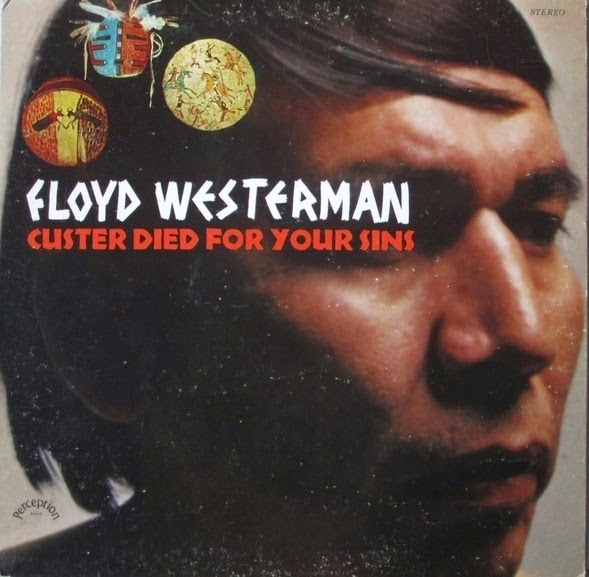
FLOYD WESTERMAN – Custer Died for Your Sins – (Perception) – 1969

 
At the outset I point out to those who refer to any grammar inconsistencies or for the “biti-ness” of paragraphs that these comments are written contemporaneously with the listening to of the record (usually while I am doing something else) and are meant to be comments not reviews, though, obviously, sometimes I have to spin through the record twice. You are lucky I even spell-check!
 
I was on a bit of a Jimmy Curtiss (what Frank is listening to #100, #111) kick so I bought this Native American protest album as Curtiss was behind it. The fact that Westerman is a authentic Native American is a bonus.
 
I have always been partial to Native American music, whether it be authentic “Native American rock” (Redbone) , music with Native American themes (Johnny Cash) or Hollywood Native American music (Elvis soundtracks) … I even have some Indian chant albums.
 
I suspect my appreciation was fuelled by watching a lot of western movies as a kid.
 
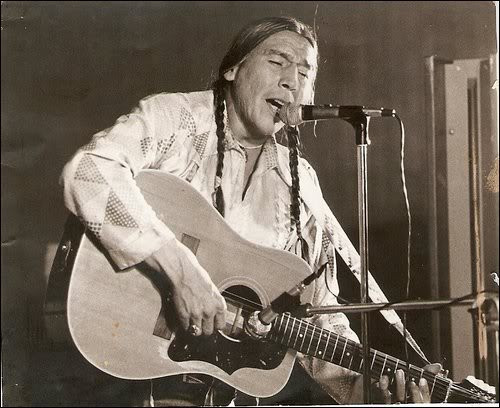
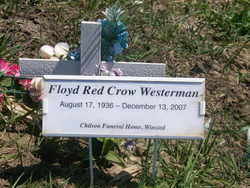
By way of bio regarding Westerman, wikipedia: Floyd “Red Crow” Westerman (August 17, 1936 – December 13, 2007) was a Dakota musician, activist and actor. Late in his life, he became a leading actor depicting Native Americans in American films and television. He is sometimes credited as Floyd Crow Westerman … Westerman was born Floyd Kanghi Duta Westerman on the Lake Traverse Reservation, home of the Sisseton-Wahpeton Oyate Dakota (Sioux) in the U.S. state of South Dakota. “Kanghi Duta” means “Red Crow” in Dakota (one of the 3 “Sioux” dialects). As a youth, he attended an off-reservation elementary school where he was forced to cut his hair and forbidden to speak his native language. This would profoundly impact his later life and his restless pursuit of championing his own heritage. At the age of 10, Westerman was sent to the Wahpeton Boarding School, where he first met Dennis Banks of the American Indian Movement.
 
It is abundantly clear Westerman (or “Red Crow” as he is sometimes known) is an authentic Native American singing about authentic Native American issues. Westerman sings of reservations, land exploitation, governmental indifference, disease and death. This is as real as it gets … but don’t expect Westerman to be singing in a Sioux dialect doing traditional Sioux music.

Westerman was largely influenced by the immediate early protest folk of Bob Dylan (though I think he is closer to Phil Ochs) and the country music of his youth, especially Hank Williams. Though not mentioned in what I have read he must also have been influenced by Peter La Farge, the first of the great Native American (if he indeed was) folk singer activists (Johnny Cash covered his “Ballad of Ira Hayes”). Westerman’s voice is a clean baritone and all the music is punctuated with straight country (not Nashville though and I don’t mean that in a bad way). He comes over as a rougher Jim Reeves or Charlie Rich, or perhaps, even closer still, a Native American Johnny Cash. Ultimately there are unequal parts of country, singer-songwriter and folk in here, with country being the largest portion in the mix. Also, the legendary country session musician, Pete Drake, supplies steel guitar to the recordings.

If you refer to Allmusic you will see that all the songs are credited to Westerman (and I note the that the album was re-recorded by Westerman in 1982) and indeed all the reviews refer to his talent as a songwriter. The album however indicates that Westerman only co-wrote three of the tracks whereas Jimmy Curtiss wrote or co-wrote all of the songs. In the fifties it was common for songwriters to give up some of their credit to secure a recording deal but this practice was pretty much dead by the early 60s. So what is the truth?

I suspect that Curtiss was mainly behind the songs. He produced this album on his label (Perception) and plays rhythm guitar whilst the liner notes by Indian activist Vine Deloria Jr indicate Curtiss as the main songwriter. And if any other proof is needed the album sounds very, very much like Curtiss’s solo album from early 1969, “Life”. ( what Frank is listening to #100)

And just to add to the confusion the album mentions in its notes : “Lyrics based upon the book Custer Died for Your Sins by Vine Deloria Jr.“

What I suspect is that Westerman, the aspiring country folk singer and Indian activist, gravitated to New York and bumped into Queens, New York native Jimmy Curtiss and they thought they would hook up and do an album. Curtiss accordingly wrote an album of tunes, with some help from Westerman drawing on his experiences as well as on the aforementioned book (which is a seminal text on Native American history).

I only mention this at some length because a number of reviews of this album must be based on the later re-recordings or CD reissue where all the songs are credited to Westerman and wax lyrical about his songwriter abilities. I am sure they would not say the same if they found it was mainly written by a white guy from Queens. Of course this says more about music critics than anything else (I note that the allmusic review is from no less than the legendary Eugene Chadbourne).

Interestingly co-writer on 4 tracks is John Phillips … apparently it’s the John Phillips of “Mamas and Papas” fame … but the sources I have read do not allow me to say that with any certainty.

Regardless, this is powerful protest music based on a mix of country and  singer-songwriter. Curtiss has written songs with universal themes that have a Native American backdrop and the authenticness comes from his obvious close working relationship with Westerman or Deloria or both. It would be less authentic, and for me not really palatable, if he was the singer (not that Curtiss ever had that as an intention as he largely liked to hide in the background and usually doesn’t even credit his name on albums but uses “J.C.”). I norrmally like a bit of authenticness in my music …. you know what I mean?

…. delta blues from Tooting Bec?

…. reggae from Sydney?

Give me a break.
 
Deloria who does the liner notes says: “The songs, brilliantly penned by Jimmy Curtiss, are a testimony to Jimmy’s ability to transcend time and space and live with the people in their sorrow and triumphs, to understand their sense of hopelessness and yet to see their vision”.
 
I am not taking anything away from Westerman because he only co–wrote three of the songs. Those who know me well enough or who have read enough of my comments know I appreciate the singer, not just for the quality of the voice (which is not that important) but for the interpretation of the song (which is supreme). The singer is a much maligned and disregarded musician even though how the singer interprets the lyric ultimately, I believe, determines the fate of the song.
 
Westerman is not a largely expressive singer (well not here – he has done four or five albums but this is the only one I have) but what he is, is a sincere and straightforward singer. He sings, but yet there is a feeling he is standing in front of you discussing Native American problems. This ability is much underrated. And this matter of fact-ness combined with some catchy tunes and potent protest lyrics makes for a great album.
 
It takes a couple of listens to get into it but, ultimately, its a winner.
 
Tracks (best in italics)
  • Custer Died for Your Sins  – this song really sums up the tone and mood of the album – putting forward an alternative version of history, finger pointing at those who have done wrong, pointing out the suffering of Native Americans, casting an accusing eye at the “masses” and “middle America” who sit by and do nothing about the problems, and finally a plea for a “new day” to begin. If you can get past the late 60s early 70s arrangements the music is quite powerful.
            For all the lies that were spoken
            For all the blood that we have spilled 
            For the treaties that were broken
            For the leaders, you have sinned
 
            Custer died for your sins
            Custer died for your sins
            Now a new day must begin
 
            For the tribes you terminated
            For the myths that you keep alive
            For the land you confiscated
            For a freedom, you deprived
 
            Custer died for your sins
            Custer died for your sins
            Now a new day must begin
 
            For the truths that you pollute
            And for the life you have cost
            For the good you prostitute
            And for all, that we have lost
 
            Custer died for your sins
            Custer died for your sins
            Now a new day must begin
 
  • Missionaries  – a particularly barbed attack on white Christianity being imposed on Native Americans.     
  • World Without Tomorrow  – a song right out of the Johnny Cash songbook.
  • Going Back  –   whether it be straight country or Native American country matters not, here is a familiar theme – going back to the land of your youth and your ancestors. The potency here is of course the fact that the land is truly, before all else, the ancestral home of the Native American.
  • Thirty Five More Miles  –  the story of Floyd’s mother and her suffering.
  • Red, White and Black  –   an interesting song juxtaposing the separate and distinct civil rights movements of Native Americans and Afro Americans and accusing white America of playing favourites. 
  • Where Were You When  –  a great song having a go at opportunistic people in the Native American civil rights movement. Much like something Phil Ochs would have written.  Biting. Ouch!    
  • Here Come the Anthros  –   a hilarious, satirical, humorous song about anthropologists coming to research Native Americans
            And the anthros still keep coming
            like death and taxes to our land
            to study their feathered freaks
            with funded money in their hand
 
  • They Didn’t Listen  – a powerful song about about environmental degradation in the search for wealth. Interestingly Westerman updated the song later to include the contentious “uranium mining” issue. 
            And I told them not to dig for gold
            For if they did the eagle would die
            They didn’t listen, they didn’t listen
            They didn’t listen to me
            And I told them if the eagle died
            There would be no keeper of the land       
              
  • Task Force  –    another humorous song – though this one darkly so. About a “task force” from Washington who come to see why the “Indians” are unhappy. 
  • B.I.A.  –   a Native American chant in both Native Indian dialect and English that attacks the B.I.A …. the Bureau of Indian Affairs (thanks google)
And …
 
A great album and if you love mid-period Johnny Cash you should have no trouble loving this. I do on both accounts so I’m keeping this.

Sounds

Custer Died for Your Sins    

the rerecorded version

http://www.youtube.com/watch?v=oY_a-HjdiOE

original attached

World Without Tomorrow  

the rerecorded version

http://www.youtube.com/watch?v=aWZcuIfjyR8&feature=related

 
Where Were You When  
attached 
 
They Didn’t Listen  
attached
 
Task Force      
the rerecorded version
Other:
 
Review
 
 
Bio
 
 
Obituary:
 
Other:
 
Trivia
  • It would be remiss of me not to point out these songs are universal enough to be relevant to any peoples dispossessed of their traditional lands whether they be Irish, Croatian or (especially) Australian Aboriginal. The WASP “invasions” of both Aboriginal and Native American lands are strikingly similar (though with some fundamental differences) and much of this album can be transported to present day Australia … “sorry” or not. There has been no official “sorry” in America but I suspect the knowledge of Native American problems as well as sympathy for them has more popular support than the equivalent here in Oztralia. Interestingly, the music of the Australian aboriginal, they being largely rural Australians till recently, is also country, not reggae or hip hop or any other forms of music associated with African Americans which they have little in common with. This is something that is largely overlooked, even though there have been quite a few Aboriginal country acts … and that is saying something as the Australian country music establishment is even more reactionary and conservative than the American equivalent. (Where are “Mop and the Dropouts” when you need them?)
Pictures
 
 
Floyd Red Crow Westerman

(originally posted: 17/01/2010)

Posted in Folk Rock, Singer Songwriter | Tagged | Leave a comment

THE SIDEWINDERS – The Sidewinders – (RCA) – 1972

Another album that has been kicking around in my "pile" of records for about 20 years. I recall listening to it some time ago and putting a few songs on cassette but I wasn't convinced I should get rid of it, so here it is, again.
 
Central to The Sidewinders is Andy Paley who has worn many hats in the music industry but is mainly recognised for his role as a producer from the late 70s on  Madonna, The Ramones, Jonathan Richman, Debbie Harry, Brian Wilson, NRBQ, Mighty Lemon Drops, Jerry Lee Lewis and others.
 
Here, he is the vocalist and the main songwriter and his influence on the band comes clearly through on the record. On first blush the artists he produced later may appear to be diverse but this record certainly indicates that his producing tastes aren't necessarily based on monetary concerns but on personal taste, because on this record the band under his leadership cover many styles from the 50s through to the 70s though all are anchored in straight ahead rock and powerpop largely reflecting the acts he would produce later on. He also had a powerpop combo in the late 70s with his brother Jonathan, "The Paley Brothers". He obviously has a thorough knowledge of rock history.
 
By way of bio, http://www.webcitation.org/5knI5ap1B: Meanwhile, in or around the summer of 1970, we find a Biddeford, Maine, rock ensemble called Catfish Black. Band members were Harvard students, and they returned there in the fall, filling a few trial musical engagements. Around that time, Jimmy Mahoney left the group; and drummer Andy Paley replaced him as lead vocalist. Suzie Adams soon became the band's manager. Apparently it was about the same time that the group recorded a demo tape at the MIT student union … Sometime after that, two other members, Ernie Brooks and Jerry Harrison, left the band. The next news of these two that we caught was really not much later when they were members of the fabled Modern Lovers … In 1971, Richard Robinson got Catfish Black some bookings at Max's Kansas City in New York. After reaching New York, members of Catfish Black caught wind of another group with a similar name; so they collectively rechristened themselves the Sidewinders, taking that name from the Roger McGuinn song, "Chestnut Mare." Not much later, the group was signed to RCA Records … A week before recording started, producer-to-be Richard Robinson was replaced by future Patti Smith guitarist, Lenny Kaye. It is said that David Bowie stopped by the sessions. The album jacket names these members of the Sidewinders: Leigh Lisowski, Andy Paley, Mike Reed, Eric Rosenfeld, Henry Stern … Far from a commercial success, nonetheless The Sidewinders (LP, RCA, 1972) seems to have been a critics' record, achieving favorable reviews in Circus, Creem, Rolling Stone, and Variety …The Sidewinders history, which seems sketchy at best, becomes quite murky at this point. Band members auditioned a host of guitarists. We are told that the Sidewinders were informed that Billy Squier was their new guitarist, though no mention is made of who did the telling … The Sidewinders broke up. End of story. Right? Not hardly. Young punk rockers in suburban garages and in the lofts and basements of Boston heard these guys and liked and understood the music. This wasn't another boogie band cranking out da blooze in the region's bars. This was something different. This was stuff younger musicians and fans could call their own. The band was gone, but its music was still doing its work.
 
The last paragraph is particularly relevant as it seems clear that the music was influential on subsequent punk acts. Though punk can be traced back to The Saints, Rocket from the Tombs, New York Dolls, and The Ramones and then even further back to the MC5 and The Stooges, (any further back and there may be the punk energy in individual acts though not the direct stylistic influence IMHO), what is unacknowledged on punk is the less aggressive and more straight forward rock (powerpop) acts that influenced it like Grin (with Nils Lofgren), Earthquake, Big Star, The Nerves, Cheap Trick, The Sneakers, The Flamin Groovies and even Bruce Springsteen. What they shared were songs that were short, sharp, in your face, and punchy. Which, in the early to mid 70s … a decade of glam excess, bloated jazz rock fusion, ponderous prog rock pretentious, middle of the road country rock and all forms of disco, sounded quite revolutionary and progressive, despite the fact that lyrically the music rarely rises above boy + girl songs.
 
This album is a beautifully constructed and I think an obvious homage to a lot of 60s American music and not just the obvious references. There is Brill building pop, frenzied instrumentals, some early 60s doo wop, Beach Boys harmonies, sunshine pop, up tempo Byrds jangle and a  lot of powerpop  …
 
allmusic defines power pop as: Power Pop is a cross between the crunching hard rock of the Who and the sweet melodicism of the Beatles and Beach Boys, with the ringing guitars of the Byrds thrown in for good measure. Although several bands of the early '70s — most notably the Raspberries, Big Star, and Badfinger — established the sound of power pop, it wasn't until the late '70s that a whole group of like-minded bands emerged. 
 
Despite my general antipathy to the generally overrated The Who (their best album is Daltry's first solo album – ha!) I would still say I disagree with that statement anyway. Yes, the Beach Boys, Beatles and Byrds are all here to be heard but they have all been sped up as a sign of the times rather than crossbred with any The Who's "crunching hard rock". The Who's crunch is coming from a different place amyway.
 
None of the songs on this LP are bad and some are positively catchy. The production by Lenny Kaye (later guitarist for the Patti Smith Group and the liner note writer to the original "Nuggets" compilation) is low fi, un-fussy and very un–70s, which just serves to accentuate the tunes. In its scope, without any concessions to modernity (circa 1972) this album is refreshing and ironically quite prophetic. (In tone this album is strikingly similar to Grins work of about the same time or Nils Lofgren's magnificent self titled debut album from 1975).
 
Tracks (best in italics)
 
Side 1
  • Bad Dreams – a perfect start to the band and a perfect example of power pop.
  • Superhit  – a staple of power pop – a song about young love.
  • Moonshine – a beautiful homage to early 60s Gary Lewis type pop.
  • The Bumble Bee – the much covered (usually live with many variations on the name) Rimsky-Korsakov classical composition: Jose Feliciano, Jean-Jacques Perrey. This here seems to be a arranged much like the amped up B Bumble and the Stingers (Kim Fowley's) version from the early 60s … though there is a bit of Dick Dale in there also. Though there was a bit of Dick Dale in the B Bumble version also.
  • Told You So   – a Flamin Groovies type rave up – like "Teenage Head" but without the nastiness.
  • Rendezvous   – now I know this sounds like something … I think maybe a Grin song that post dates it. Again in tone its a mid-60 California pop ballad like Gary Lewis especially in the middle bridge.
Side 2
 
Side Two side tends to lean more to the 70s in style and, putting aside my preference for the 60s, this side is still slightly weaker than the first.
  • O Miss Mary  – another perfect example of perfect power pop
  • Got You Down – another track that could have been on a Knack or Romantics album 8 or 9 years later.
        Take a Look at you room
        and take a look at your life
        You say that you'll be leaving soon
        but I know that's a lie
        So when you get up to go
        you wont have to tell me
        I'll know
        cause
        I've got you down
  • Slip Away   – a bit of Paul McCartney in this ballad … it's a pity it's too long.
  • Reputation  – another boy / girl type power pop rave-up.
  • Parade – a fitting closing to the album – a statement of faith in the future much like "Better Things" on the Kinks masterpiece of mainstream power-rock from 1981, "Give the People What they Want". Though this could have used a little more production.
And …

Edgar Willow in the notes that accompany the compilation "Boston Incest Album" (1980) said: Many long-time observers of the music scene consider the Sidewinders to have been the best Boston band of the early seventies (if not the decade).

i would have to say on the strength of this album he has a point.

I'm keeping this.

Sounds
 
Bad Dreams
The Bumble Bee  
Rendezvous  
attached
 
Bio


(originally posted: 13/02/2010)


Posted in Power Pop | Tagged | Leave a comment

THE JIM CARROLL BAND – Catholic Boy – (ATCO) – 1980

I welcome another couple of bods to this list … who I have migrated over from another list …

I have Carroll's "Dry Dreams" album which is quite good but this is his better known album with his "well known" tracks. Given that he passed away recently (11.09.2009 of a heart attack) it is appropriate that I pull this out of the pile and have a listen.

There's no shortage of biographical information on Carroll (see links at end) but suffice it to say he had a pretty fucked up adolescence.

He was born in 1949 in New York.

wikipedia: Carroll was of Irish descent and attended Roman Catholic grammar schools from 1955 to 1963. In fall 1963, he entered public school, but was soon awarded a scholarship to the elite private school Trinity School (New York). He entered Trinity High School in 1964 … Apart from being interested in writing, Carroll was an all-star basketball player throughout his grade school and high school career. He entered the "Biddy League" at age 13 and participated in the National High School All Star Game in 1966. During this time, Carroll was living a double life as a heroin addict who prostituted himself to afford his habit, but was also writing poems and attending poetry workshops at St. Mark's Poetry Project.

He then dealt with his past through his poetry (he was first published in 1967) and secondly through his music (this is his first album). Accordingly, and not surprisingly, his music is very much an extension to his poetry.

It certainly is punk, but not the visceral punk of California, the aggressive "no future" punk of Detroit and Cleveland, or the garage punk of the mid-west (or Brisbane, Australia). It is the intellectual punk of New York which is "very New York" and of the time (The Ramones and The Dictators excepted).

New York punk defined the New Wave style as well as laid back punk intellectualism. Even the aggressive and confrontational "No Wave" NYC punk sounds positively high-brow when compared to some kid from the mid-west who cant string two words together and whose only expression is bashing his instrument into oblivion. Accordingly there is as much "beat poetry" and art in NYC punk as there is angst and rage. Think Television, Blondie, Richard Hell, James Chance, Patti Smith, Talking Heads, Lou Reed, Suicide etc. There is nothing wrong with that, and, indeed I have named some of my favourite punk acts, but it certainly is something specifically New York. If you weren't from New York and you had those punk stylings in you then you gravitated to New York anyway like Richard Hell, The Nails etc.

Unfortunately, today this is what makes the music less "punk" to the kids. Most of the modern punk bands take their musical cues from California hardcore or English first generation punk and then just "pop" the songs up. Very few popular acts look back to the "art" and "beat" punk coming out of New York. (Yeah Yeah Yeahs, Sonic Youth excepted).

And that's a shame.

Jim Carroll was certainly one of the more articulate of the NYC punks and was certainly influenced by the Beats (he was a friend of Burroughs, Ginsberg and Kerouac). I say NYC punk knowing that Carroll shuffled around a lot between New York and California …. which I suppose is very "Beat" of him.

His voiced is pitched like Richard Lloyd delivered by Lou Reed and has all the angst that punk requires without any need for screaming, yelling or frantic distorted instruments … so he comes over as a more rockier male version of Patti Smith. His lyrics, unsurprisingly, are always evocative and literate with an abundance of (Catholic) religious imagery whilst his rhythm section lays down a beat as busy and dangerous as NYC streets at night (I wrote that sentence myself and winced after I had finished it). The songs, accordingly, come across as mini film noir movies about redemption and regret like a Abel Ferrara film in gentler moments, perhaps.

Tracks (the best in italics)

  • Wicked Gravity – a good slice of first generation new wave punk.

  • Three Sisters  – more obvious punk stylings. I leave it to others to figure out what the lyrics are about

            Though I don't really understand her
            I love my sister, her name's Miranda
            The boys from uptown they can't stand her
            The more she denies them the more they demand her
            But she just wants to lay in bed all night
            Reading Raymond Chandler
            She got high heel shoes
            She sings the blues
            She says abracadabra when she goes down on you

  • Day and Night 

  • Nothing Is True

  • People Who Died – pretty unrelenting … a litany of people who Carroll knows who have died, done as a structured stream of consciousness … I'm glad I'm not his friend. (This must have been an influence, structure wise,  on The Nails magnificent "88 Lines about 44 Women"). A perfect example of Carroll's knack of capturing the feeling of the streets.

                Teddy sniffing glue he was 12 years old
                Fell from the roof on East Two-nine
                Cathy was 11 when she pulled the plug
                On 26 reds and a bottle of wine
                Bobby got leukaemia, 14 years old
                He looked like 65 when he died
                He was a friend of mine

                Refrain:
                Those are people who died, died
                Those are people who died, died
                Those are people who died, died
                Those are people who died, died
                They were all my friends, and they died

                G-berg and Georgie let their gimmicks go rotten
                So they died of hepatitis in upper Manhattan
                Sly in Vietnam took a bullet in the head
                Bobby OD'd on Drano on the night that he was wed
                They were two more friends of mine
                Two more friends that died / I miss 'em–they died

                Repeat Refrain

                Mary took a dry dive from a hotel room
                Bobby hung himself from a cell in the tombs
                Judy jumped in front of a subway train
                Eddie got slit in the jugular vein
                And Eddie, I miss you more than all the others,
                And I salute you brother/ This song is for you my brother

                    Repeat Refrain

                Herbie pushed Tony from the Boys' Club roof
                Tony thought that his rage was just some goof
                But Herbie sure gave Tony some bitchen proof
                And Herbie said, "Tony, can you fly'";
                But Tony couldn't fly . . . Tony died

                    Repeat Refrain:

                Brian got busted on a narco rap
                He beat the rap by rattin' on some bikers
                He said, hey, I know it's dangerous,
                but it sure beats Riker's
                But the next day he got offed
                by the very same bikers

                Repeat Refrain; repeat song to Eddie

  • City Drops Into the Night 

  • Crow  

  • It's Too Late  

  • I Want the Angel

  • Catholic Boy – must be an Irish American Catholic upbringing … cause it certainly isn't a Croatian–Australian Catholic one … though some of it rings true. Similarities or differences in upbringing aside this is a great song.

            I was born in a pool, they made my mother stand
            And I spat on that surgeon and his trembling hand
            When I felt the light I was worse than bored
            I stole the doctor's scalpel and I slit the cord

            Refrain:
            I was a Catholic boy,
            Redeemed through pain,
            Not through joy

            I was two months early they put me under glass
            I screamed and cursed their children when the nurses passed
            Was convicted of theft when I slipped from the womb
            They led me straight from my mother to a cell in the Tombs

            Repeat Refrain

            They starved me for weeks, they thought they'd teach me fear
            I fed on cellmates' dreams, it gave me fine ideas
            When they cut me loose, the time had served me well
            I made allies in heaven, I made comrades in Hell

            I was a Catholic child
            The blood ran red
            The blood ran wild

            I make angels dance and drop to their knees
            When I enter a church the feet of statues bleed
            I understand the fate of all my enemies
            Just like Christ in the Garden of Gethsemane

            Repeat Refrain

            I watched the sweetest psalm stolen by the choir
            I dreamed of martyrs' bones hanging from a wire
            I make a contribution, I get absolution
            I make a resolution to purify my soul

            Repeat Refrain

            They can't touch me now
            I got every sacrament behind me:
            I got baptism,
            I got communion,
            I got penance, 
            I got extreme unction
            I've got confirmation
            'Cause I'm a Catholic child
            The blood ran red
            The blood ran wild!

            Now I'm a Catholic man
            I put my tongue to the rail whenever I can.

And …

This as good as any other album that came out of the New York New Wave and of all the poet / rock cross overs I would think that Carroll has to be in the Top 5. 

Australia wise, I could easily see (or have seen) Slaughterhouse Joe doing this if the guitar was a bit more sharp (and loud) … a less strident Nunbait also would be barking up this tree. 

Chart Position

Billboard Pop Albums #73  (1981)

People Who Died   single Dance Music/Club Play Singles #51  (1981)

Sounds

Wicked Gravity

live: http://www.youtube.com/watch?v=_bFwbBcRXLE

Three Sisters 

http://www.youtube.com/watch?v=u1qVKyidDPg

Day and Night

http://www.youtube.com/watch?v=aq30WdtEsww&feature=related

People Who Died

attached

http://www.youtube.com/watch?v=9bOjc70f4p8

http://www.youtube.com/watch?v=D4LqjVtXUvE

It's Too Late

http://www.youtube.com/watch?v=X8yoh_P_1EQ

Catholic Boy

http://www.youtube.com/watch?v=pdftnLhRCuQ

Others (interviews and poetry):

http://www.youtube.com/watch?v=fV8zfL5DGhk

http://www.youtube.com/watch?v=WCWiOfY2V_Q&feature=related

http://www.youtube.com/watch?v=bBEkjFZ4XdA&feature=related

http://www.youtube.com/watch?v=ussjmiAbeFU&feature=related

http://www.youtube.com/watch?v=4n1y0wnS9uQ&feature=related

http://www.youtube.com/watch?v=-NvCCcVAhxk&feature=related

Review

http://allmusic.com/cg/amg.dll?p=amg&sql=10:jifoxqw5ldke

Bio

http://allmusic.com/cg/amg.dll?p=amg&sql=11:wifrxqw5ldfe~T1

http://en.wikipedia.org/wiki/Jim_Carroll

http://www.nytimes.com/2009/09/14/books/14carroll.html

Website

http://catholicboy.com/

Trivia

  • His funeral Mass was held at Our Lady of Pompeii Roman Catholic Church on Carmine St. in Greenwich Village.

Pictures

‹

New York 1981: Jim Carroll (middle right) with punk stars Dave Treganna, Dave Parsons (looking like a blonde Elvis), and Stiv Bators of The Wanderers

(originally posted: 10/01/2010)

Posted in Punk and New Wave | Tagged | Leave a comment

GARY LEWIS – I’m on the Right Road Now – (Liberty) – 1969

 
On almost the eve of Elvis' birthday I have up this album up for comment … on the basis of a tribute song.
 
If you are a regular reader of these posts then you will have encountered Gary Lewis before. This, however, is the least typical Gary Lewis album if for nothing else than it is a "Gary Lewis" album rather than a "Gary Lewis & The Playboys" album, and that alone speaks volumes about the changes.
 
In the past I have said on a number of occasions: ""Most of his albums were 1/2 originals( some written by him) and 1/2 covers of recent(ish) hits. Regardless, whether original or cover, Lewis seemed to have hit after hit. I suspect cause the records are well recorded, tightly played pop rock with a consistent musical personality throughout all …… Gary had a limited vocal range and was a bit gawky looking – like some sort of uber nerd but what he had was sass and good backing. He does what he does best, allows his voice to be pushed into the background or chorused with backing vocals or a multitude of instruments. The result is a romantic, lush pop rock with lyrics that are very mid 60s California – fun, sun, happy and optimistic"
 
This all applies with one difference … Gary Lewis has changed (or "updated" is more apt) his sound and his image.
 
He hadn't been doing well in the charts after prior to being discharged from the army a year earlier in 1968 (after serving in Vietnam) so, I assume, he thought it was time for a change … and the changes are:
  • no "Playboys" backing band – he is a "solo artist" backed by a band who are all "newbies" to him – Arnold Rosenthal (bass), Billy Boatman (drums), Charley Carey (guitar). Accordingly there is less reliance on session musicians and his new band mates also assist with song writing duties.
  • no production by Snuff Garrett or arrangements by Leon Russell.
  • no clean cut Gary Lewis – longer hair, sideburns, updated "threads" – he looks positively counter culture.
  • a new voice – Gary has pitched his voice a little lower. In fact it doesn't sound like him at times.
The album's title "I'm on the Right Road Now" is meant to be its credo. There is a blurb on the back referring to Gary traveling many musical paths  before finding his "own way". Whether this is just some record company PR persons spin I don't know, but Gary certainly, at least on face value, has broken with his previous works.
 
He proves he could cut the mustard and at worst he proves he has learnt something off his father Jerry, namely impersonations. There is an updating of sound and style but Lewis hasn't made a clean break with his musical past as that would be disingenuous, if you accept that your musical influences are part of your musical personality. He still wears his "tastes" on his sleeve despite a couple of left field tracks.
 
There is not one bad song here. That's not to suggest that the album is great but it's as credible as anything else coming from the same paddock.  What is most noticeable is Lewis' brand of pop rock has been ditched for something much more 1969. That is not to say this is psychedelic, jazz fusion, protest, acid blues or underground. The music is still poppy rock though Lewis has added a bit of chug a lug rock a la Creedence Clearwater Revival. And, for the most part, as per usual, the songs are half covers and half originals (mostly written by Lewis in collaboration with one or more of his band mates).
 
Oh, and a couple of the tracks are memorable.
 
The Tracks (the best in italics)
  • Something Is Wrong – Rosenthal –  a big mid-tempo cabaret type song like Mark Lindsay or the late 60s Bee Gees would have sung. Nothing wrong with that. It's actually quite easy on the ears.
  • Times Are A Changin' – Rosenthal, Boatman – not the Dylan song but a bouncy country folk with a "social" lyric. There's clearly a nod to the Lovin Spoonful … and there's nothing wrong with that either.
  • I Saw Elvis Presley Last Night  – Lewis, Rosenthal, Boatman – an Elvis tribute song. Of course it's magnificent. Well actually it isn't but it is "heart on the sleeve" type stuff. I assume Lewis went and saw Elvis' electric return to live engagements in Vegas in 1969 which by all accounts, even by otherwise reserved rock critics, was akin to some sort of religious experience. Dylan saw Elvis around the same time and wrote: "Went to see the Gypsy". Lewis is obviously not as obscure in his song title or in his lyrics … which by the way are magnificent (of course … ha ha).
 
The song called,” I Saw Elvis Presley Last Night," was written and recorded by Gary Lewis in the early seventies. In his own words Gary says: "Everyone who knows, has told me that my song for Elvis was the only tribute song to him while he was still alive. I saw him in Las Vegas in 1971 or 1972, at the Hilton and loved it so much that I wrote the song. I couldn't figure out a title, so I just called it,’ I Saw Elvis Presley Last Night'." In addition Gary says: "After I saw Elvis in 1971 or 1972 at the Hilton in Las Vegas, he sent someone out to bring me and my wife back to meet him. He was so gracious. He was pouring Champaign for everyone and giving all the wives his scarves. He even said to me, 'Hey man, nice suit'. I had a cool purple suit on. I thought he was great."
 
Two problems wrong with that statement … firstly there were hundreds of Elvis tribute songs written about Elvis prior to 1969, and secondly, this track was on an album that came out in 1969 or 1970 so Gary may have seen Elvis in 1971/72 but he also saw him beforehand. I dare say he saw him in Vegas at the MGM Grand in 1969 or perhaps he is talking about seeing him on TV in the "68 Comeback Special".   
  • I'm Ready If Your Willin' – Lewis,Rosenthal,Marcinko,Boatman – A slight rip off of  the old rock and R&B songs "I'm Ready" and "Back Door Man" ? For some reason they have slowed down the tempo though.
  • Three Cheers –Lewis, Rosenthal- a flashback to the Lewis of old with more than a nod to the Beatles and also a touch of the Kinks from "The Village Green Preservation Society" type era ("Village Green" was an influential underground hit in the US whereas it sold less than nothing in England which was odd given its "Englishness") … otherwise it is obviously quite autobiographical and quite a haunting song. 
  • Great Balls Of Fire -Hammer, Blackwell – I don't know who "Hammer" is but Otis Blackwell wrote this and Jerry Lee Lewis made it famous. This is an out and out rock song and Lewis does it slower than Lewis (or the great Elvis version) but adds a bit of the Creedence Clearwater Revival chug a lug and it works.  
  • I'm On The Right Road Now – Boatman – mid tempo very late 60s rock song … which is a quite catchy statement of life.
  • I'm Gonna Shoot The Moon – Lewis, Rosenthal, Boatman – interesting lyrics (late 60s style) but …
  • Co-Op Farm – Rosenthal – very, very Rolling Stones circa "Let it Bleed" ….and a send up of late 60s counter culture lifestyles. One of the aforementioned songs out of left field.
  • Orangutan – Rosenthal – very Kinks like … thematically anyway. "Apeman" by the Kinks came out in 1970 so any simian similarity is coincidental probably but this is still very Ray Davies.
  • Silly Girl – Rosenthal – back to old style Lewis …
  • Roll Over Rover – Rosenthal, Boatman – I'm not sure what's up here …"Roll Over Rover"?
 And …
 
The album was different and the public reacted accordingly. The album bombed as did the singles ( "I Saw Elvis Presley Last Night", "I'm On The Right Road Now"). Lewis was too associated with his earlier image though ironically the clean pop sound he had helped to create was all over the charts – The Archies, Ohio Express and 1910 Fruitgum Co all had Top 10s circa 1970. 
 
This, accordingly, was Lewis' last album … but it is by no means embarrassing. It's actually endearing in some ways. It's probably in the Top 5 Lewis albums. I'm keeping it. 
 
Sounds

I Saw Elvis Presley Last Night

attached


Three Cheers
attached
 
I'm On The Right Road Now
Orangutan
attached
 
Other:
Beatles

what is Frank Listening to #22
what is Frank Listening to #72
what is Frank Listening to #88
what is Frank Listening to #96
what is Frank Listening to #108
 
(originally posted: 06/01/2010)


Posted in Pop Rock | Tagged | Leave a comment

SONNY & CHER – Mama Was a Rock and Roll Singer, Papa Used to Write all Her Songs – (MCA) – 1973

I have a dirty little secret … I love Sonny & Cher.

Well that's not that much of a dirty secret but I also like Cher's solo stuff up to a point and that is more of a secret. That's where the secrets end and don't read too much into this, even if I have many albums by Marlene Dietrich and Judy Garland.

Sonny & Cher were stamped on my young boy mind in the 1970s as my mother would religiously watch the "Sonny & Cher Show" (as well as The Benny Hill Show and Number 96) and so did I. These things, maybe unsurprisingly, had a bearing on me as an adult so the rose coloured glasses are firmly on my head when listening to this.

So with Sonny & Cher on TV and in the charts was there anything wrong with a young pre-pubescent boy at a private Catholic boys school getting into Cher. Notice there is no "?" at the end of ther last sentence … that's because that is a rhetorical question and I don't require responses. Suffice it to say that despite the fact that Cher has become a gay icon diva, to me her voice recalls the hard-ons she gave me when I was a kid … and since.

When I put on a "Sonny & Cher" album it's like listening to an old friend and I never had a problem playing their discs. Though, by the time the 80s rolled around their 70s shtick and Cher's solo stuff was distinctly unhip even if their 60s beat/rock/pop material was still kitschy popular in the indie clubs.

But, as often is the case, the more you dig the more cultural archaeological artefacts of worth you find even in a couple of semi comedic pop singers like Sonny & Cher.

At the outset I will say that Sonny was a bit of genius. He worked for Phil Spector in the early 60s and with Jack Nitzsche. He played instruments, sang, arranged and wrote some great tracks : like "I Got You Babe","The Beat Goes On", "Bang Bang"and  "Needles and Pins". He was certainly no slouch and, more importantly, he certainly was slightly twisted. The songs are not Captain Beefheart but they also aren't mainstream … he certainly is quirky, like a less country Lee Hazlewood perhaps. If you don't believe me try listening to his only solo album from 1967, "Innerviews" http://www.allmusic.com/cg/amg.dll?p=amg&sql=10:wcfoxqejldse. It's "out there". And if you still need some convincing as to Sonny's worth then covers are a sincere form of flattery : http://www.amazon.com/Bonograph-Sonny-Gets-Share-Tribute/dp/B000OOUP20/ref=sr_1_2?ie=UTF8&s=music&qid=1260574020&sr=8-2.

And, to all those who complain that I lean to people who "sing well" … I give you Exhibit 1: "Sonny Bono".

But, what really sold the music was Cher who had a distinctive voice and forceful personality which by the 70s had become quite sexually aggressive. She's smart.

By way of short bio:

allmusic: "Sonny & Cher proved one of the magical musical combinations of the mid '60s and one of the better rock-influenced MOR acts of the early '70s, their wisecracking repartee providing counterpoint to a series of adoring hit duets. Salvatore "Sonny" Bono (b. Feb. 16, 1935) started out at Los Angeles-based Specialty Records as a songwriter in the late '50s, responsible for "Koko Joe" by Don and Dewey and "She Said Yeah" for Larry Williams, which was later covered by the Rolling Stones and the Righteous Brothers. Bono became a protégé of Phil Spector, managing to write a handful of successful songs, most notably "Needles and Pins" in collaboration with his protégé Jack Nitzsche, which became a success for Jackie DeShannon and a huge international hit for the Searchers. In 1964, while working sessions with Phil Spector, he met an 18-year-old would-be singer named Cherilyn Lapierre (b. May 20, 1946), and the two were later married. They formed a professional duet, initially as Caesar and Cleo for Vault Records and later Reprise, but it was only after they were signed to Atlantic Records as Sonny & Cher that success came their way. The couple embarked on parallel careers, with Cher later signed to Liberty/Imperial Records as a solo act.

They were a strange duet in the sense that neither had a great voice and, indeed, their voices were so similar that Atlantic's president Ahmet Ertegun was convinced that Sonny had come close to breaking a contract by turning up singing with her on her solo hit "All I Really Want to Do" and her other Imperial hits. The latter song, however, also demonstrated their ability to spot a hit, as well as good material for themselves — they'd heard the Byrds performing the Dylan song at a club in Los Angeles and got Cher's recording out before the Byrds' own was in stores, beating the folk-rock group at its own game of popularizing Dylan songs. She subsequently hit with "Bang Bang (My Baby Shot Me Down)" while Sonny charted with "Laugh at Me" on Atco, but their biggest success was as a duet on Atco, with "I Got You Babe" and "The Beat Goes On."

For a time, from 1965 until 1967, they were rock & roll's hottest couple, so much so that in some conservative communities they were considered almost morally subversive; parents locked up their kids when Sonny and Cher were passing through for a concert appearance. They were popular enough, and sufficiently well-known in their images that the Rolling Stones impersonated them on the British television music showcase Ready Steady Go, miming to "I Got You Babe" with Brian Jones subbing for Sonny".

This album is well suited to the 1970s – loud, brash, overproduced arguably, and in your face. Like a MOR version of a glam rock band. But for all that they aren't happy with straight covers and they actually deconstruct a couple of the songs. This may be kooky, kitsch, funky, cabaret shtick but it's more listenable than most of the prog rock coming out at the same time.

This was their last studio album – they broke up and Cher went on to immortality whilst Sonny went on to become a Republican congressman, and a spokesman for the Salton Sea

http://en.wikipedia.org/wiki/Sonny_Bono_Copyright_Term_Extension_Act

and, indirectly responsible for the extremely controversial Sonny Bono Copyright Term Extension Act

http://en.wikipedia.org/wiki/Sonny_Bono_Copyright_Term_Extension_Act

Tracks (best in italics)

  • It Never Rains in Southern California (Albert Hammond, Mike Hazelwood) – Albert Hammond's great song (and a big hit – #5 US for him though oddly, given he is British, it did not chart in the UK). This is a great MOR version.

  • I Believe in You (D. Pregnolato, M. Rubini, D. Dunne) – pure cabaret.

  • I Can See Clearly Now (Johnny Nash) – One of the greatest of all songs … many times covered and many great versions. The definitive version is still probably Johnny Nash but my favourite version is locked in my memory as it has never been released (on record that is). I saw Harry Dean Stanton (yes – he sings) do it at Jack's Sugar Shack on Sunset Strip in L.A. in 1994. Due to the enthusiastic cheering of  three well oiled Australians, well two well oiled ones – myself and a certain Italian–Australian – Harry Dean reprised the song for us … four times! This version is cabaret but I still love the song.

  • Rhythm of Your Heart Beat (T. Macaulay, G. Stevens) –  Pretty much anything Englishman Tony MacAulay wrote was MOR – but anyone who wrote David Soul's "Don't Give up on Us" and Elvis' "Love Me Love the Life I Lead" can't be all bad.

  • Mama Was a Rock and Roll Singer Papa Used to Write all her Songs (Part 1 & 2) – (S. Bono) –  Sonny's only original song on the album and also produced by him also. 9 minutes 39 seconds of something … but fun.

            You think you're just a fox
            And that's all that you got to be
            Oh well you might be a fox
            But Lady that ain't enough for me
            You're jacking everybody in town
            But you ain't jacking me around

  • By Love I Mean (Hal David, W. Jacobs, M. A. Trujillo) –  MMOR* (* more MOR)

  • Brother Love's Travelling Salvation Show (Neil Diamond) –  Neil Diamond's eccentric opus from his concept album just got more eccentric.

  • You Know Darn Well (T. Macaulay) –  MMOR.

  • The Greatest Show on Earth (B. Stone) –  MMOR.

  • Listen to the Music (T. Johnston) – The Doobie Brothers track goes cabaret with some Blood Sweat and Tears horns.

And …

This is not the glorious pop rock of the 60s but straight 70s mainstream pop bordering, and often crossing over, into cabaret. But then shouldn't everyone own one cabaret record? Or maybe two or three? 

I'm keeping this.

Sounds

It Never Rains in Southern California

attached


Listen to the Music

attached


Other clips:

Sonny & Cher (70s)

http://www.youtube.com/watch?v=LT_y5qri00o&feature=related

http://www.youtube.com/watch?v=qU10TZs1ow0&feature=related

http://www.youtube.com/watch?v=DHE1ZXoE–o&feature=related

60s

http://www.youtube.com/watch?v=K60qAdZMOv8&feature=related

and one for the Beatles fans

http://www.youtube.com/watch?v=K_VKuivXAYs&feature=related

Cher

http://www.youtube.com/watch?v=eWeezUxIzaE

http://www.youtube.com/watch?v=uxoWto09Oyg

http://www.youtube.com/watch?v=lGNJJkhAzXY

and the last statement on subtlety (straight or gay):

http://www.youtube.com/watch?v=mEszTzdUMcY

for those have some time:

http://www.youtube.com/watch?v=es5JyPmb5i0

and a curio:

http://www.youtube.com/watch?v=HnnT45ywxcw&feature=related

Bio

http://en.wikipedia.org/wiki/Sonny_%26_Cher

http://en.wikipedia.org/wiki/Cher

http://en.wikipedia.org/wiki/Sonny_Bono

http://www.allmusic.com/cg/amg.dll?p=amg&sql=11:hpfuxqtgldte~T1

Websites

http://www.officialcherfanclub.com/

http://www.cher.com/

Pictures

and the back cover is great also (wouldn't you love a bedroom like that?)


(originally posted: 03/01/2010)

Posted in Pop Rock | Tagged | Leave a comment

SHADOWS OF KNIGHT – Gloria – (Dunwich) – 1966

  
This is the first album I have heard by the semi legendary garage / R&B rockers "Shadows of Knight". 
 
Wikipedia says: "At the time they first started recording, the band's self-description was as follows: "The Stones, Animals and Yardbirds took the Chicago Blues and gave it an English interpretation. We've taken the English version of the Blues and re-added a Chicago touch.", to which noted rock critic Richie Unterberger commented: "The Shadows of Knight's self-description was fairly accurate." 
 
"Shadows of Knight" are generally referred to as a garage band and I suppose that is right but they do, at least on this album, straddle the white R&B genre. A little bit further along the track to R&B and there isn't much difference between them and The Paul Butterfield Blues Band or The Blues Project. Not that there is anything wrong with that. What edges them into garage is the punchy delivery both vocally and musically. The sound is surprising clean, the guitars bite and the vocals are positively "punk". It's nor surprising that they were influential on later punk bands.
 
By way of bio suffice it to say the band was from Chicago in the mid-60s, so blues was second nature to them as Chicago had one of the biggest blues scenes (if not the biggest) in the US at the time. More surprising is the fact that the singer, Jim Sohns, is 19 and the other four members are between 18  and 20. There is a lot of confidence despite their youth. Their youth also explains why there are no musical surprises either. But when you rock this hard and with this much conviction you don't have to be original.
 
I prefer the first side to the second side of the album … the "punk" attitude is turned up on the first side where there is more blues hollering on side two. This album is as good as anything put out by any English R&B bands and more than often, better, though unfortunately missing that one killer, iconic track.
 
Tracks (the best in italics)
  • Gloria (Van Morrison) –  a great cover of the great Van Morrison penned Them song, and oddly, despite what I have said above, not as wild as the Them version. Apparently their live version was wild but for whatever reason the song was toned down for this record.
  • Light Bulb Blues (McGeorge, Sohns) – an original, which though highly derivative (there is a touch of Dylan), is definitely a nasty piece of rock.
  • I Got My Mojo Working (Morganfield) – the great Muddy Waters track from the 1950s that has been done by everyone including Conway Twitty (1964), Manfred Mann (1964), The Zombies (1964), Jimmy Smith (1965), The Paul Butterfield Blues Band (1965), Canned Heat (1969), Elvis Presley (1970), Rory Gallagher (1971). This version is certainly raw though it can't top some of the other covers.
  • Darkside (Rogers, Sohns) – another original but this time a blues ballad.
  • Boom Boom (John Lee Hooker) –  Hooker's signature song.
  • Let It Rock (Chuck Berry) –  Is there a bad Chuck Berry song? A great version with some great guitar work … only the harmonica break slows the song down where it should have pumped it up. Still, it rocks.
  • Oh Yeah (McDaniel) –  The Bo Diddley track done well though it doesn't top the original.
  • It Always Happens That Way (Rogers, Sohns) – an original that slowly smokes with some great lyrics and a repetitive guitar dirge backbeat.
  • You Can't Judge a Book by Looking at the Cover – (Willie Dixon)  – Willie Dixon … always coverable.
  • (I'm Your) Hoochie Coochie Man (Willie Dixon) –  ditto  … you have to be confident to pull this one off. A good version.
  • I Just Want to Make Love to You (Willie Dixon) –  A frantic version which explodes (a la The Who).
And …
This isn't the best album in this genre that I've heard but it still smokes … I'd be a fool to get rid of it.
 

Chart Action

The album went to #46 in the US charts. "Gloria" went to #10 and "Oh Yeah" went to #39 in the singles charts.
 

Sounds   

Gloria

http://www.youtube.com/watch?v=cxBDj5YVkj8&feature=related

Light Bulb Blues

attached
 
Let It Rock
attached
 
Oh Yeah
It Always Happens That Way
attached
 
Review
 
Bio
 
Website
 
(originally posted: 31/12/2009) 
Posted in Garage, Surf and Frat | Tagged | Leave a comment

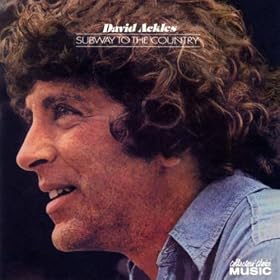
DAVID ACKLES – Subway to the City – (Elektra) – 1970

If I didn't already know who Ackles was (I have "American Gothic" (1972) and I commented on "Five & Dime"(1973) back in "what Frank is listening to #91" ) I would still have picked this album up as it's on the Elektra label – home of The Doors, Tim Buckley, Love, Stooges, MC5, Phil Ochs etc. Just about everything that label released in the late 60s /early 70s was interesting.
 
That however is a throwaway opening as I know who Ackles is and he is brilliant.
 
In commenting on the "Five & Dime" LP I said: "I have Ackles' "American Gothic" (1972) which is generally regarded as his best album … and it certainly is a good 'un. Ackles is, simply put, magnificent. His small body of work contains some of the highlights of the "singer songwriter" genre. Though these grandiose statements of mine are not without qualifications.  If you like your music straight ahead, not to complicated, and more tune based rather than character or story based then give him a wide birth ( but, don't get me wrong,  there is nothing wrong with "straight ahead" and "uncomplicated"). Likewise if you think John Lennon or Harry Chapin are the heights of 70s singer songwriters then steer clear. And, finally, if you don't like musical theatre you wont make it past the first song".
 
This album,"Subway to the City", is less musical theatre and more singer-songwriter but only just. It's as if a singer-songwriter was residing in, ah um,a musical theatre when he wrote the songs.
 
A brief bio: "Born on February 20, 1937 (in Illinois) , he was working in vaudeville by age four and in the mid-'40s played a character named Tucky Worden in Columbia's Rusty the Dog film series. His co-star was Dwayne Hickman, who would later go on to play Dobie Gillis on television. He attended the University of Southern California and took a year to go to school in Edinburgh, where he studied literature. He eventually got a degree in film studies, though he was proficient in the theatre, ballet, and choreography. He held several odd jobs after school and was eventually hired as a songwriter by Elektra. He managed to parlay that assignment into a multi-record deal …"
 
I went on to say this in #91: (I like referring to earlier comments – less thought is needed) : "He recorded 4 albums over a 5 year period between 1968  and 1973 …they sold nothing ("American Gothic" is the only record he had that charted – #167) . Ackles died of lung cancer on March 2, 1999, at the age of 62. He is however ( and had been) extremely influential on many ( and many minor) artists like Elvis Costello, Phil Collins, Bernie Taupin and Elton John. Don't let those names put you off …..I can see only the obvious story song aspects of Ackles in them – with the exception of Costello who seems hell bent on re-reading the "American Songbook" and maybe Bernie Taupin.
 
Ackles is of the singer-songwriter genre from the late 60s and early 70s. The genre is much heralded, though it should also be much maligned as anyone who puts pen to paper and plays a guitar or piano is considered a "singer songwriter"… but most of them do not rise above a catchy hook and some lines  that rhyme. Ackles however (especially on this LP) encroaches on musical theatre territory  though I hasten to add that he is from the "rock" paddock as opposed to the "popular" music field (Sinatra, Crosby, Mitchell et al), though he does blur the lines".
 
If you care to read that comment I then waxed lyrical about "rock ballads" before saying "OK …. Ackles is way out in left field …. "
 
And I stick to that.
 
Apparently the great Lonnie Mack played guitar on this album as did Jim Gordon (Derek and the Dominos, session drummer on Pet Sounds and for The Byrds, the Beau Brummels etc) and Larry Knetchel (from Bread and session muso for Simon & Garfunkel, Duane Eddy, The Beach Boys, The Mamas & the Papas, The Doors, and Elvis Presley) and others.
 
A lot of the mood (apparently) could be due to the arrangements (and conducting) by Ackles school friend Fredric Myrow. Myrow had little background in rock music (perfect), but ended up at Elektra in the late 60s.
 
He'd been a composer-in-residence under Leonard Bernstein at the New York Philharmonic, but by the late 1960s was scoring an experimental movie for former UCLA film student-turned-rock-star Jim Morrison, Highway. Myrow would go on to discuss a creating a musical with Morrison, with Myrow doing the music and Morrison the text and lyrics, although those plans were scrapped after the Doors' singer's death in 1971. Fred subsequently scored several movies, most famously Phantasm, before dying in 1999, only about six weeks before Ackles passed away. "Fred Myrow was certainly from a very classical background and discipline," notes Janice Vogel Ackles. "He added some really interesting things, tonally, to the album. I know that David was extremely pleased about that."  http://www.richieunterberger.com/subway.html
 
This album, his second, is a hyper emotional, brutally honest (which is unusual as the older I get the more I realise that not everyone has insight though I thought everyone did) and quite eccentric. I'm not sure who Ackles thought his audience was in1970 but if there ever was a time for experimentation it was the late 60s or early 70s. Despite the fact he does not draw on the "great American songbook" as much as he does on "Five & Dime" what he does draw on is American art, tin pan alley, and the avant garde which really culminated in his third album, "American Gothic" . This is glorious music and quite visual in it's structure … in mood he comes across as a more frantic aural version of a Edward Hopper painting from the 40s (I don't want to be an obtuse wanker but even if the Arts otherwise means to you "reaching for your handgun" you should google Edward Hopper …)
 
Musically, the album swings between narrative heavy, world weary, singer-songwriter and the avant garde experimental theatre atonal style of Kurt Weill with (not surprisingly) Bertolt Brecht lyrics. Is this bad … fuck no. It doesn't always work but when it does it soars.
 

The Tracks
 
(they are all good) … the best in italics:
  • Main Line Saloon –  very David Ackles and with a bit more "beat" it would be very early Tom Waits. The characters in the narrative are very Brecht-Weill. Very much of its time … like a surrealist counter-culture off-Broadway play … accentuated by the clapping at the end. 
  • That's No Reason to Cry – singer-songwriter balladry.
  • Candy Man – a song about a child abuser … holding up a mirror to his accusers?
  • Out on the Road – it's pretty clear that Elton John and Bernie Taupin ripped Ackles off blind (and cleaned and sanitized him in the process).
  • Cabin on the Mountain – country rock apparently though more like Broadway's Oklahoma" updated to 1970 … and I like "Oklahoma". 
  • Woman River  – a very dark lounge jazz tune.
  • Inmates of the Institution  –  this sounds at times like the theme to a TV show from the early 70s before changing mood after a keyboard freak-out half way through … "Inmates of the Institution" …now that would be a TV show I would like to see.
  • Subway to the Country  – a beautiful song. Are you escaping the city for the country or is this just a desire to show your child that there is more to life than  the big smoke and everything it implies. The imagery is vivid … he throws lots of little details into the narrative ... and it's his most upbeat song, though even here there is a tinge of melancholia:
            Coney Island's not a place to look for starfish
            or to find yourself a fifteen colour stone
            that you can carry in your pockets till you're grown
            aah there just aren't any subways to the country
 
            But your Daddy, he's gonna try
            I I ever get three bucks together I'm gonna buy
            three tickets on the train
            and I'll show you rain
 
            I will carry you through clean smelling rain
            one boy to a shoulder
            hey we better go quick
            before we get older
 
            Central Park is not a place to watch the sunrise
            or to look for redskin writings in a cave

            or even find the kind of frogs you like to save
            hey I wish we had a subway to the country
          
            New York City is a town too big for children
            where there's so much dirt

            they think that snow is grey
            and you have to watch their childhoods waste away
            Hey, you've got to find a subway to the country
            or anywhere
 
            well, your Daddy is gonna try
            If I ever get three bucks together I'm gonna buy
            three tickets on the train
            and I'll show you the rain
 
            I will carry you through clean green meadows smelling rain
            One son to a shoulder
            hey we better go quick
            we're getting older
 
And …
 
As I have said before …. Ackles apparently regarded the message from Ecclesiastes as gospel (half pun intended) : "Who gathers knowledge gathers pain" …  this pretty much sums up his music.
 
I'm keeping this …brilliant
 
Sounds
 
Main Line Saloon      
attached    
 

Subway to the Country 
attached
 
Review
 
 
Bio
 
 
Website
 
 
(originally posted: 28/12/2009)


Posted in Singer Songwriter | Tagged | Leave a comment