BUCK OWENS – In The Palm of Your Hand – (Capitol) – 1973

 
this one is for Ivan …. 
 
More Buck!
 
A lot of this is cribbed from previous Buck entries …
 
For background biographical detail on Buck read "what Frank is listening to #117" in relation to his 1971 album "Bridge Over Troubled Water". In that same comment I said the following about Buck:"He and like minded others could do that as they were relatively isolated from the (frowns of the) country music establishment. Owens had settled in Bakersfield, California in 1950 and started playing music in bars. Many others from west Texas and the dustbowl areas settled and they all shared a love of the hard country of their youth and played in that style. Being isolated also meant they could incorporate other influences into their music that the country music establishment wolf have frowned on ….. especially the rock n roll that was increasing in popularity. Eventually there was quite a large group of musicians playing in that style in and around Bakersfield and when that started translating into hits the "Bakersfield Sound" was born. Buck Owens and Merle Haggard are the most well known exponents of the sound… though Dave Dudley, Hank Thompson and Wynn Stewart all loom large also.
 
The Bakersfield sound was the direct precursor to country rock. When Gram Parsons and others started started experimenting in incorporating country into rock it had already been done by Owens  though in reverse as he incorporated rock into country. Incidentally, Elvis, Charlie Feathers and others had predated Gram with the "experiment" by some 10 years or so.
 
The influence of the Bakersfield sound of which Owens was central has been substantial on Gram Parson, The Flying Burrito Brothers, Dwight Yoakam, Dave Alvin, The Derailers, Dale Watson, The Mavericks, Brad Paisley, Dave Gleason and many others as well as on the "alt Country" and "Cow punk" genres".
 

I also said this about that album: "Having said all that this album, comes at mid point in Owens career …  and on this particular album the electric honky tonk is toned down. The album is made up of ballads and mid tempo songs and there are backing voices and various instrumental incidentals around the edges that smooth out some of the edges. On top of that Buck has covered 3 Paul Simon songs, a Dylan and a Donovan. As a result of all this the album moves closer to the country pop sound popular at the time, but, regardless it does not sound like anything coming out of Nashville. The regional accents are alive and well and even the most maudlin of tracks have a crisp little bite to them. There is no mistaking that this is anything but country music".

This album is from the same period as the others I have commented on ("I Wouldn't Live in new York City" is from 1971) so the sound and Buck's temperament is fairly consistent across the albums.

 
I have said this before: "Buck was always a interesting writer and had as way of communicating his feelings in a straightforward and simple way … which is something common to the best country writers. Where Buck deviates is he could write about a range of topics not just love songs, drinking songs, leaving songs or cheatin' songs. What is endearing is the honesty in what he communicates.
 
What he also has is a bit of humour  …so quite a few of his songs are funny jokey but the jokey has a satirical bite. Buck is not afraid of putting in satire and aiming it at his targets. I'm not saying he is Lenny Bruce but his observations are just as keenly detailed within the limits of a song structure. His satire also tends to be a little more good natured ( maybe not as much as Tom T Hall) but when he feels strongly he will point the bone".
 

This album has a good many songs recorded by Buck before, re-recorded here, as well as quite a few new songs. Country music (like blues and rock before the Beatles) was about work, not art. Accordingly, the music is about product (and live shows) … it is not unusual for country artists to re-record songs and have albums put out to capitalise on singles. And Buck was a workhorse – he put out some 50 albums between 1960 and 1980. What is impressive is the general consistent high quality of the material (at least from what I have heard).

Tracks (best in italics)

  • In the Palm of Your Hand  – Owens – "in love" or "p whipped"? Either way a excellent song. Buck's grimly determined vocal suits the narrators desperation perfectly. Originally recorded by Buck in 1966.
  • There Goes My Love  – Owens –  another love song. This is incredibly catchy and one of the best country songs about pleading love. It's beautifully written and says everything in its two and half minutes. Looks like Buck is still "In the Palm of Her Hand"…
            There goes the girl I used to know
            There goes the girl that I love so
            There goes the arms that used to hold me tight
            There goes the reason that I sigh
            There goes the reason that I cry
            There goes the lips I used to kiss goodnight
            There goes my love
  • Made in Japan – Morris, Morris – another winner … for all of you who have or who have had the "y fever" … I know you are out there. Extremely well written. But what really makes it great again is Buck's vocal. Again, he has the right amount of country twang in his voice and he sings the song straight but manages to steer away from the potentially maudlin subject matter.
            My transistor radio comes from far away
            And when it's night over here over there it's a breakin day
            I remember all the good times I had a walkin in the sand
            With the beautiful girl that I met made in Japan
 
            The beauty of her face was beyond my wildest dreams
            Like cherry blossoms blooming in the mountain in the early spring
            As we walked by the river and she softly took hold of my hand
            That's when I fell deep in love with the girl made in Japan
 
            In the dark of night we would lay on Tokyo Bay
            And the singin of the birds woke us up at the break of day
            Her smiling eyes always seemed to try to understand
            All the love in my heart for the girl made in Japan
 
            My transistor radio comes from far away
            And when it's night over here over there it's a breakin day
            She cried when she said she'd been promised to another man
            That's when I left my heart with the girl made in Japan
            Yes my heart will always be with the girl made in Japan.
  • Sweethearts in Heaven  – Owens –  a more traditional country song lyric but well done… originally recorded by Buck in 1963.
  • Arms Full of Empty  – Owens – Buck must have been obsessed with some chick ... another love song where he will gladly take the woman back. Looks like Bucks still "In the Palm of Her Hand"… great word play
            Oh, you took my car and took my money
            Done me wrong and that ain't funny
            Left me standing here a looking silly
            Jump aboard that silver plane
            (Wave to me through the window pane)
            Left me with my arms full of empty.
 
            Darling if you will come back
            I promise you that I won't be mad
            For I never was one to burn bridges
            I ain't had no tender loving care
            Since you've been gone
            I've only had two arms full of empty.
  • You Ain't Gonna Have Ol' Buck to Kick Around No More  – Owens – aahh that's more like it. For anyone who's been in the palm of her hand and been used. Near perfect … "The next sound that you hear will be the slamming of the door"
            Oh. you ain't a gonna have ol' Buck to kick around no more
            The last time was the last time and this time it's for sure
            The next sound that you hear will be the slamming of the door
            And you ain't gonna have ol' Buck to kick around no more.
  • Whole Lot of Somethin'  – Alan –
            Well, I've treated you the best that I knew how
            But what have I got to show for all that now
            I've got a broken heart and that's somethin' you seem to lack
            It's gonna take a whole lot of somethin' to bring you back…
            It's gonna take a whole lot of somethin' to bring you back
  • Get Out of Town Before Sundown  – Owens –  more than a hint of Kris Kristofferson's "Me and Bobby McGee" and very catchy (it could almost be a response to that song).
  • Something's Wrong  – Owens –  an excellent country ballad about a relationship gone sour. Can lyrics get more honest?
            Something's wrong when you no longer want to hold me
            Something's wrong when your lips have turned to stone
            When the love of your life turns into a waste of time
            When there's no peace of mind something's wrong
  • I Love You So Much It Hurts – Owens –  Buck is back in the "palm of her hand" …
            And if you do me wrong
            I'll still tag along
            'Cause I love you so much it hurts…
 

 And …

Well this is clearly Bucks love album. Just about every song is about a singular obsessional love. Though in true country style there are the flipside "when the love is over" songs as well.  This is one of the best Buck albums I have heard thus far … though it is short ( around 26 minutes) … 'm a keepin this, pardner.

Charts Action

Album
1973   In The Palm Of Your Hand   Country Albums #21
Singles
1972   Made In Japan   Country Singles #1 (Bucks last #1)
1972   You Ain't Gonna Have Ol' Buck To Kick Around No More   Country Singles #13
1973   Arms Full Of Empty   Country Singles #27
1973   In The Palm Of Your Hand   Country Singles #23
 
Sounds
 
There Goes My Love  

Made in Japan 
attached

Arms Full of Empty  
attached
You Ain't Gonna Have Ol' Buck to Kick Around No More  
Others:
Covers:
 
Review
 
 
Posted in Country | Tagged | Leave a comment

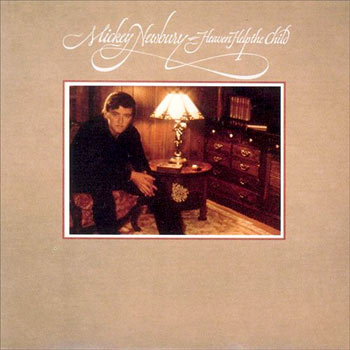
MICKEY NEWBURY – Heaven Help The Child – (Elektra) – 1973

Heaven Help the Child
I have commented on a couple of other  Mickey albums in the past and have always been impressed. He is perfect Sunday morning listening … though not religious, there is a peaceful spirituality in the music.
 
I commented on Newbury back in "what Frank is listening to #78" in relation to his "His Eye is on the Sparrow" album from 1978 and I said this back then: "It is Newbury's subtlety and thought that put him at the forefront of "progressive country". "Progressive Country" roots lie in traditional country, roots music, folk, Americana, regional rock n roll and was largely comprised of younger country songwriters writing country music with naked honesty, which is no mean feet as country music generally is "nakedly honest" ( think Hank Williams, Patsy Cline).  What they did do was write incredibly personal songs much like their "singer-songwriter"relatives in the pop field with an ear to the past. The other thing they did was sing their own material regardless of the quality of the voice. Consequently, they have put out many albums and are well respected but their songs are often associated with other singers. Think Townes Van Zandt, Danny O'Keefe, Kris Kristofferson, Willie Nelson, Terry Allen, John Hartford, Billy Joe Shaver, Butch Hancock, Gene Clark, Tom T. Hall, John Prine, Jimmie Dale Gilmore, Guy Clark Dennis Linde, etc. Some of those artists moved into the more up-tempo "outlaw country" whilst the rest continues on and eventually became the cornerstones of "alt country" in the 80s and 90s".
 
Newbury, born 1940 in Houston Texas (D: 2002) put out his first album in 1968. This is his 9th album.

This album though recorded in Nashville is more singer-songwriter than his other albums I have heard. Though, of course, this singer-songwriter "lives" in the "country", not in the city, so that country sound is always going to come through.

I also said back in comment #78: "It is Newbury's subtlety and thought that put him at the forefront of "progressive country". "Progressive Country's" roots lie in traditional country, roots music, folk, Americana, regional rock n roll and was largely comprised of younger country songwriters writing country music with naked honesty, which is no mean feet as country music generally is "nakedly honest" ( think Hank Williams, Patsy Cline).  What they did do was write incredibly personal songs much like their "singer-songwriter"relatives in the pop field with an ear to the past".

And that still applies … the songs are very reflective and can be listened to as mood pieces or as little ruminations. I'm not sure what you have to tap into to put your thoughts in a song but certainly some insight is required. It is easy to assume that if a song is reflective there is insight but that is wrong. Most of us do not have insight all the time and a lot of us do not have insight at all. Newbury manages to get his feelings on paper in a way that shows insight, despite what you may think of the music. For me the music is a perfect compliment … and that's just what it is – a compliment. Add a melody and voila there is a song. Newbury goes one step further because his knowledge of old music is added to his songs as evidenced by brief snatches of public domain songs and old timey instruments thrown in. Through this all his voice suits the music perfectly – it's almost a ghostly tenor at times.

Newbury was sharp as he takes from all American musical traditions of all era's and creates an album of individual songs though with one mood.

The great Dennis Linde produced this album and the playing is good … it's a who's who of Nashville legend sessionmen including Wayne Moss (guitar) Chet Atkins (guitar), Vassar Clements (violin), David Briggs (keyboards), Buddy Spicher (drums). There are some sound effects and backing voices in the form of a choir but they work ( and that is hard to do).

Newbury has also "covered" four songs he had released before – three songs from his very first album, "Harlequin Melodies" (1968): "Sunshine" "Sweet Memories," and "Good Morning Dear" which are not so much re-recorded as reinvented. They may as well be different songs. Similarly "San Francisco Mabel Joy" from his immediately preceding album has been given the same treatment. I'm not sure why this is but I assume he was on a roll and every song he wrote at the time was part of a song cycle … maybe every song he ever wrote was part of that cycle?

This is amazing … it works on many levels … and entertains at the same time. I actually feel smarter after listening to it.

Tracks (best in italics … which is hard as they are all good):
  • Heaven Help the Child – a amazing multi generational song about an American odyssey. It's not so much a narrative as a mood piece with fragments of stories … and a couple of lines of Auld Lang Syne is thrown in at the end.
            1912 in New York 
            I took a walk up to Park Avenue 
            To sip some brew with my good friend 
            Maggie the Bohemian 
            She was quite a woman of the world 
            I was the envy of the men 
            Heaven help the child heaven help the child
 
            Paris in the 20s 
            It can offer plenty to a young man 
            With a vision so they say 
            With a friend named Fitzgerald 
            I was headed for the old world 
            On a merchant steamer 
            Bound for Biscay Bay
 
            Heaven help the child heaven help the child 
            Take him back to where he has never been
 
            Nothin like a freight train 
            Get you to the city 
            Pick another sad song for me Jim 
            I hate to leave the old man 
            All alone to work the cotton 
            but the country never 
            Seemed to bother him
  • Good Morning Dear – a relationship song in the mould of Rod McKuen … this isn't "I Wanna Hold Your Hand". Stephen Sondheim would be proud.
            Were the night's any sweeter 
            The morning's any cooler 
            When she was here 
            Was her mind grown accustomed 
            To hearin', "Good Morning, Dear"'
 
            Should I still feel the sunshine 
            Remembering brings to mind 
            In my thought's of her 
            When Lord, we both know thing's 
            Could never be 
            The way they were
  • Sunshine – another lost love song with a bouncy backbeat which beautifully juxtaposes the lyrics. It has the feel of "Gentle on My Mind" by John Hartford which comes across as a non self pitying sadness.
            Sunshine 
            So you found my window 
            But you won't find me 
            Cause Sunshine 
            I've got my friend the darkness 
            Here to hide me
 
            Sunshine 
            As far as I'm concerned 
            I'm where I want to be 
            Sunshine 
            As far as you're concerned 
            Don't be concerned for me
 
            Cause she don't love me 
            She don't love me anymore 
            No she doesn't want me 
            She doesn't want me anymore
  • Sweet Memories – another excellent song – and it sounds like something I cant put my finger on … though given it has been covered over 70 times maybe I'm thinking of a cover … perhaps the Andy Williams version or was it The Everly Brothers version …
  • Why You Been Gone So Long  – a change of pace with this country stomper … though it's the familiar "lost love" song. Newbury has a lot of them – then again if you have a country background then …
  • Cortelia Clark – old men and trains … central to any country folk song … this is beautiful … and a touch of Kristofferson's "To Beat the Devil" in there.
            He was just some blind old begger 
            They all said 
            But Lord I'll wager 
            He won't be beggin' on Your streets
 
            And you'll find him Lord this morning 
            He'll be stepping from the dark 
            Would You save a street in Glory Lord 
            For Cortelia Clark
  • Song for Susan – a incredibly romantic song – without being maudlin.
            The light from the neon night 
            Silently lights up the sky 
            Sails through the window 
            To dance with the tears in her eyes
  • San Francisco Mabel Joy – a beautiful long narrative in the country folk tradition – the lyric is extremely evocative and plays out as a movie in your head.

 And …

Every track is a winner of some kind … this is country experimentalism at its best. Screw today's singer-songwriters. I'm keeping this. 

Chart Action

The album went to #173 on the pop charts.

"Sunshine" went to #53 Country Singles and #87 in the Billboard Hot 100 in 1973.

Sounds
 
Heaven Help the Child   
attached

Sunshine
   
Sweet Memories  
attached
 
Why You Been Gone So Long   

Cortelia Clark  
 
Mickey's most famous song:
"An American Trilogy"
MN
EP
Hawaii
or, given the recent anniversary of Elvis's passing
 
Bio
 
The guy has been well covered:
 
Kenny Rogers and the First edition covered one of his best songs " Just Dropped In" ( to see what condition my condition was in). …youtube it.

Other Comments

what is Frank Listening to #79

what is Frank Listening to #122

Trivia

my LP sleeve is Australian and has the same design as the US sleeve above but the picture seems to be intentionally blurred.


(originally posted: 28/02/2010)


Posted in Alt Country | Tagged | Leave a comment

GLEN CAMPBELL – Southern Nights – (Capitol) – 1977

For background on Glen see "what Frank is listening to #76".
 
Glen moved from guitarist extraordinaire to country pop crooner par excellance. I always prefer his albums that show off his guitar abilities but since the late 60s the country pop has been dominant on his albums. Country pop by it's nature tends to be very middle of the road. It is only saved when the source material or execution transcend the limitations of the country pop style. With Glen we saw that happen many a time in the late 60s when his Al De Lory arranged and / or produced songs written by Jimmy Webb, John Hartford or Chris Gantry reached heights of country pop ecstasy rarely matched : qv: "Galveston", "Wichita Lineman", "Gentle on My Mind", "Dreams of the Everyday Housewife".
 
Glen albums from the 70s are (generally) patchy but are always worth listening to (though I only have about half so the last statement may be a bit premature). In other words they are never tiresome though some aren't always particularly exciting. What they all have is a song or two which stands out among the MOR country pop tracks.
 
This album sleeve, on first glance, promises a southern concept album – the title, the shack, the old southern tree, the crescent moon – but alas the sleeve was designed to capitalise on the "Southern Nights" hit single I expect, because with the exception of the title track there are few references to the South. A pity.
 
This album is firmly in MOR territory and was a big hit as was the single "Southern Nights". Glen's guitar is restrained but the strings aren't though we do have is a good batch of songs. Jimmy Webb contributes two songs and plays on the album, whilst other covers include songs by Neil Diamond and Brian Wilson.
 
So, all is not lost ….
  • Southern Nights  -Toussaint – the big crossover pop hit. A bouncy song and very infectious. 
  • This Is Sarah's Song – Jimmy Webb  – very Jimmy Webb … which ultimately means very good. What sounds on first hearing like romantic slop is actually quite a Sondheimian rumination on love.
  • For Cryin' out Loud – Smotherman –  Campbell sang a lot of Smotherman's songs (Smotherman was in Captain Beefheart's band !!) – and though he's not Jimmy Webb he is solid with more than a few well written gems in the singer-songwriter vein. This is somewhere about half way – pleasant but not particularly memorable … I think the big production goes too far and it would have been better stripped down.
  • God Only Knows – Asher, Wilson  –  And why cant Glen Campbell do the Beach Boys … afterall he was their bass player in 1964-65 and he played on "Pet Sounds". Glen's version of this song (one of the best songs ever written – in my opinion) is too solemn and maybe a touch maudlin whereas the Beach Boys version is otherwordly … but at least he puts his stamp on it.
  • Sunflower – Neil Diamond –  As much as I love Neil Diamond his songs always sound like Neil Diamond songs which is less about his personal signature than about the fact that he only writes one type of song. But hey … it's a good type.This version by Glen is bouncy and poppy and thoroughly pleasant.
  • Guide Me – John Jennings  –  the kitchen sink has been thrown in … a religious secular song, if that makes any sense. Neil Diamond wrote a million of these and they weren't much chop, less here.
  • Early Morning Song – Jimmy Webb  –  unmistakeable Webb
            There's a woman and she thinks I can do no wrong
            She's been waiting for me, all night long
            Still she forgives me, when I drag it home
            And tells me I belong
            For her this early morning song
  • (I'm Getting) Used to the Crying – Miller, Smotherman –  a country theme in the title if there ever was one – results are patchy here.
  • Let Go – Cadd  –  Look at the writer – Brian Cadd! Yes the Australian Rock Hall of Fame–er (solo, The Groop, Axiom). Cadd had a #14 with this track in Australia in 1972. From 1975 -93 he was based in the USA and was well covered by the likes of Gene Pitney, Bonnie Tyler, Ringo Starr etc. A pleasant song though I would have preferred it if Glen had covered "Alvin Purple" or "Class of '74".
  • How High Did We Go? – Albright, Medlin  – the overwrought country ballad which really needs operatic country big ballad power. Elvis in the 70s could have done this in his sleep. Glen isn't bad but he needs that oomph to take the song out of the serious into the "over the top and pained" category.

 And …

The album is patchy and none of the tracks ever really soar but a good handful of them justify the album. It's country pop MOR but it's pretty good country pop MOR. I'm keeping this … if for nothing else than to pad out the Glen Campbell collection.


Chart Action
 
Album
1977   Southern Nights   Country Albums #1
1977   Southern Nights   The Billboard 200 #22
 
Singles
1977   Southern Nights   Adult Contemporary #1
1977   Southern Nights   Country Singles #1
1977   Southern Nights   The Billboard Hot 100 #1
1977   Sunflower     Adult Contemporary #1
1977   Sunflower    Country Singles #4
1977   Sunflower    The Billboard Hot 100 #39
 
Sounds
 
attached
 
attached
 
 
Early Morning Song
attached
 
  • I saw Glen live in Brisbane in 2009 and the crowd – mainly 50+ types were possibly the most ignorant, vacuous and music hating crowd I have seen. They wanted reaffirmation of the Glen Campbell they know from MOR AM radio and nothing else. Apart from mercilessly heckling the supporting act (the very brave idiosyncratic, original delight that is Dave Graney) they had no time for Glen's Beach Boys medley or rock references. The audience was truly insipid. And even the old cunt behind me who heckled all the way through Dave Graney until I turned and called him a fuckwit didn't have the balls to reply or hit me. I note he also had a habit of  singing along with all the songs he knew – luckily it was only about three. Nevertheless, this is what made Queensland famous – stupidity, isolationism, inbreeding and ignorance.These people were truly losers. (The Tex Perkins "Johnny Cash Show" had a similar audience). This "audience" I suspect transcends borders but it is galling. I should say Glen's set was safe and predictable for the most part. You have to pay the bills.
Note to self: if I ever become a country promoter …. Glen will be brought back and put into a nightclub live venue with no seating and crappy toilets where people do drugs. There will be lots of alcohol, tickets will be no more than $50 (so more riff raff can come) and a country punk band will be the support – someone like Assjack, Green of Red or the Drive By Truckers who will then back him through his set. I know he will have fun and it will offend the insipid fans.
 
(originally posted: 24/02/2010)
Posted in Country | Tagged | Leave a comment

LOS INDIOS TABAJARAS – Twin Guitars in a Mood for Lovers – (RCA) – 1966

In a quiet mood I have chosen this from the pile of records behind me.
 
Los Indios Tabajaras are not strangers to anyone who has spent time in op shops as they frequently appear in multiple copies.
 
Having said that their appearance in op shops frequently does not mean they are bad but rather that they had an audience, were extremely popular, sold many records, and are now not highly collectible ... hence the overrepresentation in the op shop bins.
 
Which is a pity as there are durable delights to appreciate in their music.
 
I have a couple of their albums and what attracted me to them initially was the fact they were from South America and fairly exotic.
 
Allmusic: "Certainly the most uncommon duo of Brazilian artists to have a solid international career, Los Índios Tabajaras was formed by the brothers Antenor Moreyra Lima (Muçaperê) and Natalício Moreyra Lima (Erundi). In the U.S. they had success in the early '70s with "Sakura-Sakura," and their biggest hit was the fox trot "Maria Helena," which won second place at the American charts and sold over one-and-a-half million copies. Their 48 LPs also sold millions of copies worldwide, and they toured South, Central, and North America, Asia, and Europe before settling in the U.S….
 
Indians from the Tabajara tribe, they left Ceará with their people in 1933, traveling on foot the almost 2,000 km to Rio de Janeiro. During the three years spent on the journey, they collected a number of regional musics. In Rio de Janeiro they were registered and baptized by the lieutenant Hildebrando Moreira Lima, from whom they took their Christian names. Their first public performance was in 1945"
 
From: http://jukebox.au.nu/instromania/solo_virtuosos/los_indios_tabajaras/ "Los Indios Tabajaras was formed by the brothers Antenor Moreyra Lima (Mucapere) and Natalicio Moreyra Lima (Erundi) – sons of a Tabajaras Indian chieftain of an isolated jungle tribe. Their promoters have always drawn a veil of mystery around Los Indios Tabajaras, so it's tough to trace their early years accurately. Their literature claimed they discovered a guitar mislaid by European explorers, in the jungle during their journey through the hinterlands of Cariri, Ceara, and, after making sure it wasn't going to explode like other firearms their tribesmen had found, began to examine it (later they had to give this guitar away for a pound of beans) . Eventually, they both mastered the instrument and came to the attention of townspeople, one of whom took them to Rio de Janeiro to play.
 
Dressing up in ceremonial Indian costumes, the brothers perfected a nightclub act in which they sang and played Brazilian and Latin folk songs. They changed their names to Natalicio and Antenor Lima and began touring throughout South America. In 1943, RCA's Latin American arm signed them to a contract, but it wasn't until the late 1950s that they were released in the U.S., and their first album was on a minor label, Vox, rather than RCA".
 
They broke through in the US in the early 60s and continued playing until the 1980s. (Nato died in 2009 aged 91, Antenor died in the 1990s)
 
In the best tradition of B. Traven the biographical details are sketchy and seem outlandish in relation to Los Indios Tabajaras. Whether the above is the truth or not probably doesn't matter because the basics are correct. I just thought I should mention that some of the specifics have been disputed … I assume record company spin has been used to make their backgrounds even more exotic.
 

Legendary Eugene Chadbourne had this to say this (about their "Many Splendored Guitars" album from 1965) and it applies here: "The myth behind this popular recording duo of the '60s and '70s is obviously a bunch of poppycock. Someone has to come out and say it. Brothers Mussapere and Herundy "found" a guitar out in the jungle and learned how to play it? Sure. With the humidity the way it is in the jungle, one might have been able to play scratch baseball with the neck of the instrument, but that's about it. No, the way these fellows get around the chord changes of these Tin Pan Alley songs, show tunes, and cosmopolitan Latin American instrumentals makes one feel sorry for them having to wear paint and feathers at all their gigs. No one ever asked that of Jim Hall. This is mellow, peaceful guitar music. The instruments stay very close to arrangements, articulating the melodies of the songs with as little extra seasoning as a Cuban peasant might have to sprinkle on his dish of rice and beans. It is similar to the way Willie Nelson solos, for example, although there are sometimes flashy little connecting runs that sound more like Django Reinhardt. Backup is subtle, emphasizing quiet Latin percussion, and there is a beautiful recorded sound from the RCA studios as can be expected".

Eugene doesn't always get it right though. Apparently, on their live concerts, Los Indios would perform the first half wearing the traditional Indian head dress feathers, woven vests etc and then reappear for the second half, dressed in formal attire and perform their unique classical guitar arrangements.
 
Either way it was the exotic and other wise otherworldly guitars that caught the imagination of the American public as well as the ear of country music legends Chet Atkins and Don Gibson who recorded them. (apparently Chet Atkins made the Del Vecchio Resophonic his secret weapon in the studio as a direct result of hearing Nato and eventually, buying his guitar).
 
I will let the guitarists do their own research into how Los Indios created their distinctive sound as that's too technical for me (there are some links below) .
 
What I like about them is that the music is gentle, velvety, and evocative, without being syrupy and obvious. All their music that I have heard, even their upbeat tunes, are spiced with melancholia and seem to conjure up the past or remember things lost. Other tunes are downright sad. If there ever was a music that seems to conjure up the retreating rainforest of South America, the plight of the forgotten native peoples, and the encroachment of modern mid 20th century civilisation then this is it.
 
Or maybe I'm reading too much into it?
 
This  is certainly exotica or lounge music but "folk-exotica" or "faux folk exotica"?
 
This album is all that above and I'm surprised the albums sub-title is "In a Mood for Lovers" as I would have thought a better title is "In a mood  for lost loves". Look at the song titles "Some of These Days", "Who Can I Turn to", "The Song is Ended", "Time Was", "As Time Goes By" … get the idea? The accompaniment to the guitars is very much in the background – some later recordings had all sorts of things happening around them. Also, there are no vocals on this album, which is the norm, though occasionally they would sneak in a vocal.
 
There are some obvious song choices in here and none are really surprising but that is compensated by the fact that Los Indios change the songs to suit their sound.
 
Tracks (best in italics)
  • Make Believe – (from the musical "Showboat") – a great song, though it doesn't sound like this normally – this is stripped down. A gentle Hawaiian lilt runs through the track.
  • The High and the Mighty – ( from the 1954 film) – the theme song by the legendary Dimitri Tiomkin and Ned Washington from the (until recently) rarely seen John Wayne film "The High and the Mighty" which is the granddaddy of all "airport", "air disaster" type films and a box office hit in 1954. This theme was a big hit when released for a number of people (Les Baxter #4 1954, LeRoy Holmes #9 1954 and Victor Young #6 1954). I have heard many versions of it and this is a good one despite the fact the distinctive whistling is not in this version. This song captures the loneliness and aimlessness of a man (a pilot) who has crashed in the past killing all passengers including his wife and young son.. http://en.wikipedia.org/wiki/The_High_and_the_Mighty_(film)
  • El Reloj
  • Some Of These Days
  • Who Can I Turn To (When Nobody Needs Me) – (from the musical "The Roar of the Greasepaint-The Smell of the Crowd") – again they have taken the song and changed it to fit their style with no significant damage to the song.
  • The 3rd Man Theme – (from the 1949 film) – the famous theme and upbeat though more restrained than the famous Anton Karas original
  • The Song is Ended – the old Irving Berlin song done by everyone- Nat King Cole, Tony Bennett, Ruth Etting, Ella Fitzgerald.
  • Time Was – another old tinpan alley type song recorded by the Lettermen and The Four Freshmen amongst others.
  • La Mer – the much recorded French song by Charles Trenet. Bobby Darin had a gigantic hit with it in 1960 as "Beyond the Sea". A wonderfully evocative song with or without the lyric …
  • Lagrimas de Sangre 
  • As Time Goes By – the Casablanca (1942) song
  • Smoke Gets In Your Eyes – the Jerome Kern standard recorded by everyone. http://en.wikipedia.org/wiki/Smoke_Gets_In_Your_Eyes . This version has some sublime guiitar playing.
And … 

Great late night music with a cocktail and the lights down low … a perfect way to ease a troubled mind … you should have 2-3  Los Indios albums in your collection … I'll keep this.  And, you have to love the cover art.

Sounds

The High and the Mighty
attached

The 3rd Man Theme
As Time Goes By
Original versions
La mer
 
High and the Mighty
 
 
(originally posted: 21/02/2010)
Posted in Lounge & Exotica | Tagged | Leave a comment

BUCK OWENS – I Wouldn’t Live in New York City – (Capitol) – 1971

For background biographical detail on Buck read "what Frank is listening to #117" in relation to his 1971 album "Bridge Over Troubled Water".
 
In that same comment I said the following about Buck: "He and like minded others could do that as they were relatively isolated from the (frowns of the) country music establishment. Owens had settled in Bakersfield, California in 1950 and started playing music in bars. Many others from west Texas and the dustbowl areas settled and they all shared a love of the hard country of their youth and played in that style. Being isolated also meant they could incorporate other influences into their music that the country music establishment wolf have frowned on ….. especially the rock n roll that was increasing in popularity. Eventually there was quite a large group of musicians playing in that style in and around Bakersfield and when that started translating into hits the "Bakersfield Sound" was born. Buck Owens and Merle Haggard are the most well known exponents of the sound… though Dave Dudley, Hank Thompson and Wynn Stewart all loom large also.
 
The Bakersfield sound was the direct precursor to country rock. When Gram Parsons and others started started experimenting in incorporating country into rock it had already been done by Owens  though in reverse as he incorporated rock into country. Incidentally, Elvis, Charlie Feathers and others had predated Gram with the "experiment" by some 10 years or so"
 
The influence of the Bakersfield sound of which Owens was central has been substantial on Gram Parson, The Flying Burrito Brothers, Dwight Yoakam, Dave Alvin, The Derailers, Dale Watson, The Mavericks, Brad Paisley, Dave Gleason and many others as well as on the "alt Country" and "Cow punk" genres".
 
I also said this about that album: "Having said all that this album, comes at mid point in Owens career …  and on this particular album the electric honky tonk is toned down. The album is made up of ballads and mid tempo songs and there are backing voices and various instrumental incidentals around the edges that smooth out some of the edges. On top of that Buck has covered 3 Paul Simon songs, a Dylan and a Donovan. As a result of all this the album moves closer to the country pop sound popular at the time, but, regardless it does not sound like anything coming out of Nashville. The regional accents are alive and well and even the most maudlin of tracks have a crisp little bite to them. There is no mistaking that this is anything but country music".
 
Given that this "I Wouldn't Live in New York City" album came out the same year as the album described above indicates that most of the sound as described above still applies. The difference here is that this album has every song written (or co-written) by Buck.

Buck was always a interesting writer and could communicate his feelings in a straightforward and simple way which is something common to the best country writers. Where Buck deviates from other trad country witers is that he could write about a range of topics, not just the usual country love songs, drinking songs, leaving songs or cheatin' songs. What is endearing is the honesty in how he communicates the message of the song regardless of the subject.

What he also has is a bit of humour  … so quite a few of his songs are funny jokey but the "jokey" has a satirical bite. Buck is not afraid of putting in satire and aiming it at his targets. I'm not saying he is Lenny Bruce but his observations are just as keenly detailed within the limits of the song structure. His satire also tends to be a little more good natured (maybe not as much as Tom T Hall) but when he feels strongly he will point the bone.

This album is a concept album of sorts – all the songs on the album are about cities or towns, mainly in America. But rather than an ode to each place Buck sings his impressions of the place either done through the eyes of a protagonist or as a stream of consciousness. To add to the ambience he also inserts sound bites (or sound affects) of actual street sounds into the songs – gambling tables, sirens, riverboat whistles etc.

 
The album is in no way pompous and it's not even ambitious. By that I mean this: if this was done in rock it would be ambitious but country songs have always lent themselves to ruminations on places and events. Buck here Buck has just strung them all together over the course of one album (even though some are re-recordings of songs he has already recorded).
 
Buck doesn't seem to be to concerned about stepping on toes or on what other people's perceptions of him are, either. There is some aforementioned bite to some of the songs but it is never nasty. There is some humour, chest thumping pride and melancholia also.
 
On first listening this album comes off as pleasant. On my second (and third) listenings (the album is quite short) I start to hear the depth of feeling, one way or the other, that Buck has for each place.
 
Tracks (best in italics)
  • I Wouldn't Live in New York City (If They Gave Me the Whole Dang Town) – Buck's put down of New York ... in the liner notes he reveals the song is about his first visit to NYC in the winter of 1964 (though he admits he has been there 100 times since). He was shafted by cabbies, doormen, bellboys and confronted by a sea of sour faces something he believes even locals complain about. So he dedicates this album to "New York City people in hopes that some day they'll remember to look beyond those hard, grey, bleak concrete walls and find the sun". Buck may be a little harsh ... I was in NYC in both summer and winter and there is a marked difference in the people … apart from the fact there is always someone trying to shaft you. Apparently this track was recorded live on the streets of NYC and the police car at the end was actually coming to see what is going on. I have no idea if that is true but I'll accept it. I don't think his New York fan base (such as it is) was affected by this song.
            It ain't nothin' but a concrete jungle with people packed like sardines
            Where everybody's tryin' to live beyond their means
            And like a fleas on a puppy dog they got no place to go.
            Where all the natives hurry and scurry too and fro
            I wouldn't live in New York City if they gave me the whole dang town
  • Reno Lament – the woes of gambling …
  • Down in New Orleans  – the prettiest girls are down in New Orleans … after chasing girls around the world. Slight but entertaining …
  • Wind Blows Every Day in Chicago  – emotions as weather. Very catchy.
  • The Kansas City Song  – another country song of separated love …
            Now honey, watch those Kansas City Romeos
            And don't let them fool you with their charms
            Have a lot of fun but remember that I love you
            And I'm a waiting here with my two open arms.
  • It's a Long Way to London Town –  a old Buck song re-recorded … jokey but not without it's wisdom.
            I nearly froze to death in Russia
            Burned up in Timbuctoo
            I got drunk down in Australia
            and nearly married me a kangaroo
  • Houston Town –  a weird song with dialogue from NASA.
  • Santa Domingo – steel drums and a Latin flavour. Country always seems to work well with Mexican flavours and this is no exception.
  • No Milk and Honey in Baltimore – hard times for a hard luck couple … traditional country themes which, like it or not, have rarely been explored in rock.   
  • Big in Vegas – part Merle Haggard's "Mama Tried" and anticipating Glen Campbell's "Rhinestone Cowboy" … a perfect country song about the boy who didn't listen and who has disillusionment waiting for him around the corner.
            When I was young I left my home
            And went away, to Vegas
            With my guitar and my dreams,
            I had to try to play and sing, in Vegas
            But my momma told me I was wrong,
            And she begged me to stay at home
            But my will was strong and
            I had to make it big, in Vegas
 
And … 

Keeping

Sounds

I Wouldn't Live in New York City (If They Gave Me the Whole Dang Town)
http://www.youtube.com/watch?v=gEe02hCiWmk

Down in New Orleans 
http://www.youtube.com/watch?v=J5IhhTokwH8

Santa Domingo   
attached

Big in Vegas  
http://www.youtube.com/watch?v=OCt6Ws8ivBw
http://www.youtube.com/watch?v=X9fqs73vG14
http://www.youtube.com/watch?v=MK7csq4USCM

attached
 
Bio
Posted in Country | Tagged | Leave a comment

NANCY SINATRA & LEE HAZLEWOOD – Nancy & Lee Again – (RCA) – 1972

I’m not sure what to write here. I don’t want to wax lyrical and go on forever as I am hungover and I assume people know the basics of Nancy (probably) and Lee (maybe). So forgive me if these comments are bittier than usual but …

I was looking forward to this album and have rushed it through the pile of records to the turntable. This is the only Nancy & Lee album I don’t have (there were three). It is also the only Nancy album per se I don’t have and it is one of a handful of Lee Hazlewood albums I don’t have. So, obviously, the enthusiasm levels to listen to this were pretty high.

Do we need a background on these two?

Nancy Sinatra – The daughter of Frank Sinatra, born in 1940, became an uber babe, had a handful of hits in the 60s including the immortal “These Boots are Made for walking”, co-starred in movies with Elvis and Peter Fonda and then faded from public view.

Lee Hazlewood – A maverick music wunderkind … country music by birth (1929 Oklahoma) and background though happy to mix country with folk, pop, baroque, lounge, exotica, psychedlica, poetry and anything else that takes his fancy. The man was bona fide genius but a genius from left field as he really did march to the beat of a different drum. He moved to Sweden in the early 70s and continued releasing albums before dying in 2007.

See bio links below for more detail on Nancy and Lee.

No, they weren’t married and didn’t go out.

Lee is, musically, more important to this story being the driving force behind the duo (he writes, arranges, sings and produces). Lee’s voice is pure country which is a mix of gravel and cigarettes. Importantly though, he knew what he was looking for musically, as twisted as it may be. Without Lee, Nancy would have been a stunning looking but pleasant pop singer as her solo Lee-less records show. With Lee she became a stunning looking pop singer who transcended music and became an icon well worthy of a “Greatest Hits” album (so many bands put out greatest hits albums though few bands are worthy of them). Nancy’s voice, which admittedly doesn’t have the widest range, is compensated for in tone and expression. Her voice is sexually ethereal (visually she is stunning, but her voice alone can make your peg move). Lee tapped into Nancy’s vocal sexuality (and persona) and her voice became expressive and suggestive which was the perfect counterbalance for his everyman country ruminations. Maybe he was trying to cover various markets, but in Nancy he found the perfect vocal companion and then they both transcended the material to create great country baroque pop mini melodramas.

It’s hard trying to pigeonhole this music (I love pigeonholing) but at best it is all those things I have said above, (country pop, baroque pop, country, pop, lounge) but it probably also falls into “exotica” and what record nerds have called “obscuro”.

Allmusic:

Exotica is a form of easy-listening lounge music that draws upon world music, but it doesn’t aim for authentic replication. Instead, exotica’s primary concern is lightweight entertainment, gathering readily identifiable ethnic sounds into a smooth, easily digested pop form. The music typically conjures up images of exotic foreign tourist destinations geared toward white Americans, and in that sense, it’s sort of the equivalent of a pre-packaged resort vacation — fun, inauthentic, and safely familiar. Exotica is usually arranged for standard orchestras, with instrumentation added according to the location being evoked (ethnic percussion, string instruments, etc.); some exotica also borrows the weird, otherworldly sound effects that define the space-age pop style. Even in its ’50s/early-’60s heyday, exotica was often derided as cheesy and contrived, but its ’90s revival among alternative music fans embraced those very qualities (albeit ironically), and also brought a sincere reassessment of the music’s inventive production techniques.

Obscuro is a nebulous category that encompasses the weird, the puzzling, the ill-conceived, the unclassifiable, the musical territory you never dreamed existed. Or, to put it another way, it’s the kind of music that devoted record geeks play for one another, with the announcement “you have to hear this.” Obscuro records might be novelties good only for a laugh or two; they might be so utterly bizarre that you can’t quite process them no matter how often you’ve heard them; they might be failed experiments in commercially accepted styles, or wildly uncommercial; or, they might just be extremely rare records that have become legendary among collectors in part because very few people have heard them. Though it can come from virtually anywhere, obscuro tends to be concentrated in areas that either tried to push the boundaries of studio technology, or that experimented with offbeat instrumentation or stylistic fusions.

I have never liked the term “obscuro” as I find most “obscuro” tends to be either “lounge” or “exotica” and the term suggest that the music is “obscuro” in commerciality which it may have been but it was intended for the mainstream. The more experimental “obscuro” albums I tend to identify as either avant-garde lounge or avant-garde exotica.

Okay, okay there is a lot of splitting hairs here but I get some comfort in applying a mutated Platonian Theory of Forms in relation to music. Why? Cause it answers the question “what is that”?

To suggest that categorising, labelling or pigeonholing music somehow stifles the musician is banal. To suggest labels are useless is worse … life is to short to listen to everything and labels are shortcuts to what you like. So accurate labelling gets you to the sound you like. Your appreciation of the individual act then is up to you.

End of soapbox statement #1.

So, the music of Nancy and Lee is mainstream though out there because of the slightly twisted personalities involved (specifically Lee). I always found people like Lee more interesting than those who set out to be twisted and avant guard .For me the mainstream artists who are slightly off kilter tend to put out more interesting and experimental music as they have more room to move (and usually draw from more influences) where as avant guard artist seeks avant guard for its own sake and usually remains within it’s formal musical boundaries and becomes less experimental or at the very least, less interesting.

It’s not accident that the most innovative music acts of the 20th century – Elvis, Frank Sinatra, Bob Dylan, The Beatles and The Beach Boys – were all mainstream musicians and had their tastes rooted in the mainstream.

Lee’s solo material is fascinatingly idiosyncratic though admittedly not as easily accessible as this. Likewise, part of that accessibility is due to Nancy and her willingness to listen to Lee. His album with Ann-Margaret is fascinating but flawed (I haven’t heard the albums he did with Swede vocalists). Likewise, Nancy did an album with country singer Mel Tillis that is quite listenable but nowhere near as interesting as the Lee collaborations.

This album is all those things I have discussed above and almost plays like a concept album. Again Lee wrote most of the tracks, arranged and produced the album so it his vision. Nancy though, as always, fits in perfectly.

Tracks (best in italics)

  • Arkansas Coal  –   amazing MOR “suite” about a Arkansas coal miner and his woman …. with Lee doing the voice of the miner and Nancy doing the wife and the daughter. Politics excepted, this covers the same territory as many, many folk songs on coal mining.
  • Big Red Balloon  –  about a man who leaves his wife … in a big red balloon.        
Sometimes a man and a woman spend 30 or 40 years together

 and they don’t belong together
And then one day one of them tries to leave
and does but in a most peculiar way

  • Friendship Train – A big ballad much in the style of their 1968 hit album and music we know.
  • Paris Summer –   another up-tempo ballad that recalls “Some Velvet Morning” … with the lyric “Paris Summer” replacing “Phaedra” from the other song. Still its totally dreamlike in a depiction of a Paris of lovers.
  • Congratulations –  (not written by Hazlewood) this is an biting song anti-war song (it’s 1972 don’t forget and the war was dragging on) … the musical MOR disguises it’s potency and the lyric sometimes pulls at the obvious heartstrings but it’s still convincing.
  • Down From Dover – a Dolly Parton song that could pass for a Lee Hazlewood song with Lee singing in his lowest possible register.
  • Did You Ever – the #2 hit in the UK and an unlikely hit but, then again, dancing frogs, singing rats and assorted wombles have had hits there. If nothing else the English love a novelty tune. Written by country singer songwriter Bobby Braddock (and recorded by Charlie Louvin and Melba Montgomery in 1971 – I don’t know whose version was done first as the Nancy & Lee single version was released in mid 1971) this song harkens back to the jokey light hearted call and response songs Nancy did with her father (“Something Stupid”) and Dean Martin (“Things”) though as befits 1972 the song is laden with innuendo. Rodriguez didn’t dodge the question in his similar themed “I Wonder”
  • Tippy Toes – This is outta left field … a song about little baby girl on tippy toes.
One of the nicest things about being a big people
is discovering you can make little people

And little girl people are something extra special to their daddies
And so on Sunday morning when you’re trying to sleep late
and because she loves you very much
she walks around the house on her tippy toes wearing your boots

  • Back On The Road – similar to Roger Miller’s “King of the Road” … and there’s nothing wrong with that. 
  • Got It Together  –   This song is a total cack and a wonderful way to the end the album though not something you can listen to often. It’s Nancy & Lee unplugged and in format it recalls some of the Sonny & Cher ad-libbed monologues set to music. Lots of personal in-jokes and veiled topical references;  guitar picker Jerry Reed was running hot in the charts, Vietnam was ongoing, Hazlewood had moved to Sweden in the late 60s. And yes … Nancy’s speaking voice is enough to make the loins stir. 

And …

This album is their second of three collaborations (the first was Nancy & Lee from 1968 and the third was from 2004). And, conveniently, this album is the second best of the collaborations with the first as the best. The first had all the hits: “Summer Wine,” “Sand,” , “Jackson,” and “Some Velvet Morning”. The last was extremely underrated but possibly lies a shade under this LP… and this album is just below the first. 

A thoroughly entertaining album … I’m keeping it … and playing it at the next dinner party. 

So much for keeping this comment short and simple.

Chart Action

No chart action in the US.

In England the single “Did You Ever” went to #2 ( and the album was re-titled to that for the LP release and it went to #31)

Sounds

Arkansas Coal
http://www.youtube.com/watch?v=PzCm70yTWvk
live
http://www.youtube.com/watch?v=-0ITIYnBWhY

Big Red Balloon

attached
 
Friendship Train
Paris Summer
Down from Dover
Did You Ever
 
Got it Together
attached
 
Other Nancy
 
The big solo hit
 
with Lee
 
with Elvis
from Speedway 1968
with Elvis, Frank and Sammy Davis Jr 1960
with Dean
with Frank
backed by the Bobby Fuller Four in a beach movie
Other:
Other Lee


Bio

Nancy
Lee


Website

Nancy
Lee


Pictures

hubba hubba

Lee, Lee’s daughter and Elvis circa 1967

(originally posted: 14/02/2010)

Posted in Pop Rock | Tagged | Leave a comment

PETER AND GORDON – Peter and Gordon – (Columbia) – 1964

Peter Asher and Gordon Waller always crop up on "hits" albums of the 60s and indeed they should as they had many hits in the 60s.
 
from allmusic: In June 1964, Peter & Gordon became the very first British Invasion act after the Beatles to take the number one spot on the American charts with "A World Without Love." That hit, and their subsequent successes, were due as much or more to their important connections as to their talent. Peter Asher was the older brother of Jane Asher, Paul McCartney's girlfriend for much of the 1960s. This no doubt gave Asher and Gordon Waller access to Lennon-McCartney compositions that were unrecorded by the Beatles, such as "A World Without Love" and three of their other biggest hits, "Nobody I Know," "I Don't Want to See You Again," and "Woman" (the last of which was written by McCartney under a pseudonym)
 
Ultimately though they are an English, geekier version of the Everly Brothers with folk overtones.
 
P&G tend to be forgotten a bit, which is a pity, as the music is listenable and quietly pleasant if not surprising. They were also quite underrated (their music was considered to be too slight) as their self composed songs are quite good and even some of their later "non-hits" are good tunes (from what I have heard). The only other problem is identity – I tended to get them mixed up with Chad & Jeremy another English pop/folk/rock duo that had all the strengths of Peter and Gordon.
 
On this, their first LP, (called "A World Without Love" in the USA), they, without casting aspersions of mimickery on them, incorporate elements of what was popular around them at the time and put it all skilfully together into a slick, teen oriented sound. There's some Everly Brothers, some Mersey Beat (even a track written by Lennon / McCartney – Peter was Paul McCartney's girlfriend's brother), a lot of pop folk (a la Peter Paul and Mary  and the Kingston Trio), and slick orchestral backing as was common place in the early 60s (though here the guitars are up front) . There is nothing wrong with any of this and some of the tracks are memorable, but a little of this goes a long way and unfortunately it feels as if you have heard it all before, which of course you have.
 
What I like most is that, even though this album is from 1964, Peter and Gordon tap into that much forgotten (the most forgotten) period of English music between 1958 and 1963. Before all the loud R&B bands blew everything away and before my generation became more important than anything else there were many bands, The Beatles included, covering 50s American rock 'n' rollers or writing and recording gentle innocent pop songs.
 
Oddly enough, as English as they were, Peter and Gordon had more of a chart career in the US. Though that is not unusual … think The Kinks.
 
Tracks (best in italics)
  • Lucille – Collins, Little Richard – The Little Richard tune though, obviously, they have patterned their cover on the Everly Brothers version.
  • 500 Miles – West – the song associated with Peter Paul and Mary with nothing added here, pleasant as it is though.
  • If I Were You – Asher, Waller – an original which is a winner. A Mersey beat number with continental overtones. As if Paul McCartney was channelling Burt Bacharach writing for the San Remo song writing contest.
  • Pretty Mary – Mezzetti, Okun, Stookey – another Peter Paul and Mary tune.
  • Trouble in Mind – Jones – as allmusic says in its review: "and they attempt to sound bluesy on "Trouble in Mind" and fail, but they fail in no worse fashion than 98 percent of the white British singers who went down that road in 1964". I agree
  • A World Without Love – Lennon, McCartney – a great pop song.
  • Tell Me How  – Allison, Hardin, Petty – a Buddy Holly tune – with nothing to add to the original, apart from some Mersey style guitar.
  • You Don't Have to Tell Me – Asher, Waller – another pleasant self penned song showing again that P&G sound much stronger on the original material rather than on the covers.
  • Leave My Woman Alone – Charles – a Ray Charles tune … nothing new.
  • All My Trials – Traditional – another track associated with Peter Paul and Mary.
  • Last Night I Woke – Asher, Waller – a Beatles type number.
  • Long Time Gone – Trad – arranged Asher, Waller – a Kingston trio type folk number.
And …
 
I'll tape a couple of tracks and sell …
 
Chart Action
 
US
The album went to #21.
A World Without Love  #1 in the Billboard Hot 100
 
England:
The album went to #18.
A World Without Love  #1
 
Sounds
 
 
If I Were You
attached
A World Without Love
and attached
 
All My Trials
attached
 
Review
 
 
Bio
 
 
Website
 
 
Trivia
  • Peter Asher went to some influence as a music executive. wikipedia: "Asher became head of A&R for Apple Records. Asher has continued his career as a recording executive in California where he exlusively managed and produced Linda Ronstadt and James Taylor throughout the 1970s and 1980s. Peter has also produced recordings for Cher, 10,000 Maniacs, and Diana Ross. His daughter Victoria Asher is a member of the alternative group Cobra Starship".
(originally posted: 10/02/2011)
Posted in British Invasion | Tagged | Leave a comment

THE SEEDS – The Seeds – (GNP Crescendo) – 1966

This is hardly an op shop special. I bought this on eBay for about $15 … and its' a re-pressing. Further, it's appropriate to "comment" on this now given the recent passing of vocalist Sky Saxon (June 25,2009)
 
Apart from the odd Seeds songs on various garage compilations I have never heard The Seeds en masse.
 
A lot of garage bands had one or two great tracks and a lot of filler … and your tolerance of the filler depends on how much you love garage rock or the specific band.
 
At the outset I will say this album is "mostly killer, a little  filler". Though the "killer" has little to do with the musicianship which is rough and ready to put it politely but it has everything to do with attitude. This is primitive music at it's best ,and it's not a long line between this and punk as it developed in the 1970s.
 
In what Frank is listening to #84 I said: "Garage" … was an American response to the British invasion. It is fair to assume that many garage bands were inspired by the rockier side of the British invasion – The Stones, Kinks and the Who though the truth is also that many of these bands had been "frat rock" bands who incorporated elements of the new British R&B/rock to their sounds, and then – partly because of poor equipment but more so because they wanted to beat the British invasion bands at their own game – they developed a sound that was infinitely more raw and rockier. ( much like a lot of Australian bands in the 60s)
 
In what Frank is listening to #52 I said:  …. garage bands were largely a response to the English invasion pop. And lets face it on the rock spectrum The Beatles weren't in your face rock … and neither were the Searchers, the Dave Clark Five, Freddie and the Dreamers, or Herman's Hermits ( who actually  were the third biggest hitmakers after the Beatles and the Stones). And ultimately even in the Stones,the Who, and some of the Kinks ( by far the hardest English rockers until 1965) sound positively tame when compared to the garage bands springing up all over the US. Though to be fair all of those bands learnt their song writing craft by listening to The Beatles (or the Beach Boys) pushing the song writing envelope. in any event a lot of the pre-Beatles "Frat Rock" bands mutated into "garage rock" bands….. .( eg: anything on the Pebbles records).
 
Occasionally people refer to The Kinks (my favourite English band bar none … actually my favourite band bar none) and The Who as being punk precursors but nothing could be further from the truth. The Kinks reputation as rough and ready rock act rests on the shoulders of one (or two) songs (You Really Got Me, All Day and All of the Night) whilst the rest of their mid 60s repetoir was colour by the numbers English R&B or intriguing Ray Davies ballads. The Who have occasional similar slabs of aggression though they also sound like a London tea party when placed next to the music of the US garage bands.
 
After listening to this album it is clear that the Seeds have been influential and on the strength of this album alone The Seeds would have to be in the top 5 garage acts.
 
Wikipedia has this to say:
The Seeds were a rock band best known for the hit single "Pushin' Too Hard", released in 1966. Based in Los Angeles, California, its raw and abrasive energy and simple, repetitive lyrics came to exemplify the garage rock style of the 1960s. The group are considered one of the pioneers of punk rock.
 
The band was formed in 1965 though Sky Saxon has a music career that commenced in the pre-Beatle era (he was born in 1937). It is perhaps Saxon's age that distinguishes The Seeds from other garage bands. Unlike others who were trying to outgun The Rolling Stones and The Kinks, The Seeds seemed to embrace primitiveness on their own terms. The Seeds as a result of Sky's influence (I suspect) have elements (updated of course) that date to before the raucous Brits … back to 50s rock and roll acts like Link Wray or Eddie Cochran. Saxon was criticized for ripping of Mick Jagger but it's more likely they both were listening to the same 50s sources though Saxon approached the music from a different, less reverential, angle.
 
Every song on this album is in your face, sneering aggression. There are no compromises made to any other genre of music. Most of the songs are under three minutes … they come, they assault you and then they leave. In fact , after istening to the whole album you feel like you have been mugged.
 
The production by Marcus Tybalt and lead singer Sky Saxon is also suitably primitive. I assume they only got away with this (and with allowing the singer to co-produce) because they were on a relatively small label.
 
The only drawback as other commentators have mentioned is that a lot of the songs tend to sound the same … but if you love that sound then you have thirty or so minutes of ecstasy. Oh and sometimes the musicianship is clunky …b ut who cares … this is garage punk.
 
Tracks (best in italics)
  • Can't Seem to Make You Mine   – the least frantic song on the album and an odd way to start the record but if there ever was a "garage ballad" then this is it.
  • No Escape   – a R&B stomper which really stomps.
  • Lose You Mind   – Buddy Holly done by Bo Diddley in a garage.
  • Evil Hoodoo   – another nasty rocker with early psych overtones. Sounds a little like "The 13th Floor Elevators".
  • Girl I Want You   – a sexually aggressive romantic song which, if I was a girl, and a boy was serenading me with it, I would be scared.
  • Pushin' Too Hard   – a bona fide classic and one of the best rebuff songs. The Doors also possibly lifted some of this … listen to it.
  • Try to Understand   – another "13th Floor" similar styled tune … things were happening contemporaneously States apart …
  • Nobody Spoil My Fun   – a statement of faith with atmospheric guitar and organ work …
  • It's a Hard Life   – a bluesy song
  • You Can't Be Trusted   – another "relationship" song … there is a theme developing and it's not "I Wanna Hold You Hand" or "Love Me Do" …
  • Excuse, Excuse   – yet another "relationship" song
  • Fallin' in Love   – the only other slow-ish song on the album and a nice way to end with a bit of a melodic organ freakout in the middle
And … 

The true measure of their influence comes not so much in chart action but in how many times the album was repressed (a lot) and how many tracks ended up in compilations … and, of course, in how many bands covered them. And yes it does sound a bit like Dementia 13. 

The Seeds are also huge (like many US garage acts) in Spain and Italy.

I'm keeping this. 

Chart Action
 
Singles
Can't Seem to Make You Mine  – #41 US
Pushin' Too Hard  – #36 US
Try to Understand  – Failed to chart
 
Album
The album reached #132 in the US. 
 
Sounds
 
Can't Seem to Make You Mine 

No Escape 

Evil Hoodoo

Girl I Want You
attached

Pushin' Too Hard 
attached

Try to Understand

Nobody Spoil My Fun

It's a Hard Life

You Can't Be Trusted  

Excuse, Excuse
 
Review
 
 
Bio
 
 
Website
 
 
(originally posted: 07/02/2011)
Posted in Garage, Surf and Frat | Tagged | Leave a comment

KOOL & THE GANG – As One – (De-Lite) – 1982

 
Ooooh , I approached this album with trepidation. Disco and funk has it's place … but not in 1982.
 
Allmusic: Formed as a jazz ensemble in the mid-'60s, Kool & the Gang became one of the most inspired and influential funk units during the '70s, and one of the most popular R&B groups of the '80s after their breakout hit "Celebration" in 1979. Just as funky as James Brown or Parliament (and sampled almost as frequently), Kool & the Gang relied on their jazz backgrounds and long friendship to form a tightly knit group with the interplay and improvisation of a jazz outfit, plus the energy and spark of a band with equal ties to soul, R&B, and funk.
 
Wikipedia: Kool & The Gang are an American jazz/R&B/soul/funk/disco group. They originally formed in Jersey City, New Jersey, U.S.A. in 1964.[1] They went through several musical phases during the course of their recording career, starting out with a purist jazz sound, then becoming practitioners of R&B and funk, progressing to a smooth pop-funk ensemble. They have sold over 70 million albums worldwide.
 
"Kool & The Gang" were the least experimental and most slickest of the successful black funk acts. Any early hard funk or jazz inclinations were subsumed into smoother and smoother disco sounds as the 70s progressed and by the time of this album there was beat, groove and style but very little of the attitude and inspiration one associates with the black funk genre.
 
This album leans very much to "funk pop" possibly in an attempt to capture some of The Jacksons (more so than Michael solo) success. Unfortunately in an attempt to capture that white market … pathetic white salesmen at suburban discos enjoying their five minutes of predatory sexuality before settling for a life of mediocrity … they have moved so far from their roots that I'm not surprised they haven't white-faced themselves up. They come across as only slightly more black than KC and the Sunshine Band (and not as danceable, at least not on this album).
 
This is dancing music … nothing more and nothing less, and though not as good as some of their 70s material it is competent and well, err danceable. In this age of  colour by numbers dance tunes this album of early 80s colour by numbers dance tunes is pleasant and hold its own, but it's not good. It is rarely inspired and there is some pop of the most maudlin kind … right out of a bad 80s romantic drama. If the stereotypes are right and good funk dance music is aggressive sex then this is strictly starfish stuff. And what's worse, in keeping with the genre conventions all the songs are between 4 – 7 minutes long, which only works when the songs are strong. Here they manifest themselves as a bad 10 hour blowjob, with teeth. 
 
Worse still, the introduction of some reggae beats to a couple of songs is unforgivable.
 
Oddly this was produced by Deodato (he also produced some other Kool & the Gang albums apparently) but has no trace whatsoever of any Brazilian sounds Deodato is otherwise associated with.
 
Best Tracks
  • Big Fun
And …
 
Nup ..not keeping this.

Chart Action

 
The Album:
1982   As One  R&B Albums #5
1982   As One  The Billboard 200 #29

The Singles:
1982  Big Fun   R&B Singles #6
1982  Big Fun   The Billboard Hot 100 #21
1982  Let's Go Dancin' (Ooh La, La, La)   R&B Singles #7
1983  Let's Go Dancin' (Ooh La, La, La)   The Billboard Hot 100 #30
1983  Street Kids   R&B Singles #78
 
Sounds
 
Street Kids 

Big Fun

As One 
 
Let's Go Dancin' (Ooh, la, la, La)  

Pretty Baby  

Think It Over 
 
Others:
their big hit
ah yes I remember this at The  Underground. ( I could hear it coming through the windows from the footpath … remember they wouldn't let anyone in wearing black jeans)
 
Review
 
 
Bio
 
 
(originally posted: 03/02/2010)
Posted in Soul, Funk & Disco | Tagged | Leave a comment

BOB GIBSON – Where I’m Bound – (Elektra) – 1964

 
I have been asked before and I say again … yes these comments are off the top of my head apart from obvious biographical detail or where I have acknowledged otherwise.
 
I said back in #112 … "I went through a 60s folk kick in the mid 80s. The kick was largely based on the fact that there were many, many old folk records on the Vanguard and Elektra labels to be found in op shops".
 
What I like about American folk is the narrative, which is central to the music. Vocal trickery, stupendous singing, guitar pyrotechnics, marshall stacks, flashy costumes, studio trickery and techniques, stage moves, flashing lights, fashion and fads aren't important. That's not to say that traditional folk singers can't sing (they can and often sing better … which I put down to all that microphone-less singing), can't play (they can usually outplay their equivalents in rock), or don't incorporate other elements into the music (Dylan, Ochs and others  added all manner of instruments and non-instruments to the folk sound). They do. But what is most endearing is, despite occasional preachiness and pretentiousness (depending on the artist and the audience), there is very little cock in hand.
 
And I think that is largely because the music is of the aforementioned narrative and story style – aural storybooks or tales to be passed from generation to generation with changes being made along the way so they are applicable to current events. The idea of folk music as some sort of a musical newspaper or history book is something distinctly American I suspect. More so the beauty of American folk lies in the fact that America is, by and large, a nation of migrants so the original Irish and Scottish melodies that folk was based on have been added to as waves of migrants (and slaves) came to the States. Every community (including Native Americans) could use the basic folk structure and adapt it (in instrument and theme) to concerns, stories and history of their communities. This was especially noticeable in the US as a result of the large, significant migrations there, and that probably indicates why, "folk" music was not as significant in similar "new world" countries like Canada and Australia.
 
Folk music, being the music of "the rural people" (not surprisingly most of the US population was rural in the 19th and early 20th centuries) became the music of protest in the 30s, 40s, 50s (Woody Guthrie, The Weavers, The Almanac Singers) and in the 60s when it crossed over into the urban educated middle classes and created a explosion of talent: Phil Ochs, Bob Dylan, Joan Baez, Hamilton Camp, Buffy St Marie, Peter Paul and Mary, Gordon Lightfoot, Ian and Sylvia, The Limeliters, Chad Mitchell, The Kingston Trio, a revitalized Pete Seeger…
 
Folk usually dealt with the "big" issues, universal truths and morality tales disguised as personal narratives while its cousin, country music, dealt with internal issues, private matters, and the skin and bone of living though, as usual, there was much blurring of lines. The folk movement of the late 50s and especially the early 60s incorporated both the "big issues" and the "personal concerns" – not always seamlessly within a song but from song to song on an album (the medium to which folk music most suited) .
 
The things I like most about folk music is that to me it's Sunday morning music … possibly because the subjective themes, tales, tone and mood remind me of (Catholic) church on Sundays … at its best it is contemplative, peaceful, and stirring music.
 
Gibson was one of the leaders of the folk explosion of the 60s … this was his 10th album (his first was in 1956).
 
Bio: wikipedia: Samuel Robert ("Bob") Gibson (November 16, 1931 – September 28, 1996) was a folk singer who led a folk music revival in the late 1950s and early 1960s. He was known for playing both the banjo and the 12-string guitar. He introduced a then largely unknown Joan Baez at the Newport Folk Festival of 1959. He produced a number of LPs in the decade from 1956 to 1965. His best known album, Gibson & Camp at the Gate of Horn, was released in 1961. His songs have been recorded by, among others, Peter, Paul and Mary, Simon & Garfunkel, the Byrds, the Smothers Brothers, and the Kingston Trio. His career was interrupted by his addiction to drugs. After getting sober in 1978, he attempted a comeback, but the musical scene had changed and his traditional style of folk music was out of favour with young audiences. He did, however, continue his artistic career with albums, musicals, plays, and television performances. In 1993 he was diagnosed with progressive supranuclear palsy (PSP). He died from PSP on September 28, 1996 in Portland, Oregon.
 
Gibson co-wrote many of the tracks here with his former duo partner Hamilton Camp or with legendary satirist Shel Silverstein (a genius) and though he did a lot of "historical" folk songs, traditionals and mood songs he generally avoided direct political statements (unlike a lot of the 60s new wave: Phil Ochs and Tom Paxton). He also incorporated a lot of personal concerns into his songs though not so much as to make the songs personal statements of faith. Importantly, he led the way in the early 60s in making the rural folk songs palatable to "pop" audiences, albeit, selective "pop" audiences. His music is clean (but not sanitized), energetic and committed, and occasionally humorous and jokey (as was the style). Either way, as with most folk, the music is distinctly American, and the imagery is vivid. His music fits in nicely with Oscar Brand and The Kingston Trio and he was extremely influential on 60s folkies. 
 
This was Gibson's last album of the 60s. He didn't record again till 1970. He did not incorporate rock into his music which marginalised him though I suspect even the experimentation in folk itself (in the 60s) washed away his straightforward style.
 
Best Tracks
  • Where I'm Bound (Gonna Be Singing in That Land) – Gibson, Thompson  – Written by Gibson but very much in the  uplifting utopian folk song mould of the 60s – come with me to that land with rejoicing and singing. Optimism should always be this optimistic and, importantly,  its not saccharine despite it's themes. Stirring …
  • The Waves Roll Out–  Gibson, Silverstein  –  a song of the sea (or near sea) … I'm a sucker for sea songs and I'm not sure why … though Croats (coastal ones, derrr) seemed to be sailors (or boilermakers making ships) so there are a lot of songs about the sea and family stories of the same.  Interestingly alternative folk / Americana Will Oldham has done a soundtrack for a documentary on "Seafarers" which features a song on a Croatian sailor … 
            Anyway this "sea" song is suitably evocative …    
 
            Come along boys, I'll sing you a song;
            Of the days when the fish were thick and I was young and strong.
            We set sail in the morning,
            In the teeth of a howling wind
            And the waves roll out, and the waves roll in
            And the waves roll out, and the waves roll in
 
  • 12 -String Guitar Rag-  trad –   it is what it says … no false advertising here …
  • Wastin' Your Time-  Gibson, Silverstein   
  • The New "Frankie and Johnnie" Song-  Gibson, Silverstein  –  another track co-written by Shel Silverstein and quite humorous naturally – especially if you know the original.
  • Fog Horn – Gibson, Silverstein  –  fog horns and loneliness ….
  • Baby, I'm Gone Again – Gibson, Silverstein  –  another leaving song.
  • Farewell My Honey, Cindy Jane- Gibson  –  another leaving song …
  • Same Old Woman (There Is a Woman) – Gibson, Silverstein
  • Stella's Got a New Dress – Camp, Gibson
  • The Town Crier's Song (Ten O'clock All Is Well) – Camp, Gibson
  • What You Gonna Do? – Gibson, Neil, Silverstein
  • Betsy From Pike – Gibson  –  a spooky frontier type song with a ominous bass (?)
  • Fare Thee Well (Dick's Song) – Lomax , Lomax 
And …

I'm not sure how many Bob Gibson albums I will need but this is a fine album and I'll keep it … it will fit in nicely into my medium sized folk section …

Sounds


Where I'm Bound (Gonna Be Singing in That Land)

The Waves Roll Out

attached

The New "Frankie and Johnnie" Song

Betsy From Pike
attached
 
Review
 
Bio
 
 
Website
 
 
Other:
Shel Silverstein
Hamilton Camp
 
Picture
 
a who's who of folkies ….
The Bob Gibson Class Reunion in Nashville, July 25, 1994.
(top row) Cathryn Craig, Tom Paxton, Peter Yarrow, John Hartford, Emmylou Harris, John Brown, Kyle Lehning;
(second row) Dennis Locorriere, Oscar Brand, Bob Gibson, Ed McCurdy, Glenn Yarbrough;
(bottom row) Barbara Baily Hutchinson, Shel Silverstein, Spanky McFarlane, Josh White, Jr.
 
(originally posted: 31/01/2011)
Posted in Folk | Tagged | Leave a comment