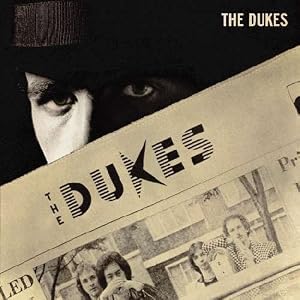
THE DUKES – Self Titled – (Warner Brothers) – 1979

Dukes
I had no idea who this band were though I thought they were American. As it turns out they are English. 
 
Unfortunately this is dire regardless which side of the Atlantic they are from.
 
This is a second string supergroup of sorts based around Miller Anderson (vocalist and guitar) and Jimmy McCulloch (guitarist and backing vocalist).
  • Miller Anderson (dob:1945, Scotland) is a UK-based blues guitarist and singer. He has had a solo career but he was also in the Keef Hartley Band, The Spencer Davis Group, Broken Glass, Savoy Brown, T.Rex, Chicken Shack,The British Blues Quintet and many others.
  • Jimmy McCulloch (dob:1953 Scotland)  was guitarist variously in the Jaygars (at age 11), Thunderclap Newman ( which he joined at age 15) in 1969, blues rock band Stone the Crows (1972 -73), Paul McCartney's Wings (1974-77),White Line ( a side line), the reformed Small Faces (1977), Wild Horses (1977), and finally the Dukes (1978-79). He died in 1979 at the age of 26.
  • Ronnie Leahy (keyboards) had been in Stone the Crows and Nazareth.
  • Charlie Tumahai (bass) had been in Be Bop Deluxe.
There is no drummer listed as part of the band but all of the tracks bar one have Stuart Elliot (ex Cockney Rebel) on drums. The remaining track (Hearts in Trouble) has Barry De Souza plying drums (a session muso who has played with everyone: Spinning Wheel, Curved Air, Rick Wakeman, Shawn Phillips, David Essex,Smith & D´Abo etc etc)
 
Despite the blues and rock pedigree this is pure late 70s MOR adult rock cheese firmly aimed at the American market and an eye on the $$$.
 
The main problem though is there is no cohesive sound but a ragbag of 70s styles. And all slick ones at that.  Both Anderson and McCulloch were well known guitarists with Anderson inspired more by the blues and McCulloch by rock pop. Both those styles are evident though in an extremely watered down form. The musical nods to Supertramp, 10CC and obviously Wings, whilst trying to keep up with things happening in 1979, is clearly a stab at fame and money for the participants. It's sad really. The album is so contrived that even without the passing of McCulloch I would be surprised if there was a follow up. 
 
To make matters worse the single "Heartbreaker" doesnt sound like the rest of the album … normally this does not make the punters happy.
 
Tracks (best in italics)
  • Hearts in Trouble – "The streets are like rivers, as they burn through the night" … in other circumstances this may be a compelling lyric. Thats the trouble with music … it's a package of voice, music, lyric, and personality which are all linked to time and place and if you take out any of those elements you can fail dismally. I could see Johnny Cash singing this faux Springsteen lyric on a country song but here when it's tied musically to late 70s MOR rock, it merely sounds stupid.
  • Leaving It All Behind – groan.
  • All in a Game – double groan … colour by numbers … the trouble is the picture wasn't worth colouring in in the first place.
  • Billy Niles – an emphasis on keyboards and a feel of some Steve Harley Cockney Rebel crossed with a new wave act (quirky keyboards),and maybe a little bit of German era Mitch Ryder.
  • Crazy Fool – the obligatory romantic power ballad. Fuck, listening to this is hard work …
  • Who's Gonna Tell You – I've just listened to this and I have already forgotten it.
  • Time on Your Side – please make it end.
  • I'll Try to Help – the side 2 power ballad.
  • Heartbreaker – the only track to feature lead vocals by McCulloch I believe. The only straight rock song on the album … such as it is.
And …

It's a pity because with the pedigree of the musicians this should be a lot better than it is … sell, sell, sell.

Chart Action
 
nuttin no where
 
Sounds
 
Hearts in Trouble
 
Billy Niles 
attached
 
Heartbreaker 
Others
McCulloch
 
MIller
 
Miller with Ian Hunter in "At Last the 1958 Rock and Roll Show " (Thats the name of the band!)
 
Review
–
 
Bio
 
 
Website
–
 
Trivia
  • WIKIPEDIA: McCulloch died from a heroin overdose in 1979 in his flat in Maida Vale, North West London. He was 26. Previously, he had composed the anti-drug song, "Medicine Jar", on the Wings album Venus and Mars, and the similar "Wino Junko", on "Wings at the Speed of Sound".
  • cover art by the 70s influential Hipgnosis group – they did many album covers … http://en.wikipedia.org/wiki/Hipgnosis
(originally posted: 03/10/2010)

what Frank is listening to #177 – THE DUKES – Self Titled – (Warner Brothers) – 1979

Posted in Rock & Pop | Tagged | Leave a comment

THE FREE DESIGN – Kites Are Fun – (Project 3) – 1967

kite.jpg image by nicjt321
Okay, I've always been a fan of sunshine pop and I've always been a fan of The Stooges, MC5, Detroit Rock, rockabilly and garage rock. Do music genres have to be mutually exclusive to ones musical palette?
 
No … you need something tranquil to sooth the angry beast. It also helps you think "outside the box" …
 
I have discussed sunshine pop before, for discussions on sunshine pop see: what Frank is listening to #111, what Frank is listening to #148

Like a lot of east coast sunshine pop acts though, there are substantial elements of baroque pop in the music. For discussions on baroque pop: what Frank is listening to #94
 
Sunshine pop by its nature is quite light and easy on the ear. On a spectrum of sunshine pop you would get the Beach Boys or the Left Banke with their melodies and harmonies tempered by a jagged edge in lyric, or the use of rock instruments in a rock setting on one side whilst on the other end there would be MOR which encompasses The Free Design, The Association and some Nancy Sinatra. There's nothing wrong with Nancy (she's glorious) or The Association but it's a slippery slope from there to The Carpenters.
 
Sunshine Pop is not the music you are going to put on to charge yourself up before a Saturday night on the town … the boys are not back in town, one hand loose wont keep you satisfied and you aint gonna get Dixie fried.
 
It's not drinking or rooting music.
 
But as I sit here on a Sunday morning  I find this is perfect Sunday morning music. Maybe the "celestial harmonies" and innocent clean cut lyrics remind me I should be going to mass (I'll go this afternoon … the young, hand clapping Catholics at the afternoon mass sing and harmonise in a manner not dissimilar to this anyway).
 
If you haven't heard of the Free Design don't feel bad as they are obscure though legendary among sunshine pop aficionados who have long held them in high esteem:
 
Allmusic: "The commercial failure of the Free Design remains one of the most baffling mysteries in the annals of pop music — with their exquisitely celestial harmonies, lighter-than-air melodies, and blissful arrangements, the group's records were on par with the work of superstar contemporaries like the Beach Boys, the Association, and the Cowsills, yet none of their singles even cracked the Hot 100".
 
The band formed in the middle 60s …..by way of background, from wikipedia: "The members were all members of the Dedrick family: Chris Dedrick (who wrote most of the songs), sister Sandy and brother Bruce were the original lineup. Younger sister Ellen joined the group later, and youngest sister Stefanie joined near the end of their initial career. Their father, Art, was a trombonist and music arranger. Their uncle Rusty Dedrick was a jazz trumpeter with Claude Thornhill and Red Norvo. They formed the band while living in New York City. Chris has said the group was influenced by vocal groups like The Hi-Los (who performed in Greenwich Village frequently at the time) along with Peter, Paul and Mary and the counterpoint experiments of Benjamin Britten. Their trademark sound involved complex harmonies, jazz-like chord progressions, and off-beat time signatures, all products of Chris's classical training".
 
This is their first album for the Project 3 Audiophile label run by Enoch Light who produced this album (the label put out a lot of "stereo" lounge music especially percussion and Tony Mottola guitar albums …) and he is the perfect producer for them as a result of his slightly avant guard classical bent.
 
Unfortunately Project 3 being an independent were never going to be in a position to market or exploit the Free Design to the wider public.
 
Cest La Vie.
 
Apparently studio musicians (including guitarist legend Tony Mottola) are used on this album (and I believe most of the bands albums) which means the vocals, writing, arranging and conducting is done by the band, specifically Chris Dedrick (age 20!).
 
The groups covers indicate their influences but listening to this I can hear, apart from the sunshine and baroque pop, religious, classical, folk pop, choral group, vocal pop, easy listening, lounge, AM pop, soundtrack, and MOR schmaltz music. Any number of these genres isolated and in the wrong hands could well be mind numbing but here the music is sublimely intrusive … it literally works it's way into your head and floats around your brain.
 
The closest musical reference is some sort of a mix of Paul Simon and Brian Wilson with maybe more of the Wilson tempo. But whereas Brian took his vocal harmonies from doo wop and pop vocal groups the Free Design take their vocals from jazz vocal groups.
 
This is good.
 
It may all seem perfectly frothy MOR but it is in reality quite subversive.
 
Tracks (best in italics)
  • Kites Are Fun – (Chris Dedrick) – what a way to start an album … amazing … the lyric is genius … Brian Wilson eat your heart out …
            I like flying
            Flying kites, flying kites, flying kites
            Kites are fun, kites are fun, kites are fun
 
            See my kite, it's fun
            See my kite, it's green and white
            Laughing in its distant flight
            All that's between us is a little yellow string
            But we like each other more than anything
            And we run along together through the field behind my house
            And the little drops of rain caress our face and wash my blouse
            And we'd like to be a zillion miles away from everyone
            Cause Mom and Dad and Uncle Bill don't realise
  • Make the Madness Stop – (Chris Dedrick) – this has more beat and irresistible …
            Whoa, whoa, blow your mind but not completely
            make the madness stop
            Deplete we must the store of hate immense and men grouping groping nonsense
  • When Love is Young – (Sandy Dedrick and Stephanie Dedrick) – "a slippery slope to the Carpenters" … but this is still at the top of the hill …
  • The Proper Ornaments–  (Chris Dedrick) – vocals with trumpets and cello … wow. Pure pop but if you listen to the lyrics – totally subversive …
            Ba Ba Ba…
            Ornaments of Life, ornaments of life
            There’s your brand new car, sir, here’s your hat and gloves
            There’s your pretty wife, sir, whom you almost love
 
            There’s your color TV set and your impressive pad
            There’s your little baby girl you’re almost glad you had
            Such a pretty dress, miss, such a graceful walk
            Bubbling femininity, authoritative talk
            There’s your man he’s prominent; treats you like a queen
            All your little secrets kept, your reputations clean
            The proper ornaments of life.
 
            Gotta have status
            have a paid vacation,
            have an intellectual education
            ornaments of life
            proper ornaments of life
  • My Brother Woody – (Chris Dedrick) – a little weaker than the other tracks though still up there.
  • 59th Street Bridge Song – (Paul Simon) – a song popular with MOR instrumental albums here the songs light, breezy lyrics are take to the extreme.
  • Don't Turn Away – (Chris Dedrick) – Tony Mottola is on guitar (as is Jay Berliner) but there is some beautiful French Horn … romantic songs rarely get more romantic than this …
  • Umbrellas – (Bruce Dedrick) – beautiful harmonies.
  • Michelle – (Lennon/McCartney) – The Beatles song in name only … this is a total de-construction … like a 60s barber shop quartet (a cooler version of the B Sharps ?) … amazing.
  • Never Tell the World – (Sandy Dedrick and Chris Dedrick) – their vocal freak out … and reminiscent (as quite a bit of this album is) of Les Double Six of Paris.
  • A Man and a Woman – (Francis Lai) – the song of the film of the same name – another popular song with the MOR instrumentalists of the time … and another de-deconstruction.
  • Stay Another Season – (Chris Dedrick) – reminiscent of the 5th Dimension and their "Up Up and Away" (as quite a bit of this is, also) … which came out in 1967 also. I don't know which came first …
And …

I'm keeping this and looking for more….but it's not cheap. 

See you in church.

Chart Action
 
zip everywhere
 
Sounds
 
Kites Are Fun
and attached
 
Make the Madness Stop
 
The Proper Ornaments
attached
 
My Brother Woody
 
Don't Turn Away
 
Michelle
attached
 
Never Tell the World
 
Review
 
 
Bio
 
 
video doco:
 
Website
 
 
Trivia
  • Apparently The Free Design later influenced the bands Stereolab, Cornelius, Pizzicato Five, Beck, Super Furry Animals, Belle & Sebastian, Danger Mouse and The High Llamas. Again I implore you to by pass these marginal or otherwise risible crud acts and go to the source for inspiration.
Picture
 
Stereolab were never this cool … and I'm not sure if these guys are cool …
Free Deisgn
 

(originally posted: 26/09/2010)


Posted in Sunshine Pop and Baroque | Tagged | Leave a comment

TEX RITTER – Songs from the Western Screen – (Capitol) – 1958

This album was always going to be a winner for me as it merges some things I love, namely, cowboy songs and cowboy movies.
 
Tex (1905 -1973) was one of the great exponents of the Hollywood cowboy song. If anyone was qualified to sing it he was. He was born in Texas, and was a Hollywood B-western cowboy star for a while in the 1930s and 1940s.
 
His bio makes for interesting reading for those with more than a passing interest in the western films of Hollywood (see Bio links below).
 
He also had a substantial career as a country music hit maker. He touched on western swing and straight country but it his cowboy songs and ballads which he is most known for.
 
Cowboy ballads lend themselves to a bit of "Hollywood" and the genre is inexorably tied up with and most popularised by Hollywood westerns.
 
Allmusic has as good a definition as you could wish for: "Cowboy Music was originally handed down from the genuine Old West articles, its repertoire consisting of songs sung on the open range to pass the time on cattle drives. This tradition continued to inform country & western music long after its attendant lifestyle had all but disappeared, since romanticized cowboy mythology still held a fascination for many. That fascination resulted in the production of innumerable Western and cowboy films, and with those films came a revival of interest in cowboy music. Actually, it wasn't so much a revival as a hunger for more mythology — singer/actors like Roy Rogers and Gene Autry relied far more on new compositions which evoked similar themes of cowboy life. The performances and production of cowboy songs depend largely on the context — while movie songs were usually recorded with modern soundtrack-style orchestras, old-time groups like the Sons of the Pioneers relied on traditional, unadorned acoustic instruments".
 
Tex's songs / versions are not usually the lonesome cowboy ballads of "The Sons of the Pioneers" or others (well not from what I have heard thus far – I haven't heard much of his 30s or 40s work though). They have been tarted up a little and made more "Hollywood" but they are still evocative of time and place and usually have a narrative and moral point that sucks you in.
 
Tex's voice is straight ahead and not as expressive as that of Bob Nolan, Gene Autry or Roy Rodgers  but he has the requisite amount of drama the songs require (no doubt something left over from his Hollywood acting days) and his voice is commanding. He is like a country version of Burl Ives.
 
If you accept the observations above then you will enjoy Tex .. especially after a few beers.
 
This is Tex's first album after a long career of 78s and singles.
 
This is a collection of film theme songs.
 
Some of these songs were recorded for the films by Tex though I suspect the versions here are not the film versions but specifically re-recorded here. But then again there are different orchestras and conductors listed so who knows. You can google if you feel compelled.
 
If you have seen the film then the versions only help to relive the film in your minds eye but even without having seen the film the songs are pretty "filmic".
 
If you havent seen at least half the films below ... then shame on you.
 
Tracks (best in italics)
  • The Bandit – Carr, Do Nascimento, Turner – from the 1953 Brazilian 1953 "O'Cangaceiro" ("cangaceiros" were poor peasants who roamed the north-eastern deserts of Brazil in the first decades of the 20th Century) which is a Brazilian western inspired by American westerns. I have never seen it but have always wanted to … if anyone has a copy … the song fits in perfectly with the other cowboy songs.
  • Wichita – Salter, Washington – from the 1955 film "Wichita" beautifully directed by Jacques Tourneur and starring Joel McCrea. This is a Tex film theme original, and co-writer Ned Washington wrote just about every second film song. http://en.wikipedia.org/wiki/Ned_Washington
  • I Leaned on a Man – Shanklin, Rosenman – from the 1957 film "The Big Land" starring Alan Ladd and Edmond O'Brien. The song has the feel of "Sixteen Tons" … and much like that song it is quite downbeat.
  • Brave Man – Evans, Livingston – from the 1954 western musical film "Red Garters" starring Rosemary Clooney and Guy Mitchell. Bob Livingston was a founding member of the The Sons of the Pioneers. Evans and Livingston wrote many songs http://en.wikipedia.org/wiki/Jay_Livingston  and http://en.wikipedia.org/wiki/Ray_Evans. In feel not dissimilar from Ritter's High Noon … though with a familiar familial backing vocal chorus.
  • The Searchers (Ride Away) – Jones – from the 1956 film "The Searchers" (possibly the greatest film ever made regardless of genre) … the theme was originally done by The Sons of the Pioneers and written by a friend of director John Ford. http://en.wikipedia.org/wiki/Stan_Jones_(songwriter) . Not as otherworldly as the "Sons" version but still quite powerful. The song clearly articulates the central figure in the film, the tortured Ethan Edwards. 
  • Last Frontier – Lee, Washington – from the 1955 film "The  Last Frontier" by the masterful Anthony Mann and starring Victor Mature and Guy Madison. I think Rusty Draper did the film version – you google it.
  • Remember the Alamo – Bowers – from the 1956 short "Down Liberty Road" which Tex appears in. I've not seen this film. A Tex film theme original – http://en.wikipedia.org/wiki/Remember_the_Alamo_(song). A story song which gives the orthodox view of the siege of the Alamo. Still stirring in its own way. Though for my money "Green Leaves of Summer" from John Wayne's 1960 film, The Alamo, is the best of the Alamo songs. "Remember the Alamo" has been memorably covered by Donovan, Johnny Cash and others though by favorite version is by cowpunk-ers and ex-Dills, "Cowboy Nation".
  • High Noon (Do Not Forsake Me) – Tiomkin, Washington – from the good but overrated 1952 film "High Noon". This is Tex's theme song to the film and probably the most well known western film song. That and "The Man Who Shot Liberty Valance" … which actually wasn't in the film. Tiomkin is a legend among film composers for his ballsy, memorable soundtracks, especially the westerns. http://en.wikipedia.org/wiki/Dimitri_Tiomkin
  • Marshall's Daughter – Jones, Murray- from the 1953 film "The Marshall's Daughter" which I haven't seen. I believe Tex does this theme song to the film. A lament by the father of a beautiful girl out west.
  • Prairie Home – George, Smith – from the famous Disney documentary from 1954, "The Vanishing Prairie" – I haven't seen this film either. A fairly standard clip clopping cowboy song.
  • Trooper Hook – Fried, Fielding – from the underrated 1957 film "Trooper Hook" starring Joel McCrea and Barbara Stanwyck– this is Tex's theme song to the film. Another song that narrates the films plotline. The song however emphasises the the stirring elements of the cavalryman, Trooper Hook, whereas the film is a low key study of racism and miscegenation.
And …
 
I'm keeping this.
 
Chart Action
 
US
—
 
Note: "High Noon" in the film version was a #1 hit in1952.
 
England
—
 
Sounds
 
Wichita
 
I Leaned on a Man
and attached
 
Searchers
and attached
Remember the Alamo
and attached

High Noon (Do Not Forsake Me)  

live
 
Bio
 
 
Film Career
 
Trivia
  • His son is John Ritter of "Three's Company" fame.
(originally posted: 19/09/2010)
Posted in Country, Film Songs | Tagged | Leave a comment

THE BABYS – Broken Heart – (Chrysalis) – 1977

 
I only knew The Babys from the single "Isn't it Time" which is still a magnificent piece of AOR pop released on the cusp of punk and new wave.
 
The Babys, critically, are usually referred to as one of the the great white hopes of the 70s to fend off the new wave invasion … their pop rock is BIG … dinosaur big … with smooth horns, strings, backing vocals, meaningful lyrics, overwrought emotion. They were part of a larger group of AOR pop rock stalwarts like REO Speedwagon, Loverboy, Boston, Journey, Foreigner, Heart, etc etc.
 
The only distinguishing features are they are (surprisingly) English whereas the rest the aforementioned are American or Canadian, their powerpop influences were more obvious, and they had some new wave image trappings – despite the hairstyles.
 
allmusic, "The Babys generated extensive hype upon formation in 1976 as one of mainstream pop/rock's brightest hopes for the future. While competent, their music never broke away from its Raspberries-meets-AOR style and developed its own distinctive sound. The group consisted of vocalist/bassist John Waite, guitarist Wally Stocker, former Spontaneous Combustion and Strider drummer Tony Brock, and keyboardist/guitarist Mike Corby, who was replaced by Jonathan Cain in 1978; bassist Ricky Phillips also joined later on. Overshadowed by the punk and new wave movement in their native U.K., the band concentrated on the American market and did score two Top 20 singles with "Isn't It Time" and "Every Time I Think of You." By 1981, the Babys' future didn't look so bright anymore and the group disbanded, with Stocker joining Air Supply's road band. Waite went solo and finally broke through on the charts in 1984 with the number one smash "Missing You," while Cain joined Journey; the two later reunited in the AOR supergroup Bad English".
 
The whole sound, despite some good tunes (doesn't every genre have it's fair share of good tunes?), reeks of slick big label production. The music is as airbrushed as the the record sleeve. It does not offend (well if doesn't offend me) and it is singable. Should music be more? Some would argue yes but a bunch of pissed secretaries on a Friday night looking to throw their legs up in the air in a V probably wouldn't. I think there is room for this (the music that is ..err well maybe …).
 
More importantly, the music is quite catchy.
 
Reference is usually made to The Raspberries when referring to the The Babys and though I can see that I can also hear a lot of Nils Lofgren's band Grin (the better band by a country mile) who play pop rock songs with grit. But The Babys, like a lot of their ilk, have diluted that sound and taken away the rough edges, and any impulse to "rock out" is a controlled one. They are also however that much more pop-ier and sweeter than their genre partners. English bands have always had a tendency to popi-fy music with a emphasis on the saccharine side of pop. Put any American band up against any English band in any genre (punk, garage, R&B, hard rock, traditional, soul, rock n roll) and with a few exceptions the rule is usually proved. Is this a bad thing – no. Though to make a tune simplistically popp-y is the easy way out and it's a slippery slope from there.
 
The emphasis here is on melody and pop hooks without any asides, quirkiness or dirt. Is this bad? Maybe not but a little of this music goes a long way.
 
But despite my reservations the album is quite catchy.
 
If the Beatles had lasted into the 70s and McCartney ran the show to the exclusion of the others I suspect they would have sounded like this. Well for a little while at least.
 
Image wise The Babys had a little new wave sheen to their act mainly because of Waite's Ziggy Stardust like look, if not music. But they were too conventional to be adopted by the new wave even though there were many new wave acts that did look back to McCartney and the Beatles for inspiration.
 
The reality is the new wave changed everything but AOR pop rock bands never lost their dominance and the mainstream 80s were dominated by bands who had picked up this sound or had incorporated the blandest of new wave stylings into their sound and had hits. As I have said before the 80s, thus far, were probably the worst decade for mainstream music. In any event the era proved that when music went to the masses the masses flocked to the middle like lemmings and then waited like Pavlov's dog.
 
But then again … the Babys do have some good songs, and, err, they are quite catchy.
 
Tracks (best in italics)
  • Wrong or Right – very Grin like – maybe it's the tone and pitch of Waites voice that sounds like Nils Lofgren to me.
  • Give Me Your Love – hmmm very Grin like again … voice and music … but a lot slicker.
  • Isn't It Time – a great tune … and in mood a little bit like "McCartney's "Live and Let Die" … superb pop with a great tinkly piano, backing vocals and horns … probably the Baby's finest moment. I even have the 45.
  • And If You Could See Me Fly – a power ballad and not bad at that.
  • The Golden Mile – feels like a 20 minute mile … though there are some Paul McCartney like symphonic excess.
  • Broken Heart – hmmm … a little like Pat Benetar doing power pop.
  • I'm Falling – another power ballad.
  • Rescue Me – slow, guitar crunching ballad …eaghh.
  • Silver Dreams –  the gentle ballad.
  • A Piece of the Action – overly dramatic, portentous and silly power ballad. But I like it.
            If you take me there
            You can claim your share
            Of the action
            Oh, for a piece of the action
            Oh, for a slice of the cake
            Oh, for a piece of the action
            Oh, for a slice of the cake
            For a slice of the cake
            Oh, oh, oh………………….
 
And …

I wasn't sure if I would like this album … but it's hard to dislike … have I mentioned it's quite catchy … there are a couple of tracks I'll tape … fuck it I'll keep it … anyone know where I can get some secretaries?

Chart Action
 
US
Singles

Isn't It Time #13, 1977
Silver Dreams #53, 1978
Album
#34, 1977
 
England
Singles
Isn't It Time #45, 1978
Album
failed to chart
Sounds
 
Wrong or Right

Give Me Your Love

Isn't It Time
live – Waite looks cool
attached

And If You Could See Me Fly 

The Golden Mile

Broken Heart

Rescue Me

Silver Dreams
 
Review
 
 
Bio
 
 
Website
 
 
(originally posted: 12/09/2010)

Posted in Rock & Pop | Tagged | Leave a comment

THE BEACH BOYS – Beach Boys’ Party – (Capitol) – 1965

Cats and pigeons …

Warning … generalisations abound. I acknowledge there are always exceptions but for the purpose of this comment, generalisations abound … read on …

The Beach Boys were what they call in the United States a “working band”. Music in America has largely been a job. From Elvis trying to escape his poverty, every other Afro-American jazz musician trying to escape the ghetto and every kid from the Midwest or California trying to escape the mundanity of their surrounds.  If “art”  intersects with the “job” then all that much more better.

Maybe the Americans feel comfortable with rock music. After all they invented rock music (and jazz and country etc) so they have nothing to prove. Subconsciously this must have a affect on the musician. If I was the only white kid on stage at a reggae club in Jamaica I would feel the pressure. No? Maybe this “comfort” as a musician lends itself to treating music as a job. Whereas being “uncomfortable” lends itself to hiding behind “art”?

Maybe “art” cannot be the same as a job. Artists are supposed to make money aren’t they ?

Whether a “job” in music is something specific to the American culture or whether it be the result of subservience to the dominant paradigm in advanced capitalism I leave for the sociologists to work out. I have noticed though that American bands seem less concerned with art and more concerned with entertaining their audience as opposed to their English counterparts. Whether you think the band is entertaining or not depends on your taste in music but American bands always put on a show whereas English bands seem to be playing for themselves. I say here this is a generalisation (I warned you) and examples contrary to what I have said can be found on both sides of the fence.

Putting on a show doesn’t mean star jumps or somersaults, but obviously it can (especially in American rock) but it does mean playing for the audience and giving them their money’s worth. Perhaps the putting on of a show is not about “the love of music” but about this giving the people their money’s worth. And this goes to the heart of America – the classless, egalitarian society (in philosophy not practice) where all people are equal and money is the tool by which commodities and services are exchanged. This is quite different to the class riddled societies of old Europe. Of course I know that America in the “pure form” I have just described doesn’t exist, but I think even the residuals from such beliefs is perhaps what makes American bands more “working bands”.

Working bands of course are not supposed to be “artistic” and perhaps that’s why it seems that English bands are usually elevated to the level of artists whereas American acts aren’t. It is also perhaps why the music intelligentsia usually dismiss American bands for English bands, or at the very least, regional bands for those from NYC, the only place in the USA which creates art apparently. Oddly, amongst music fans, the biggest music snobs,  pretentious turds, vogue-y poseurs and wanking dogs in the US tend to be Anglophiles outside of NYC. Go figure.

Interestingly the musical intelligentsia in rock music did not exist before the 60s as prior to that it was largely a working class and regional music. It was the generation of middle class university kids in the 60s who were not into folk or jazz who elevated rock to an artistic form. And it is an artistic form, but not one based on the pretensions and conceits of the musical intelligentsia but rather something akin to a “folk art” or “popular art”.

Can your music have a message – sure. Can it be “artistic” – whatever that is – sure. But the message is part of the job and not a calling. You still have to eat. I’m not sure if I would trust someone who says they despise money and the comfort it brings.

And this type of popular art only survives through working for money not through government grants, music schools and private patronage. So I suspect if you are a working band you have to … errr … work. You cant sit around and wait for inspiration to bite you.

How else can you explain Elvis turning out one soundtrack after another, later Dylan putting out albums year after year without allowing his songwriting skills to rejuvenate or The Beach Boys putting out an album of covers at a point in their career when they didn’t have to,  and probably shouldn’t have?

And that is this album.


Having said that, in feel, this LP is not greatly different to the successful up-tempo acoustic live albums of Johnny Rivers (“Live at the Whiskey A Go-Go“ from 1964 (#12) and others) or Trini Lopez (Live at PJ.s“ (#2) from 1963 and others) … both very popular, both LA based, and both underrated. I suspect the Beach Boys or at least some music executives were savvy enough to think it may work again. The whole “acoustic live in a club” thing was big in Los Angeles (the underrated Lee Dresser also put out an album – see what Frank is listening to #56 as did Billy Lee Riley and others).

A cynic would say they were all “chasing a buck” and a good argument could be made for that but equally it could be said that these artists looked upon music as their job even though in all their cases art intersected with their work more often than not.

Sorry I’ve been on a roll. The comments here are not fully formed and maybe too verbose for a “what Frank is listening to” comment. For the cultural relevance of rock go read Greil Marcus, Nic Tosches, Dave Marsh, Peter Guralnick, Lester Bangs and others .

This lengthy intro, though, goes someway to my answering the question above  … “How else do you explain The Beach Boys putting out an album of covers at a point in career when they didn’t have to and probably shouldn’t have”

Do we need a Beach Boys bio?

Probably yes

wikipedia: “The Beach Boys are an American rock band, formed in 1961, who gained popularity for their close vocal harmonies and lyrics reflecting a Southern California youth culture of cars, surfing, and romance. Brian Wilson’s growing creative ambitions later transformed them into a more artistically innovative group that earned critical praise and influenced many later musicians…The group was initially composed of singer-musician-composer Brian Wilson, his brothers, Carl and Dennis, their cousin Mike Love, and friend Al Jardine. This core quintet was inducted into the Rock and Roll Hall of Fame Class of 1988…The Beach Boys have often been called “America’s Band”, and Allmusic has stated that “the band’s unerring ability… made them America’s first, best rock band.” The group has had thirty-six U.S. Top 40 hits (the most of any U.S. rock band) and fifty-six Hot 100 hits, including four number-one singles. Rolling Stone magazine listed The Beach Boys as number 12 in the 100 Greatest Artists of All Time. According to Billboard, in terms of singles and album sales, The Beach Boys are the No.-1-selling American band of all time”.

I got into the Beach Boys  in a big way just over ten years ago. Up till then I had a Beach Boys greatest hits LP, “Pet Sounds“ and that’s it whereas I had every Beatles album. The original Beach Boys albums from the 60s were notoriously thin on the ground in record stores and op shops when I was growing up. The late 60s / early 70s albums sold next to nothing (even though they comprise some of their greatest works … “Friends” (1968),”Sunflower” (1970) and “Surfs Up” (1971) are up there with “Pet Sounds”) so obviously they were not going to turn up. The only original albums you came across were a couple of the big selling early surf music ones and some from the late 70s and their commercial resurgence (which weren’t great LPs).

So what happened 10 years ago?

Capitol released the Beach Boys on CD as 2fers and they were cheap. On a whim I got “Friends/20 20” and “Sunflower/Surfs Up”. Unfreaking believable. I was gobsmacked. Something had been hiding in plain sight from me for most of my youth was revealed. I bought all the other 2fers both backwards and forwards and became a Beach Boys convert. Sure there is shit in there but the diamonds weigh heavier on the scale. I note that about the same time as these releases dozens of American indie bands with a late 60s Beach Boys sound sprang up in the States (Benchwood Sparks, Flaming Lips (in their second era), Velvet Crush, The Shins and others). So others,  obviously, were also listening to or buying these 2fers.

I will say here the following …  I now prefer The Beach Boys to the Beatles. Before I hear the usual call of an anti-English bias (which I prefer to call a pro-American acknowledgement) I will say I prefer The Kinks to both the Beatles and the Beach Boys. For those of you out there who skim read the important word here is prefer. I’m not making any statement as to what is better or worth more. 

Oddly, and as an aside,  I think post R&B Ray Davies was lyrically influenced by Brian Wilson. There is a lot of his songwriting dealing with the small and mundane (just like Brian and his co–writers did) as opposed to the big picture writing of Paul and John. John and Paul seem, rather, to be more influenced by the sounds and music of the Beach Boys though not the lyric. On the other hand try googling a link between Ray and Brian and it comes up zip but both these acts are on high rotation at my place and have been for many years and to my ears there is a link in there somewhere.

Where was I? Could I have said everything above in a paragraph? Yes? Fuck. This is my Faulkner stream of consciousness with more grammar, though admittedly poorly used. And fuck … it’s late also.

For a time in the 60s the Beach Boys were the Beatles only rivals in music. Indeed with hindsight it seems pretty clear that up to 1967 The Beatles were playing catch up with The Beach Boys. Every innovation by The Beach Boys was matched within a year by the Beatles. Without The Beach Boys (and Bob Dylan) as influences The Beatles probably would have looked like a more successful version of The Dave Clark Five or The Searchers. This may be heresy to some ears but McCartney and Lennon have said as much. Where The Beatles succeeded and the Beach Boys failed could be a mix of the following Beatles attributes …

The Beatles:

  • managed to secure the musical intelligentsia in 1966/1967 (hey they are English) just at the time The Beach Boys were imploding emotionally – Brian’s “quirkiness”, “constant touring” etc were taking their toll;
  • were not as quirky or ill disciplined as the Beach Boys (more specifically Brian);
  • did not stop having hits,
  • were savvy with what sounds were around;
  • had a record label (the same mother company as the Beach Boys) that treated them better … perhaps because they were in England and working with a “respected” composer/producer like George Martin;
  • did not put out distinctly individual material at inopportune moments.


The Beach Boys had just released two transitional and seminal albums in early 1965 (“Today” and “Summer Days (and Summer Nights)”) and had been writing their own material (mainly) since their first album in 1962. To do an album of late-50s early-60s vocal group hits as well as recent hits done in a late-50s vocal group style is just too post modern.

There is quirky and then there is going out on a limb …

By all counts the critics hated this attempted career suicide. But the album was a hit in both the US and England. No doubt such crass commercial success was another slap in the face of “serious” music listeners and the critics.

No one could knock back the genius that followed in “Pet Sounds” but after that the Beach Boys (especially Brian’s) quirkiness was held against them and they were successfully marginalised by the serious rock establishment. You can‘t have serious rock artists with something to say doing old 50s songs … well not till John Lennon did it later. Then it was OK.

Why do it?

“Party” was their eleventh album in three years. Did I mention they are a “working band”?  In rock only Elvis could match this output.

It seems that their record label were pestering them for a release. Brian needed time to work on what became “Pet Sounds” so this album was thought up and released.

Allmusic, “Packaged as if it had been recorded at an actual party, it was in fact recorded in the studio, with friends and romantic partners adding sounds and vocals to create an informal atmosphere. With the exception of a bass guitar, all the instruments were acoustic; the acoustic guitar-and-bongo arrangements, in fact, give this a hootenanny campfire feel”.

Brian Wilson produced this and all the trademark Beach Boys traits are apparent whilst the use of acoustic instruments accentuates the harmonies. And, when you think of it as a full acoustic rock album then you realise it was quite novel in 1965. If it hadn’t been done in the studio it may have amounted to the first “unplugged” (As it was the first was probably Elvis’ sit down acoustic live shows as included (in part) in the “68 Comeback Special” album).

In any event this is pure pop rock …

Tracks (best in italics)

  • Hully Gully – Fred Smith/Cliff Goldsmith – vocals: Mike Love – the Boys probably know the Olympics version from 1960 (#72) given they were a doo wop vocal group of the kind directly influential on the Beach Boys.
  • I Should Have Known Better – John Lennon/Paul McCartney – vocals: Carl Wilson/Al Jardine – the original Beatles song from 1964 (#53) is a killer of course (their earlier work is more fun than most of their later work) but the Beach Boys harmonies really bring out the pop in the melody and the pop in the melody really brings out the cleverness in the lyric (post comment note – I can’t get the tune out of my head and I keep humming it in the Beach Boys way).
  • Tell Me Why – Lennon/McCartney – vocals: Jardine/C. Wilson – another excellent early Beatles track (1964) – ditto to the above and very much suited to the Beach Boys given that John here was trying to sound like a New York girl group.
  • Papa-Oom-Mow-Mow – Carl White/Al Frazier/Sonny Harris/Turner Wilson Jr. – vocals: Brian Wilson/Love – the excellent doo wop / R&B song by The Rivingtons from 1962 (#48)given the fun treatment …
  • Mountain of Love – Harold Dorman – vocals:Love – the Harold Dorman track from 1960 (#21) … Johnny Rivers had a #7 hit with it in 1964.
  • You’ve Got to Hide Your Love Away – Lennon/McCartney – vocals: Dennis Wilson – the third Beatles track (1965) and to my taste the weakest of the three here ( John was trying to do Dylan on the original).
  • Devoted to You – Boudleaux Bryant – vocals: Love/B. Wilson -the song most associated with The Everly Brothers from 1958 and a #10 hit for them. Romantic mush it is … but hey, it’s pretty.
  • Alley Oop – Dallas Frazier – vocals: Mike Love -The Hollywood Argyles has a #1 US hit with this in 1960.
  • There’s No Other (Like My Baby) – Phil Spector/Leroy Bates – vocals:  B. Wilson – A hit for the Crystals (#20 1961).
  • Medley: I Get Around/Little Deuce Coupe – Brian Wilson/Mike Love/Roger Christian – vocals: Love/Bruce Johnston – The Beach Boys do themselves.
  • The Times They Are a-Changin’ – Bob Dylan – vocals:  Al Jardine – an anomaly here – Dylan’s writing was certainly influential but his “sound” is not what they were after. I suspect either the Peter Paul and Mary or Simon and Garfunkel versions both from 1964 might have had a bearing on their cover …
  • Barbara Ann – Fred Fassert – vocals: B. Wilson/Dean Torrence – The Regents had a #13 with this in 1961. Dean Torrence from Jan & Dean actually guests on this. A most catchy song.


And …


Is this album ill-conceived – yes. This is career credibility suicide

But it’s still great and if you don’t believe me, then get it, make yourself a pina colada (make sure you add the little umbrella), put the LP on, sit down and get with the groove.

Most importantly, though, this LP gave Brian time to work on his masterpiece “Pet Sounds”.

So, this is a better than good album but it certainly did not win the group any friends with the critics or tastemakers. “Pet Sounds” was considered to be an aberration and for the rest of their career they were marginalised as a “serious” act worthy of critical “respect”. The Beatles did not make a wrong step and broke up at the right time. Their dominance was accordingly assured and the Beach Boys were relegated to a golden oldies surf band for a long time.

I like this album and I’m keeping it … ( and yes I had it on CD 2fer with the equally ill-conceived “Stack-O-Tracks”, which is up there with Elvis’ all talking album).

If you aren’t a Beach Boys fan don’t start with this obviously. 

Chart Action

USA
Album – #6 1966
Singles
Barbara Ann #6 1966
England
Album – #3 1966
Singles
Barbara Ann #3 1966
Sounds
Hully Gully
I Should Have Known Better 
and attached
Tell Me Why
and attached
Papa-Oom-Mow-Mow 
and attached
Devoted to You 
Alley Oop 
There’s No Other (Like My Baby) 
Medley: I Get Around/Little Deuce Coupe 
The Times They Are A-Changin’ 
Barbara Ann 
The Inspirations
Hully Gully
I Should Have Known Better 
Tell Me Why
Papa-Oom-Mow-Mow 
Mountain of Love 
You’ve Got to Hide Your Love Away 
Devoted to You 
Alley Oop 
There’s No Other (Like My Baby) 
Medley: I Get Around/Little Deuce Coupe 
The Times They Are A-Changin’ 
Barbara Ann 
Review
Bio
Note
  • I am not trying to rewrite history and the Beatles position in history is assured. If anything else, apart from the comments, should be taken away from this increasingly long essay, is that the Beatles, like Elvis, Dylan and others, did not exist in vacuums and did take influence and inspiration from others. 
(originally posted: 05/09/2010)
Posted in Garage, Surf and Frat | Tagged | Leave a comment

GARY LEWIS & THE PLAYBOYS – (You Don’t Have to) Paint me a Picture – (Liberty) – 1967

This album is out of step with 1967 musically. Even by Gary Lewis standards this album is regressive. That doesn't mean it's bad, at least not to my ears. It's just a little samey with none of the highs on his earlier work being hit. But, the album did have three Top 20 singles … shows you how much I know.
 
The summer of love was afoot but many Americans did not indulge and that is what we forget in the here and now. We tend to look at that year, 1967, through a prism created by Hollywood (or ad men), and that never existed in the mainstream. Middle America (and middle anywhere) is very large and looks like a parabolic curve, and the middle weren't all waiting for the great musical leap forward.
 
Having said that the album tanked out at #79 which leads me to believe either the singles were released before the album and then included with filler or Lewis was considered a "singles act" rather than an album act. Take your pick but the latter seems quite possible.
 
"(You Don't have to) Paint Me a Picture" did serve as a transitional album between Lewis straight 60s pop and his undervalued sunshine pop that followed.
 
For background on Lewis refer to any number of comments I've made on Lewis albums in the past.
 
Some of the tracks are arranged by Leon Russell (a Lewis regular) and Glen D. Hardin. Glen Hardin is a bit of a legend in Elvisworld as he was Elvis' piano player on the road and in the studio in the 70s in the "the T.C.B. Band". He's also played with just about everyone else also.
 
Tracks (best in italics)
  • My Heart's Symphony – (Glen Hardin) – Big lush pop, like a square solo version of the Beach Boys … still it's pleasant.
  • Barefootin' – (R.Parker) – this one comes across like an outtake to a beach movie … I like beach movies though …
  • Down on the Sloop John B – (Arr & Adpt Lewis-Russell-Garrett) – the trad song which was a hit for the Beach Boys in 1966. Nothing new added
  • Tina (I Held you in My Arms) – (Lewis-Curtis-Russell-Garrett) – filler but strangely memorable. A newie but one that channels Bobby Vinton circa 1962.
  • String Along – (J.Duncan-B.Doyle) – Ricky Nelson had a #25 in 1963 with this and Fabian had a #39 in 1960. Nothing new here but pleasant and totally retro.
  • (You Don't Have to) Paint Me a Picture – (Tillison-Russell-Garrett) – there is a carnival feel to this  … but like the Brisbane Ekka you've seen it all before and it's a bit old and tired …
  • Where Will the Words Come From – (S.Curtis-G.Hardin) – sunshine pop – very much in The Association style  and quite 1967 contemporary. Written by Glen Hardin and his former Crickets band mate Sonny Curtis (Hardin was in the Crickets post Buddy Holly).
  • You're Sixteen – (B.Sherman-D.Sherman) – A #8 for Johnny Burnette in 1960. (Ringo Starr had a #1 in 1974 with it) .
  • When Summer Is Gone – (S.Curtis) – a very California theme if there ever was one … perfect for 1964.
  • Linda Lu– (R.Sharpe) – Ray Sharpe had a #46 in 1959 with this great track. Probably the best cover on the album – the guitars are a little dirtier with a touch of fuzz …
  • Looking for the Stars – (Price-Hardin-Lewis-Garrett-Russell) – it was the summer of love and California was awash with drugs … some of it must have ended up with Lewis. This is a spoken track with muzak backing and has Lewis in Hollywood as the narrator wanting to meet some big stars before being woken and told he has to go on stage … the ultimate filler song or the result of a freaking big night out. I don't know if Gary is doing the impersonations but I would think he is as I recall seeing him do impersonations somewhere.
  • Wild Thing – ( C.Taylor) – the big #1 from The Troggs in 1966 written by Chip Taylor. Lewis' version is different. It sounds somewhere between the Wild Ones original from 1965 and the more well known Troggs version.
And …
 
Not the best Lewis but OK – for completeness I'm keeping it .
 
Chart Action
 
US
Singles

"My Heart's Symphony" (#13)
"(You Don't Have To) Paint Me A Picture" (#15)
"Where Will The Words Come From" (#21)
Album
#79
 
England
zip
Sounds
 
 
Down on the Sloop John B 

Tina    (I Held you in My Arms)

String Along

(You Don't Have to) Paint Me a Picture 

Where Will the Words Come From

You're Sixteen 

When Summer Is Gone 

Linda Lu
attached
Wild Thing
attached
 
Others
Beatles
Take Care of My Baby
 
Review
 
 
Bio


Website
 
 
Other Comments
 
what is Frank Listening to #22
what is Frank Listening to #72
what is Frank Listening to #88
what is Frank Listening to #96
what is Frank Listening to #108

what is Frank Listening to #131
what is Frank Listening to #134
what is Frank Listening to #148
what is Frank Listening to #162
 
(originally posted: 29/08/2010)

Posted in Pop Rock | Tagged | Leave a comment

JOHNNY CASH – Gone Girl – (Columbia) – 1978

This is one of the few Johnny Cash albums I don't have. It comes from the "forgotten" period of Cash. That is the period between his commercial peak in the early 70s and when he was discovered by Generation X as a result of the "American Recordings" recorded by Rick Rubin in the late 1990s. There are some 20 albums in those wilderness years and I dare say the generations that have recently discovered him will have trouble naming any songs from that period let alone any album titles. In fact it you were allowed to dig into their collections you would find precious little beyond the American Recordings … maybe a live at jail recording, Sun compilation or greatest hits as company.
 
Cash was unfashionable during that period and nothing he did seemed to hault his lack of popularity on the charts. He covered Springsteen, and others, beautifully to no avail, wrote some killer songs with no success, and he even tried a number of styles and sounds, again with no commerical result. Contrary to popular belief it wasn't even Rick Rubin who first stripped him down to his voice and the barest accompaniment. Cash himself had done that (though admittedly Rubin did it best).
 
This is a pity as Cash put out many great songs during his wilderness years.
 
Before I start I should clear up two misconceptions:
  1. That Cash wrote all of his own material;
  2. That everything he did was good
The reality is:
  1. He recorded many songs (around 1000?)  but I would think that well over one half up to two thirds are covers.
  2. He put out a quite a bit of of shit ("shit" is harsh, perhaps "crap" is better).
However:
  1. Cash was one of those singers who was a great interpreter. If he liked the lyric he would take it and sing it and make it sound his own. He never distinguished greatly between his own songs and covers. It was all music and the message was important, not where it came from. I assume he considered himself a storyteller so to that end it matters not if you created the story. This also fits in well with the country folk traditions of passing songs down from generation to generation. This, perhaps, in part explains why there are so many covers on his albums.
  2. Crap there may be on some of his albums but it is always listenable crap. Partly because Cash is the great aforementioned interpreter but partly also, and more so, because his voice is quite comforting. We are all so familiar with Cash's voice (and indeed his message) that when he is on the stereo it's as if an old friend is in the room. And, if you listen to him often enough it's as if a favourite old Uncle was talking to you and giving you advice.
Many people can "sing" but very few singers are interpreters (yeh yeh, I know you are all thinking "here he goes again"). But, to take a lyric and make it your own, or even to give it a different meaning or more meaning than it had before is the sign of a great singer as opposed to a good vocalist. Cash throughout his career could do this – the most obvious examples are his interpretation of Lennon's "In My Life" sung with the right emotional pitch from an old man's perspective (not just because Cash was an old man when he sang it) giving the song a meaning that Lennon never intended. Similarly, Cash's magnificent version of Trent Reznors "Hurt" caused Reznor to give praise and say that Cash had given it meanings that he never intended.
 
And maybe that is why he is so hard to pigeonhole … Country, Americana, Rockabilly, Country Gospel, Singer/Songwriter, Traditional Country, Hymns, Outlaw Country, Contemporary Folk, Cowboy, Christmas Music, Pop-Rock, Country-Pop … are all genres Cash sang in.
 
Cash is one of the best interpreters of song in popular music.
 
By way of bio: Refer to the links below or watch the 2005 film "Walk the Line" which is close enough (though decidedly one note)
 
This album comes firmly from those wilderness years I have mentioned and it is uneven. Perhaps he is not as committed as normal (Cash's voice is more tired or world weary than usual, though still expressive). Why this is the case,  I don't know. Having said that the playing and production is good (a cast of Nashville legends – Larry Butler producing, Bill Justis arranging, Nashville sessionmen playing, The Carter Family and Presley's Jordanaires on backing vocals, guest vocals by daughter Rosanne and legend Jack Clement).
 
Tracks (best in italics)
  • Gone Girl (Jack Clement) – MOR country with a hip lyric from Jack Clement …
  • I Will Rock and Roll With You (Cash) – one of Cash's many homages / remembrances of the early days of rock n roll … this one twisted in with a love song lyric … interesting but not entirely successful.
            They used to call me Rockabilly, all of us ran through
            When Elvis opened up the door with a pup-and-pup-and-boo (sic)
            I didn't ever play much rock and roll cause I got so much country in my soul
            But I'm a different man for lovin' you and I take a shot at what you ask me to
            And baby I will rock and roll with you…..if I have to
 
            Memphis 1955 on Newton Avenue
            Carl and Jerry and Charlie and Roy and Billy Riley too
            A new sun risin' on the way we sing and a world of weirdo's waitin' in the wings
            But I love you and though I'm past 42 there are still a few things yet I didn't do
            And baby I will rock and roll with you…..if I have to
  • The Diplomat (Roger Bowling) – a story song about a retiring train conductor. Very Tom T Hall and very Johnny Cash especially around the refrain.
  • No Expectations (Mick Jagger, Keith Richards) – one of the best Rolling Stones tracks from one of their best albums, Beggars Banquet (1968). (Let it Bleed from 1969  is probably their best, IMHO). Still the Stones faux Americana is a perfect vehicle for Johnny who does it in the traditional boom chikka boom style of his … great fun. And that sounds like The Carter Family in the background.
  • It Comes and Goes (Cash) – a typical song. He has written this one many times, though that's not a bad thing. Johnny's vocal here though is a bit to lackadaisical.
  • It'll Be Her (Billy Ray Reynolds) – a blah country love song …
  • The Gambler (Don Schlitz) – With it's catchy melody and sub-Kristofferson lyrics it is not surprising "The Gambler" was a big cross over hit for Kenny Rogers in 1979 (though it was on his album of the same name from 1978). Did Cash hear it there or did he do it first? It is generally assumed that Johnny's version is the cover. His version certainly isn't like Rogers' version. Bobby Bare however pre–dated both of them with his version on his "Bare" album from 1978. I haven't heard that version so I cannot comment on whether it is similar to Johnny's version. To make matters even more confusing the songs writer, Don Schlitz, had recorded the song in 1978 also (though he did not necessarily do it first … he was a "songwriter" by occupation before becoming a performer). Which is the original and which is the cover I leave to others to find out. Johnny's version is slightly jarring as Rogers version is so well known.
  • Cajun Born (Kermit Goell, Jo-El Sonnier) – an ode to Cajun life and very much like a Doug Kershaw song. 
  • You and Me (Roger Bowling, Larry Butler) – featuring June Carter Cash … despite June's glorious voice … so so.
  • Song for the Life (Rodney Crowell) – Crowell is an amazing country song writer (and singer) who though well known to discerning country audiences has not crossed over to the general public. A pity as his songs are quite complex in their narrative and recall Mickey Newbury in their lyric if not in their quirkiness.
            I don't drink the way that I used to
            Lately that just ain't my style
            And the hard times don't hurt like they once did
            They pass more quickly like when I was wild
 
            And somehow I've learned how to listen
            To a sound like the sun goin' down
            In the magic the mornin' is bringin'
            There's a song for the life I have found
            It keeps my feet on the ground
 
            The mid summer days ain't too heavy
            They just flow like a breeze through my mind
            And nothing appears in a hurry
            To make up for some ole lost time
 
            And somehow I've learned how to listen…
            Somehow I've learned how to listen
…
 
And …

This is not the best Johnny Cash album … no where near it … but there are some pearls and, again, his voice is a pleasure to hear. I'm keeping this (but then I would have to anyway for the sake of the OCD collection).

Chart Action
 
US
Singles

1978   Gone Girl   Country Singles #44
1978   It'll Be Her   Country Singles #89
1979   I Will Rock And Roll With You   Country Singles #21
Album

zip
 
England
Singles
zip
Album
zip

Sounds
 
Gone Girl
 
I Will Rock and Roll With You
live
 
The Diplomat

No Expectations
and attached
The Gambler
 
Song for the Life
attached

Others
The great singer:
In my Way
 
Hurt (also one of the best video clips ever made – watch it on full screen)


Review
 
 
Bio
 
 
Website
 
 
Picture
 
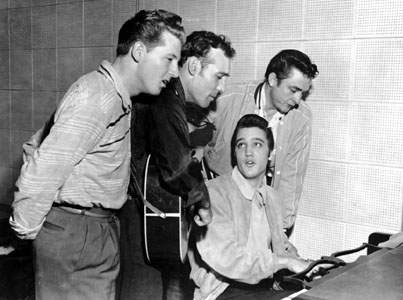
Dec. 4, 1956 four local singers came together in the storefront studio of Sun Records in Memphis and jammed for over an hour.
 
(originally posted:22/08/10)

Posted in Country | Tagged | Leave a comment

ADAM FAITH – I Survive ( Warner Brothers) – 1974

Faith was from that remarkable period of English music after the invasion of American rock but before the rise of the Beatles. New Romantic, baggy, grebo, punk, ska, mod etc have all been discussed and analysed ad nauseam by scholarly English rock writers. Unfortunately, they have avoided that period between 1957 – 1962 when English music was trying to deal with American rock 'n' roll on the airways by rockin' out themselves. By and large they reflected whatever was happening in the US, but then again so did the Beatles – they just repackaged it and gave it a little more verve … count the covers on the first Beatles album if you need proof. In any event the first wave of English rockers were washed away by the success of the Beatles and then subsequently they were kept in their place because most of them did not write their own material. Oddly the second generation of English rock acts from the 60s by–passed these guys altogether whilst praising the first generation Americans. Maybe they could smell a "copy" and looked to the original. Tis a pity they couldn't smell themselves.
 
There was much pre Beatles English rock to treasure … hold on … for fuck sake this is an Adam Faith album from 1974 … I am letting my prejudices take me off on a tangent …
 
This was Adam Faith's comeback of sorts, as he had just appeared in the successful film "That'll be The Day" as a aging rock 'n' roller. In truth he never was off the scene though he may have been out of the public eye – after his early 60s career he had a respectable film career as well as running a music management and production company. This was his first album since 1965.
 
wikipedia: "Terence (Terry) Nelhams-Wright, known as Adam Faith (23 June 1940, East Acton, London – 8 March 2003, Stoke-on-Trent, Staffordshire) was an English singer, actor and financial journalist. Teen idol turned to actor then financial advisor, Faith was one of the most charted acts of the 1960s. He became the first UK artist to lodge his initial seven hits in the Top 5. He was also one of the first UK acts to record original songs regularly".
 
Here he takes the next step – a rock roller trying to shed his past and go contemporary.
 
I always find this fascinating, this desire to be "relevant" and "in touch". It happens to everyone in music and it will happen to Radiohead, Coldplay, Oasis, Gorillaz, Powderfinger, Kings of Leon … no one is exempt from the passing of time. How a musical act confronts changing times and tastes will ultimately be their measure of worth.
 
Do you stand you ground ?
 
Do you adapt to new styles ?
 
Or do you or adapt but bring your old self with you?
 
There was a rock 'n' roll revival going on in the early to mid-70s which Faith could have cashed in on but he didn't. This is a pity as I would have liked him to do something regressive like stick to his guns and do the type of pop rock he was pumping out in the early 60s – this certainly would have kept him in good stead with the rock revivalists and maybe even nascent punkers. Think Shane Fenton aka Alvin Stardust forinstance.
 
But in losing that he has gained a very immediate and pleasing album of introspective 70s songs …
 
Of all the first generation English rockers I think (and I stand to be corrected) perhaps only Faith had faith (groan) in himself to tackle new material and sounds without sounding like a dick.
 
The sound is nothing new and reminds me of a Kinks record from the early-70s, any number of David Essex albums, Bowie around Ziggy Stardust, or Roger Daltrey's first solo LP . And I will say now all these things are good things. The Daltrey comparison is especially not surprising as Faith co-wrote all the tracks here with David Courtney who, with Faith, launched the career of Leo Sayer. And, Sayer wrote most of Daltrey's debut solo album.
 
Faith's voice is cracked and slightly world weary which is nicely counterbalanced against some arrangements that are totally MOR without making you cringe. There is some real saccharine background – strings, piano solos, gentle saxes – but guess what … it works. I suspect half is the fact that the MOR arrangements are turned on their head constantly with little strange things happening throughout, like a mid-period Tom Waits album.
 
Tracks (best in italics)
  • I Survived – a Ritchie Blackmore guitar wank at the start was totally intentional but still sounds duff to me … otherwise the song is pretty good.
  • I Believe in Love – a reviewer compared this to a Ray Davies song – and I would also – maybe not thematically but certainly in phrasing and styling.
  • Honey – some beautiful lyrics … again very Ray Davies circa "Celluloid Heroes".
  • Foreign Lady – a touch of David Essex and the fair – not typical of the other songs on this album but a nice piece of ye olde worlde English whimsy which most English acts of the time had a go at.
  • Change – shit, this could have been on Daltry's first solo album.
  • Maybe – romantic and a little like Bowie around Hunky Dory … to my ears anyway.
  • Never Say Goodbye – conjures up a nice romantic yearning and pleading
  • Goodbye – oom pa pa … Fellini and Nino Rota go to England and do folk.
  • In Your Life –  again a little early Bowie and a little Broadway – but then again wasn't Bowie a little Broadway?
  • Star Song – as good as any song about the trappings of popstar fame that I have heard.
And …

Yes – I think I'll keep this and add it to my small but select batch of English albums.

Chart Action
 
none
 
Sounds
 
I Survived     
live

Honey     

attached


Star Song 

attached
 
Others
 
 
Review
 
 
Bio
 
 
(originally posted: 15/08/2010)
Posted in Rock & Pop, Rockabilly and Rock n Roll, Singer Songwriter | Tagged | Leave a comment

ALBERT HAMMOND – The Free Electric Band – (CBS) – 1973

Anyone who wrote and sang "It Never Rains in Southern California" has to be cut some slack. Surely it's one of the best songs to come out of the California singer-songwriter movement in the early 70s. That it was sung and written by a London born Gibraltarian lad is surprising but also a testament to the seductive charms of California – sun, sand, sex. London at its most swinging-est never really competed and could not soothe the nerves like the  aphrodisiac that is California. Hence the ode to California in Hammond's hit "It Never Rains in Southern California"… get it?
 
That's not to say he doesn't sound English and the music has less singer-songwriter trappings than normal.
 
Also, that's not to say the songs on this album don't have some English concerns, they do, though those concerns are filtered through a boy growing up in Gibraltar and experiencing Spanish culture as well as English culture. After all you cant escape your past. Hammond's concerns, anyway, are less regional and more global. Themes of leaving for a better place (whether it be England or the city generally) are abundant.
 
All the songs are written with fellow Brit Mike Hazlewood (Hazlewood was a prolific writer (see link below)), who also co-wrote all of Hammonds first album with the "It Always Rains In Southern California" hit.
 
Hazlewood and Hammond had been in a band together in the 60s, Family Dogg, with American Steve Rowland, who was a Hollywood brat. Perhaps (probably) he led both Hammond and Hazlewood to LA.
 
Also despite the cover art there are a lot more instruments here than just the singer and the guitar. This album is quite lush in its instrumentation.
 
Hammond, a Gibraltarian (born in London because his family were evacuated there during World War 2 but returning to Gibraltar immediately after) had been banging around the music scene from the early 60s and vacillated between England and Gibraltar, which probably explains his easy relocation to L.A. later. I would think L.A. resembles (climate wise) Gibraltar more than London. Hammond has also released albums (and recorded many of his songs) in both English and Spanish. Again, L.A. with it's sizeable Hispanic population may have appealed to him.
 
A quick google gave me this: "A common misperception of me is … Probably where I’m from. I was born in London but raised in Gibraltar and I guess both places try to claim me. I often ask myself, ‘if I wasn’t famous, who’d want me?’ but I feel very Gibraltarian and really identify with the place. It was great to grow up there and it taught me to be instinctive – almost like a street kid. I learned to speak on the streets, both in Spanish and English".
http://www.independent.co.uk/news/people/profiles/the-five-minute-interview-albert-hammond-singer-and-songwriter-1544687.html
 
There is much to like about this album. The most obvious points of comparison on the musical scene is Elton John (you can also hear Paul Simon, Jerry Jeff Walker and Leonard Cohen), though here the lyrics are more potent and the themes more coherent. What Elton has is simple though admittedly catchy songs and a nice clean, crisp sound (with Elton's distinct clean vocals) which doesn't date quickly, whilst Hammond experiments a bit with instruments and song structure and his themes are darker and/or more complex. Despite a couple of big hits in  he US including a Top 10 (he only had one Top 20 in England for the single "Free Electric Band (#19)) he never graduated to the fame of Elton. Which is a pity because on the back of this album I think we could have used a little more Hammond/Hazlewood and a little less John/Taupin.
 
Tracks (best in italics)
  • Smokey Factory Blues – I've always liked this tune from the first time I heard it on Steppenwolf's 1974 album "Slow Flux", Steppenwolf add their hard rock grit to it but the original here is just fine and very Ray Davies in theme. (Johnny Cash has also covered it).
            Early in the misty, misty morning
            Headin' for another freeway jam
            Sleepy eyed and shivering
            Waking up and wishing it was Sunday
            I wish it was Sunday.
            On the radio they're playin' love songs.
            Songs that make me want to turn around
            Fact'ry gates are up ahead
            I wish that I was home in bed with you, my love,
            Back home with you, my love.
 
            But I work to make a living
            And I work without a break
            And I work when I am sleeping
            And I work when I'm awake
            Yes, and I'd like to leave the city
            But I can't afford the move
            And I think I'm goin' under
            With those way down low down
            Smokey fact'ry blues.
 
            I was born a lover not a worker.
            Money doesn't smell like sweet perfume
            Some of us feel out of place
            With engine oil upon our face.
            Believe me, you better believe me.
  • The Peacemaker – this sounds like a sequel to Cat Stevens "Peace Train" in theme as well as delivery … intentional or not I have no idea. Here Hammond mixes a big picture song title and big picture themes with a narrative that is about the personal.
  • Woman of the World – blah – the song not the sentiment.
  • Everything I Want to Do – the re-curring carnival "all the fun of the fair" atmosphere that's apparent on so many mid-70s albums from English acts – though here the carnival has a Caribbean twist.
  • Who’s for Lunch Today? – of course the song is not just about inviting someone over for lunch … a pity. Big picture theme/ personal narrative again.
  • The Free Electric Band – another song with a going to California theme … and a corker … there are some great lines in here …
            My father is a doctor, he's a family man, 
            My mother works for charity whenever she can, 
            They're both good clean Americans who abide by the law, 
            They both stick up for liberty and they both would go to war 
            My happiness was paid for when they laid their money down, 
            For Summers in a Summer camp, and Winters in the town, 
            My future in the system was talked about and planned, 
            But I gave it up for music and the free electric band…
 
            I went to school in hand-washed shirts with neatly oiled hair, 
            The school was big and newly built and filled with light and air, 
            And the teachers taught us values that we had to learn to keep, 
            And they clipped the ear of many idle kids who went to sleep, 
            Then my father organized for me a college in the East, 
            But I went to California, the sun-shine and the beach, 
            My parents and my lecturers could never understand, 
            Why I gave it up for music and the free electric band…
 
            Well, they used to sit and speculate upon their son's career, 
            A lawyer or a doctor or a civil engineer, 
            Just give me bread and water, put a guitar in my hand, 
            'cause all I need is music and the free electric band…
 
            My father sent me money and I spent it very fast, 
            On a girl I met in Berkeley in a social science class, 
            Yes, and we learned about her body, but her mind we didn't know, 
            Until deep rooted attitudes and morals began to show, 
            She wanted to get married, even though she never said, 
            But I knew her well enough by now to see inside her head, 
            She'd settle for suburbia and a little patch of land, 
            So I gave her up for music and the free electric band…
  • Rebecca – I love "name" songs … this is a "rich girl, poor boy" story with a counter culture twist of choosing against safety and the "establishment".
  • The Day the British Army Lost the War – Not sure what this is about though again Hammond uses the big picture / personal narrative structure here. Here those personal things are obscure but inter-generational family strife seems to predominate.
  • For the Peace of All Mankind –  You guessed it "big picture / personal narrative structure" … but a great track (and a little Lennon like)
            For the peace, 
            For the peace, 
            For the peace of all mankind 
 
            Will you go away, 
            Will you go away, 
            Will you vanish from my mind 
 
            Will you go away and close the bedroom door 
 
            And let everything be as it was before 
  • I Think I’ll Go That Way – another leaving the city song.
And …

I wasn't sure if I would like this album … but I do … I'm keeping it. 

Chart Action
 
US
Singles
The Free Electric Band   #48 1973     The Billboard Hot 100 
The Peacemaker  #80 1973   The Billboard Hot 100 

Album
The Free Electric Band   # 193 1973 Billboard
England
Singles
The Free Electric Band  # 19 1973 
Album
no action
 
Sounds
 
Smokey Factory Blues
and attached
The Peacemaker  
live
Everything I Want to Do
live
The Free Electric Band  
live
live 2004
and attached
Rebecca
For the Peace of All Mankind  
 
Others
It Never Rains in Southern California
 
Review
 
 
Bio
 
 
Website
 
 
Trivia
  • ( for you yung uns) … His son, Albert Hammond, Jr. is a successful solo musician and also a member of The Strokes.
  • In 1970 he produced the album "Coming From Reality" for Detroit folk-rock star Rodriguez.
(originally posted: 08/08/2010)
Posted in Singer Songwriter | Tagged | Leave a comment

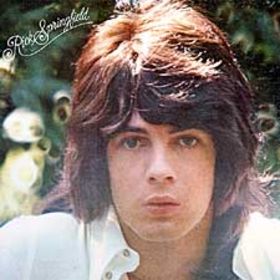
RICK SPRINGFIELD – Beginnings – (Sparmac) – 1972

This one has been kicking around for at least 25 years. I bought back in the 80s, liked it, and put it in my collection. I then had a clean out and decided to get rid of it. Finally, I had a rethink and put it in the pile where it has been till now.
 
Bio from wikipedia, "Springfield was born in Sydney, Australia, the son of an Australian army career officer. In 1967, he dropped out of high school to begin his professional music career. His first appearance in a band was as a singer/guitarist in the band Rock House. In 1968, the band changed the name to MPD, Ltd, then embarked on a tour of Vietnam to entertain the troops stationed there. In 1969, Springfield replaced guitarist Roger Hicks in the Australian rock band Zoot, a position he held until the band's break-up in 1971.The 22-year-old Springfield relocated to Hollywood, California in 1972".
 
Rick Springfield for me is one of those guilty pleasures (he appeals to too much middle America/Australia/anywhere to be hip) as his work with the group Zoot was good, his 70s work was interesting, and his early 80s powerpop memorable. Unfortunately everything else is patchy. But all can be forgiven with the one true highlight of his career –  the sheer powerpop magnificence of "Jessie's Girl".
 
"Powerpop" roots are usually traced back to the Beatles and others. According to wikipedia… Pete Townshend of The Who coined the term "power pop" in a 1967 interview in which he said "Power pop is what we play." As early as 1965, the Everly Brothers were playing music that can be called power pop. The duo's "I'll See Your Light" and "It Only Costs A Dime" displayed jangling guitars and an oblique harmonic approach that built upon the innovations of The Beatles and The Byrds. Those groups, along with The Who, The Small Faces and the Beach Boys, are often cited as the progenitors of power pop.
 
I wouldn't call The Who or the Kinks powerpop progenitors but this definition is otherwise sufficient.
 
Powerpop however – in all its shades – had been central to Springfield's sound from the start and permeates all his work (that I have heard).

Everything except one album  … this one, his first solo LP. This album stands out as an anomaly.

  It is singer-songwriter (Springfield wrote all the tracks) though it has been "produced" up.
 
        It is more MOR than low fi introspective, though it is quite thoughtful.
 
            Strings, and a full sound, abound.
 
                The shadow of The Beatles lurks in the mix.
 
                    Springfield comes across as a less "adult" Neil Diamond, 
 
and maybe that was the market they were aiming for
 
given Diamond's popularity at the time.
 
And it worked … the album and single did well in the US …. especially for an Australian. I think the only Top 40 chart action for an Australian rock act up till then was The Easybeats … you can do the googling.
 
Produced by legendary Australian guitarist Robie Porter (Rob E.G.), who also owned the Sparmac label, the sound is surprisingly crisp for an Australian of the time – possibly because it was recorded at Trident Studios in England. I notice the "direction" is by Steve Binder. I'm not sure what that means though it probably relates to the business side of things. Binder was a TV producer and the force behind the Elvis "68 Comeback Special". He probably had some significant effect on Springfield's subsequent successful US career in television and film.
 
Tracks (best in italics)
  • Mother Can You Carry Me – a deep and meaningful ballad. 
  • Speak to the Sky – His hit and a bouncy, optimistic song – which is quite infectious.
  • What Would the Children Think  –  "Eleanor Rigby" meets Ray Davies.
  • 1000 Years  –  this sounds like something else I can't put my finger on – but the song works – especially the rushed chorus … which nicely juxtaposes the balladry in the verses.
  • Unhappy Ending – overly dramatic … full of youthful drama – well he was 23 … not too bad though.
  • Hooky Joe –  some anti war lyric whimsy with oomm pa pa Beatles at their most Fellini-esque. There is also a banjo and a dog barking … not sure about all this.
  • I Didn't Mean to Love You – dramatic, meaningful with a southern soul flavour … quite credible for a kid from Sydney …
  • Come on Everybody – up tempo filler.
  • Why?  –  a big ballad with an overly dramatic lyric … ahh the wounded heart.
  • Ballad of Annie Goodbody  – I don't know who Annie Goodbody is but she provided the inspiration for the only straight ahead rock song on the album, though the title could be a double entendre … "any good body" (get it?) will satisfy the narrators desires. Not too bad with its turned down Status Quo type riff ….
And …

This album is still touch and go …but I'll keep it ( for now).

Chart Action
 
USA
Album
#36 USA 1972
Singles:
Speak to the Sky   #14 1972
What Would the Children Think  #70 1972
 
England
zip
(Springfield never had a top 40 in the UK in either the singles or album charts – not even "Jessie's Girl" – Roland the Rat and the Dancing Frog have however been Top 20 there)

Sounds
Speak to the Sky      

live

http://www.youtube.com/watch?v=j_rP5XTo6bU&feature=PlayList&p=85881CAA56339BB3&playnext_from=PL&index=0&playnext=1

and attached

What Would the Children Think      

1000 Years      
   
Hooky Joe      
live
Ballad of Annie Goodbody   
and attached
 
Other:
Interview from the time (1972)
 
Zoot doing the Beatles
 
The big hit
Jessie's Girl
 
acting:
 
Bio
 
(originally posted: 01/08/2010)
Posted in Pop Rock | Tagged | Leave a comment