DAVE EDMUNDS – Twangin’ – (Swan Song) – 1981

what Frank is listening to #207 – DAVE EDMUNDS – Twangin' – (Swan Song) – 1981
 
 
If you have read enough of my "comments" it would probably come as no surprise that I would like Dave Edmunds.
 
He is obsessed with rockabilly, roots rock, country rock and early rock n roll.
 
What may be surprising is that he is English. Normally, I think it pointless to listen to English variations on these most American of the rock 'n' roll variations. And that is still the case. However saying that there are a handful of English artists: Edmunds, Ian Matthews, Alvin Lee, Nick Lowe, Chris Spedding and a few others that does not apply to. These guys do not pretend for a second that the music is anything other than American roots music but they all play well and are inspired.
 
Edmunds has also put out a solid body of solo work (from what I have heard thus far), and has also produced or collaborated with some my other favourite acts: The Flamin Groovies, Nick Lowe,  Paul McCartney, Carl Perkins, The Everly Brothers, Dion, The Fabulous Thunderbirds, as well as Brinsley Schwartz, The Stray Cats, Jeff Lynne, Status Quo and others.
 
What appeals to me most, and this is entirely a matter of preference, is that Dave Edmunds has incredibly good taste.
 
His passion for his chosen music is not something by an affected dilettante, it is neither superficial nor an attempt to jump on the band wagon. He is passionate and is not afraid of doing some well considered covers of old songs, which though not always successful are always sincere. He also writes many new songs, that, unsurprisingly sound like "old" songs.
 
Edmunds usually acts as a producer (and built his own studio) and knows what he loves and what he is looking for ….and what he loves stopped before The Beatles rise. That's not to say he doesn't do covers that post date The Beatles but those songs themselves harken back to pre-Beatles days.
 
From what I have already heard by Edmunds I think he does better on his own songs than on his covers. He is happy "tweaking" or changing the covers (he is no slave) but ultimately he reveres them to much. The other problem is that because he has incredible good taste some of the originals he has chosen to do are hard to top or even compete with.

 
But, and this is important, his music rarely sounds dated. He manages to recreate the original sound and feel of the era he loves but he also mixes in contemporary sounds, as long as those sounds are consistent with his musical loves. So, in the era of late 60s psychedelia a band as "retro" as his "Love Sculpture" actually seemed to fit in with their driving rock 'n' roll, whilst his mid 70s solo reworkings of 50s classics also seem to fit in with the rock 'n' roll revival craze, and his late 70s solo work (which gave him the most aclaim) sounds almost new-wave with short punchy rock songs. Not that that was unexpected. After an era of bloated excess in the form of prog rock, art rock, disco and glam rock, many a straight ahead rock 'n' roller was mistaken as being "new wave" (and maybe by definition they were).
 
Edmunds knows what he loves and wears his heart on his sleeve and rarely moves outside of his field of dreams but within that area he does push the boundaries. There is many a bar band who love the same music but rarely sound as inspired or are as inventive as Edmunds. They also don't have the smarts or are as quirky as him …. he isn't afraid of throwing in things in from left field, or surrounding himself with like minded individuals (the great Nick Lowe for example)
 
A big build up.
 
Yes.
 
But, Edmunds has put out a lot of patchy work also …. maybe that is a not unexpected result of being inventive and quirky?
 
This album is (apparently) made up of outtakes from then recent Dave Edmunds sessions (with his band Rockpile, which included Nick Lowe) backing him and on one song The Stray Cats backing him (he had just produced them). The playing is uniformly excellent. The album is also his last on Led Zeppelin's Swan Song label.
 
Tracks (best in italics)
  • Something Happens- Hiatt- by the underrated John Hiatt and released on his "All of a Sudden" LP in 1982. Slightly new wave and different to the rest of the album, but it still fits in.
  • It's Been So Long – Gomm – the old Brinsley Schwartz song written by their rhythm guitarist Ian Gomm from 1972. An excellent pop rock song very much in the early 60s mould.
  • Singin' the Blues- Endsley, McCreary- Guy Mitchell's big, big hit from 1956. Edmunds misses the mark on this one. The first one was a tour de force (and a big, big hit) for Croatian- American trad pop singer Guy Mitchell. It was also exclusively a song for a vocalist with a irresistible melody conveying a certain lightheartedness despite the songs subject matter ….. here it is weighted down with too much chunk a lunk guitar.
  • (I'm Gonna Start) Living Again If It Kills Me – Carter, Edmunds, Lowe – a country flavoured up-tempo ballad with a perfect country song title.
  • Almost Saturday Night– Fogerty- from John Fogerty's magnificent 1975 album, this is one of Fogerty's best non Creedence Clearwater songs … both a celebration of, and a warning to the end of the working mans week, the Saturday night. This version is very good but Fogerty's original is perfect, no one can come close.
  • Cheap Talk, Patter and Jive -Cowart, DeVito, Dowart- written by a number of US seventies country legends ….but done first by Edmunds I think. Catchy but again the instrumentation is too heavy.
  • Three Time Loser- Covay, Miller- the Wilson Pickett B side from 1966 (the flip to "Mustang Sally") – not bad.
  • You'll Never Get Me Up (In One of Those)- Jupp- original by English pub rocker Mickey Jupp.
  • I'm Only Human -Bremner, Lowe, Rockpile, Williams – Rockabilly with a capital R. Gentle though certainly it harkens back to the 50s of the South with it's country honky tonk come rockabilly sound.
  • The Race Is On – Rollins- the George Jones song from1964. More country honky tonk with rockabilly overtones. Edmunds is backed by the Stray Cats on this tune.
  • Baby Let's Play House– Gunter- Elvis' 1954 Sun era classic. A track done by Edmunds in 1968 and released here for the first time. Edmunds manages to capture the Sun sound and Scotty Moore's guitar (and just about everything else). It's amazingly close. It's not Elvis of course and Elvis was on fire on this one. Edmund's version doesn't take the song anywhere new but in some ways it is a fitting close to the album.
And…
 
Patchy but I'll keep this.
 
Chart Action
 
US
Singles
1981 "Almost Saturday Night" #54 Hot 100  (#18 in the Mainstream Rock charts)
Album
#48

England
Singles
1980 "Singing the Blues" #28
1981 "Almost Saturday Night" #58
1981 "The Race Is On" (with Stray Cats) #34
Album
#37
 
Sounds
 
Singin' the Blues
Three Time Loser
You'll Never Get Me Up (In One of Those)
The Race Is On
Baby Let's Play House
attached
original
 
Others
Dave goes off:
Review
 
 
Bio
 
 
Website
—
Trivia
Other Comments
—
 
(originally posted: 01/05/2011)

Posted in Rockabilly and Rock n Roll | Tagged | Leave a comment

JOHN HARTFORD – Mark Twang – (Flying Fish) – 1976

what Frank is listening to #206 – JOHN HARTFORD – Mark Twang – (Flying Fish) – 1976
 
 
Those regular readers will know one of my joys is a new John Hartford album. And, I have quite a few that are awaiting discovery.
 

For background on Hartford see What Frank is Listening to #93 and #154.


There I called Hartford "Progressive" or "Weird" country. He is still that, but as I said then he is also much more.


I said:


He has also been referred to as literary folk music and "MOR romantic nostalgia told from the perspective of a homeless man remembering days of perfect love"…. I like that …. He has also been called Americana/Appalachian Folk/Country-Rock/Old-Timey/Progressive Bluegrass/Progressive Country/Progressive Folk/String Bands/Traditional Country … take you pick …but I like all those also.


I also said in relation to his "Aereo Plain" album in "What Frank is Listening to #154" :  This album is his old timey album with bluegrass and Appalachian sounds thrown in. Hartford however is no mere traditionalist as themes are updated to suit the modern world. Its as if the music of times past was never marginalized but remained the dominant mainstream music and current concerns were incorporated into the sound, just like in rock music.

 
Hartford's style is both simple and perceptive, mainstream and left of centre, populist and eccentric. His songs sing of simple joys and at times it seems that even with his regrets he doesn't have many harsh words to say and seems to accept everyone with all their quirks. That's not to say he isn't critical – he can be – but it never comes from a mean spirited place.
 
Mixed in with his observations and wit there is also quite a bit of some seemingly wide eyed sentimentalism, acute romanticism and lots of humour.
 
These songs will never be heard on radio – not commercial radio anyway – unless commercial radio is hijacked by crazed hillbilly obscurists – not such a bad idea. This album though is pure Hartford and he plays all the instruments: the banjo, the fiddle and the percussion which is his feet tapping on particle board. There are some sound imperfections wisely left in and giving the record a "in your living room" or "on your veranda" feel.
 
The simplicity of the song structure and the (lack of) arrangements allows the listener to be drawn into the lyric and more importantly the mood of the album. But it's not "easy listening" – it is easy on the ears but Hartford is not content with playing it straight. Even the "straight songs" are a bit out there. Ultimately, this is a quirky and confronting album, especially for bluegrass fans.
 
If I could surmise the album in a few words I would call it experimental avant-garde bluegrass.
 
All the songs apart from the Monroe song are written by Hartford or as he says in the liner notes: "I made up every one of these songs ( as much as you can "make up" anything) …."
 
Tracks (best in italics)
  • Skippin' in the Mississippi Dew  –   a beautiful homage to the Mississippi. A toe tapper and a joy to listen to.
  • Long Hot Summer Days  –   Glorious and evocative.
            Last night we had pork for supper
            Today It'll be chicken consume`
            And a fruit jar full of iced tea
            On a long hot summer day
            For every day I work on the Illinois river
            Get a half a day off with pay
            All day long I'm makin' up barges
            On a long hot summer day
  • Let Him Go on, Mama  –   a well observed homage to a Mississippi river man.
  • Don't Leave Your Records in the Sun  –   a song about phonograph records! This is Ray Davies at his most theatrical and like Ray's concept album period it's not accessible. But it is witty and fun.
  • Tater Tate and Allen Mundy  –  a truly weird song where Hartford tries to name every bluegrass act in this song.
  • The Julia Belle Swain  –  a song about a riverboat  (and a whole lot of other things)
  • Little Cabin Home on the Hill – the legendary bluegrass song by Bill Monroe and covered by everyone (especially Flatt & Scruggs, The Coal Porters, and Elvis Presley) . Perhaps because of it's legendary status Hartford sings it as a novelty song like a stoned baritone Elmer Fudd.
  • Austin Minor Sympathy  – majestically melancholy. An instrumental tour de force. If Davy Crockett went to Europe, hung out and smoked opium with Beethoven I think something like this would have been created.
  • The Lowest Pair  –  a revamp of "Our Father" done as a stoned nonsense ditty. It even starts with a draw back on a … cigarette?
            Give us today hors d'œuvre's in bed
            As we forgive those who have dressed up against us
            And need us not enter inflation
            But our liver, onions, and potatoes.
  • Tryin' to Do Something to Get Your Attention  –  a great song about love and writing songs
            Maybe I should give you some of the royalties to this song,
            'cause you sure did inspire me to write it.
            Maybe I should put your name in the lyrics somewhere
            'cause you sure did cause me to write it.
 
            You know as much of a lift as love songs are,
            they sure are hard to write.
            Just trying to do something. . .
            to get your attention.
 
            Maybe I should put your picture on the front of this song
            'cause you sure did cause me to write it.
            I'd tell em' how I met you in the coda of the song
            'cause you sure did cause me to write it.
   
            You know as much of a lift as love songs are,
            they sure are hard to write.
            Just trying to do something. . .
            (stand here, and pull up my overcoat like this)
            to get your attention.
 
            I tried real hard to make this song not sound like some other song I've written before.
            If I did it's because my style and style is based on limitations.
            I tried real hard not to make this song sound like some other song some other singer-songwriter might
            have written before.
            And if I did, that's 'cause it's music, and music is based on repetition.
 
            Now, maybe if you learn the words to this, your very own song
            The song you caused to be written.
            Maybe you'll sing it for somebody else that you love because you sure did cause it to be written.
 
            You know as much of a lift as love songs are,
            they sure are hard to write.
            Just trying to do something. . .
            to get your attention.
 
And…

I'm keeping this.

Chart Action
 
US
Singles
Album

England
Singles
Album

Sounds

Skippin' in the Mississippi Dew   
live
 
Long Hot Summer Days  
 
Let Him Go on, Mama 
live
  
Don't Leave Your Records in the Sun 
live
attached

The Julia Belle Swain    
 
 
Tryin' to Do Something to Get Your Attention  
attached
   
Others
 
Review
 
 
Bio


Website
 
 
Trivia
—
 
Other Comments
 
what is Frank Listening to #93
what is Frank Listening to #154
what is Frank Listening to #163
 
(originally posted: 24/04/2011)

Posted in Alt Country | Tagged | Leave a comment

MICKEY NEWBURY – The Sailor – (ABC) – 1979

what Frank is listening to #205 – MICKEY NEWBURY – The Sailor – (ABC) – 1979
Hey, I've done 3 other Newbury albums so a fair chunk of the below is a rehash (from what Frank is listening to #146 – MICKEY NEWBURY – Heaven Help The Child – (Elektra) – 1973) … but it's all still accurate.
 
I have commented on a couple of other  Mickey albums in the past and have always been impressed. He is perfect Sunday morning listening …though not religious, there is a peaceful spirituality in the music.
 
I commented on Newbury back in "what Frank is listening to #78" in relation to his "His Eye is on the Sparrow" album from 1978
 
I said this back then:
 
It is Newbury's subtlety and thought that put him at the forefront of "progressive country". "Progressive Country" roots lie in traditional country, roots music, folk, Americana, regional rock n roll and was largely comprised of younger country songwriters writing country music with naked honesty, which is no mean feet as country music generally is "nakedly honest" ( think Hank Williams, Patsy Cline).  What they did do was write incredibly personal songs much like their "singer-songwriter"relatives in the pop field with an ear to the past. The other thing they did was sing their own material regardless of the quality of the voice. Consequently, they have put out many albums and are well respected but their songs are often associated with other singers. Think Townes Van Zandt, Danny O'Keefe, Kris Kristofferson, Willie Nelson, Terry Allen, John Hartford, Billy Joe Shaver, Butch Hancock, Gene Clark, Tom T. Hall, John Prine, Jimmie Dale Gilmore, Guy Clark Dennis Linde, etc. Some of those artists moved into the more up-tempo "outlaw country" whilst the rest continues on and eventually became the cornerstones of "alt country" in the 80s and 90s.
 
Newbury, born 1940 in Houston Texas (D: 2002) put out his first album in 1968. This is his 9th album.


This album though recorded in Nashville is more singer-songwriter than his other albums I have heard. Though of course the singer-songwriter "lives" in the country not in the city so that's always going to come through.

 
I also said back in comment #78:
 
It is Newbury's subtlety and thought that put him at the forefront of "progressive country". "Progressive Country's" roots lie in traditional country, roots music, folk, Americana, regional rock n roll and was largely comprised of younger country songwriters writing country music with naked honesty, which is no mean feet as country music generally is "nakedly honest" ( think Hank Williams, Patsy Cline).  What they did do was write incredibly personal songs much like their "singer-songwriter"relatives in the pop field with an ear to the past. The
 
Newbury was sharp as he takes from all American musical traditions of all era's and creates an album of individual songs though with one mood.
 
Newbury isn't daunted by musical trappings that may kill other artists off. He has used sound affects, pop stylings and obvious singer songwriter to great effect. To him the message and the mood across the album are paramount. Here he uses strings and backing vocals in the best country schmaltz tradition. On a superficial listen this is dross. But, if you know where Newbury is coming from or are willing to listen there is a lot going on behind the frills.
 
The best point of reference for contemporary listeners looking for a Newbury comparison (on this album) is Lambchop with strings. The songs are atmospheric, thoughtful and either quietly happy or melancholy.
 
Again (like Lambchop) he draws on many styles of American popular music as he always does. Here it's:  popular jazz, country pop, singer songwriter, lounge balladeer.
 
Having said that, this is totally different from the other Newbury albums I've heard. It is a smoky midnight smooth lounge album. Charlie Rich mined this field in the 70s (and Willie Nelson and Merle Haggard would in the 80s) to great success so I assume Newbury may have had one ear on commercial success. That is not to deny him anything though as all these influences are apparent on his other albums though not as up front as they are here.
 
I'm not sure what the album title is about as there is naught a nautical song to be heard so I assume he is some sort of a "sailor of life". Either that or he was trying to ride some Jimmy Buffett waves.
 
Tracks (best in italics)
  • Blue Sky Shinin'   – you can hear Tony Bennett singing this.
  • Let's Have a Party   – as confessional song as you are likely to get
            Well at times I feel I need the rain 
            At times I need the sun 
            Pleasure is a thread of pain 
            When it is undone
 
            Moments of insanity 
            Are never like a chain 
            I only know that I'm not free 
            The nights when I am sane
  • There's a Part of Her Still Holding on Somehow   – pure smooth Nashville.
  • A Weed Is a Weed  – a look back at a wild youth from someone who has wised up. John Mellencamp would go on to write 100 songs like this.
  • Let It Go  – a country weepie ballad.
  • Looking for the Sunshine  – a gentle country stomper ( if that makes sense).
  • Darlin' Take Care of Yourself   – a song of an old (but not forgotten) love.
            Well nobody loves you like I love you 
            I will always be wishing you well 
            Honey I know you've have more than your share of sorrow 
            So darlin' take care of yourself
 
            Yes I know you've have more than your share of sorrow 
            So darlin' take care of yourself
  • Long Gone  – a straightforward but unashamedly emotional song about a broken marriage. In other words, perfect country material.
  • Night You Wrote That Song  – a slightly obscure song about country music ….it could be a Bob Dylan country tune.
And…

Ultimately, I cant deny the song writing but I don't prefer this albums to some of the other Newbury albums I have heard. Still, he's good. I'm keeping this.

Chart Action
 
US
Singles
1979  Blue Sky Shinin'  Country Singles #81
1979  Looking for the Sunshine  Country Singles #82
Album
nothing
 
England
nothing
 
Sounds
 
Blue Sky Shinin'  
attached
 
Darlin' Take Care of Yourself  
attached
 
Others
 
Review
 
 
Bio


Website
 
 
Trivia
—
 
Other Comments
 
what is Frank Listening to #79
what is Frank Listening to #122
what is Frank Listening to #146
 
(originally posted: 17/04/2011)

Posted in Alt Country | Tagged | Leave a comment

JETHRO TULL – Crest of a Knave – (Chrysalis) – 1987

what Frank is listening to #204 – JETHRO TULL – Crest of a Knave – (Chrysalis) – 1987
I went through a short Jethro Tull phase.
 
Didn't we all?
 
Growing up in the inner west of Brisbane, in the 70s.
 
        Jethro Tull was a part of what the older kids listened to ….
 
            that and Led Zeppelin, Pink Floyd, Bob Dylan, Rodriguez and AC/DC.
 
Me?
 
As a result of a number of reasons not relevant here I was listening to Elvis, Chuck Berry and Jerry Lee Lewis. At the time they were contemporary artists though from "another era". The only big concessions I made to modernity was Suzi Quatro and Skyhooks.
 
Otherwise I had little time for contemporary sounds on the prevalent and dominant AM radio. Eventually my Chilean Aunt's Chilean nephew (not my cousin – her side of the family) was up on holidays from Wollongong some time in the late 70s. He was a couple of years older and we hung out and he said that I "had" to listen to Jethro Tull …
 
… and Kiss,
 
 
… and Led Zeppelin,
 
 
… and Peter Frampton.
 
I did.
 
Led Zeppelin and Jethro Tull took my fancy. I liked Tulls experimental blues rock, English folk, quasi classical art rock with flute. Though I hardly described it like that at the time
 
Some time later I went out and bought "A" by Jethro Tull … the album where singer, Ian Anderson, discovered the synthesiser.
 
Hardly indicative of their output …nevertheless I loved that album at the time.
 
I fully intended to explore more Jethro Tull but other musics overtook me.
 
Normally around here somewhere I would give you some background on the band but they have had 40+ years and 26 album career and they are still going so just refer to the links. Suffice it to say that Jethro Tull is the band and Ian Anderson is the singer songwriter and constant member and they play experimental blues rock, English folk, quasi classical art rock with flute.
 
Dribs and drabs of Tulls 70s output I'm familiar with but everything after 1980 is pretty alien to me.
 
Certainly, on face value, this album with it's sleeve and title, "Crest of a Knave", lends itself to imagery of the medieval lunacies of mid 70s Tull (and others : remember Rick Wakeman)
 
But alas one drop of the needle followed by a little googling settles that.
 
The album is often referred to as hard rock and most of the discussion on it seems to deal with Tull controversially winning the 1989 Grammy Award for Best Hard Rock/Metal Performance Vocal or Instrumental, beating favourite Metallica and their "And Justice for All" album.
 
And yes it is hard rock of sorts ( but not really) … it's more dominant style is AOR rock. The album apparently was a slight departure for the band from the various stylings they had utilized prior to that – it was more rock with more hard rock stylings, more guitar and less synth (the fans apparently didn't like the synth period following "A") but it still is a hodgepodge of musical styles ranging from progressive rock, blues, folk, AOR hard rock with Ian Anderson's personality (and he is the driving force of the band) coming through clearly.
 
There are vocal and musical comparisons with Mark Knopfler and Dire Straits – fans will say that Ian Anderson had had throat surgery which altered his voice slightly but I think he sounds like a less nasally Bob Dylan. Certainly his voice isn't as it was on the 70s records. It still is distinctively his voice and any defences don't really explain the music which panders to the 80s and to some Dire Straits stylings. Anderson also produced it so …..
 
In any event, the album went on to become a big hit, rejuvenating the band who also toured on it successfully.
 
But do I like it?
 
Well, I think any comments made have to refer to the fact that Ian Anderson is a forceful musical personality and anything he touches will be bent to suit his personality which is itself slightly bent. And that is admirable …
 
Having said that he has put out alot of crap.
 
Not suprisingly for Anderson there seems to be a theme in the album … the songs are all about various aspects of and ancillary aspects to the "working life". All the song's narrators are workers : industrial workers, rural workers, military men, or less convincingly, musicians.
 
Tracks (best in italics)
  • Steel Monkey –  bad, bad 80s. Despite some hard rock guitar wankery on some of the "ballads" this is the only proper hard rock song on the LP, and even then it's very MOR hard rock.  Either way it's bad.
  • Farm On The Freeway –  lyrically I like this song, a rejection of the modern in favour of pastoral times…. but the 80s, clean, AOR sound is hard to get over.
  • Jump Start –  obscure lyrically but something about love redeeming or at least "jump starting" the narrator so he can face another working day.
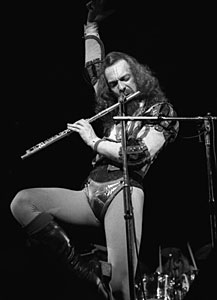
  • Said She Was A Dancer –  this has to be an Ian Anderson autobiographical song about a mid life infatuation with a Russian dancer or more simply about "wining on" …. or not in this case. If you don't believe me that this is autobiographical then find a picture of Ian Anderson (I have attached one at the bottom for you slack pricks) and listen to the narrator's lyric:
            So I stole one kiss, it was a near miss
            She looked at me like I was Jack, the ripper
            She leaned in close, "Goodnight", was all she said
            So I took myself off to bed
 
           I dare say there is honestly in that lyric.
  • Budapest –  another late mid age fantasy and seemingly another autobiographical song. This time the narrator has another infatuation (unrequited ?) with a female stage hand from Budapest. Hey, I've been to Budapest – I can understand the infatuation. Here, the redeeming elements of the song are undone by the fact that any old man singing about a infatuation with a young girl is going to sound sleazy. Any meaning he tries to inject into the song beyond trying to pull a root just comes out sounding pretentious. And it goes on to long (10 minutes or so). A pity…
            She bent down to fill the ice box
            and stuffed some more warm white wine in
            like some weird unearthly vision
            wearing only T-shirt, pants and skin.
            You know, it rippled, just a hint of muscle.
            But the boys and me were heading west
            so we left her to the late crew
            and a hot night in Budapest.
            It was a hot night in Budapest.
 
            She didn't speak much English language…
            (she didn't speak much anyway).
            She wouldn't make love, but she could make good sandwich
            and she poured sweet wine before we played.
 
           It is funny though…..
  • Mountain Men – a anti war song.
  • Raising Steam – Very Dire Straits. The narrator is a conductor on a old steam train and is the train itself.  Ahhh, the meaning. I shouldn't refer to Jethro Tull lyrics as they are an easy target especially when taken away from the music and the album concept being pushed . But I must:
            Let me be your engineer…
            have you smiling ear to ear
            raising steam.
            And will you tell me how it feels
            when you're up and rolling on your driving wheels?
            I got my whole life hanging in a sack,
            heading out into that wide world wide.
            I'll be your locomotive blowing off its stack
            and I don't care which way I ride.
            I may not be coming back.
            Raising steam.
 
        "Mystery train" it's not.
 
And…
 
OK, so I've made merry of some lyrics above but as I've said a Jethro Tull album must be looked on as a whole. And I have here and it's still not very good. But there is worse out there and at least Ian Anderson beats no other mans drum, err flute. One thing for sure though, it's not a hard rock album. Tape a couple and sell…….
 
Chart Action
 
US
Singles
1987  Farm on the Freeway  Mainstream Rock #7
1987  Jump Start  Mainstream Rock #12
1987  Steel Monkey  Mainstream Rock #10

Album
#32
 
England
Singles
—
Album
#19
 
Sounds
 
Steel Monkey  

Farm On The Freeway  

Jump Start  
 
Said She Was A Dancer  
Budapest  
and attached
Mountain Men   
 
Others
song and interview – slightly pretentious and slightly ridiculous like a lot of Tull but at least it's "honest" …. Mumford and Sons would have credibility if they footnoted this rather than Americana.
 
Review
 
 
Bio


Website
 
 
Trivia
  • the album "A" I refer to above was apparently meant to be an Ian Anderson solo album which the label encouraged him to release as a Jethro Tull album …hence the title "A" …as in "A" for Anderson.
  • wikipedia: "In response to the criticism they received over the award, the band took out an advertisement in a British music periodical with a picture of a flute lying amid a pile of iron re-bars and the line, "The flute is a heavy metal instrument." In response to an interview question about the controversy, Ian Anderson quipped, "Well, we do sometimes play our mandolins very loudly." In 2007, the win was named one of the ten biggest upsets in Grammy history by Entertainment Weekly". Oh, not a Grammy.
  • By this time Tull was effectively a core trio of Anderson, Barre, and bassist Dave Pegg, augmented by whatever musicians (drummers Gerry Conway and Doane Perry, Fairport Convention keyboard player Martin Allcock, and violinist Ric Sanders)
Other Comments
—
 
Picture
 
 
(originally posted: 10/04/2011)

Posted in Hard Rock, Prog Rock and Art Rock | Tagged | Leave a comment

THE JORDANAIRES – This Land – (CBS) – 1964

what Frank is listening to #203 – THE JORDANAIRES – This Land – (CBS) – 1964
Sorry lovers of squealing guitars, thumping drums, pulsating bass lines … but no instrument soothes my addled nerves more than the human voice. And I'm not talking about the the yackety-yak that passes for singing in contemporary pop or the overproduced rubbish that is modern R&B.
 
Doo wop, close harmony singing, traditional pop and Gregorian chants when done well are all vocal voodoo on me.
 
The Jordanaires were one of the most respected vocal groups of their time. 
 
They were based in Nashville but the members were from all over the south and into the Midwest and began singing in the late 40s. The band was normally a quartet and there have been quite a few members who have passed through their ranks, though not to many. Under their own steam they sang mainly white gospel material …. Jordan aires – get it? In the studio they did backing for any number of pop or country singers.
 
It was however their association with Elvis Presley that brought them fame ….
 
Their harmonies, usually background harmonies but occasionally close harmony vocals (and sometimes even in the same song), they did for Elvis were, if not quite revolutionary certainly inventive and trend setting. Elvis, ever the unconscious visionary and self producer knew the sound he wanted and desperately wanted them and their vocal sound as his backing band. In the early day of rock this was almost "revolutionary". No one in the rock idiom, white or black, utilised a vocal backing group before Elvis. Certainly Little Richard, Chuck Berry and Bo Diddley were not doing anything like that. Ray Charles was R&B and many of the other acts were doo wop. Sure, Elvis loved the black R&B vocal groups, doo wop, black and white vocal quartets but what possessed him to bring these vocals into the rock arena, bar whatever sound he was looking for in his head, is anyone's guess.
 
He of course did want to be Dean Martin.
 
Some history : The Jordanaires began singing backup on recording sessions for Elton Britt, Red Foley, Jimmy Wakely, and Hank Snow as early as 1954. One of television’s early talent shows helped spread their appeal even further. “We had won the Arthur Godfrey’s Talent Scout Show by singing a black spiritual like ‘Dig a Little Deeper [in] God’s Love,’” remembered Stoker, “Black spirituals are what Elvis loved and we would sing those on the Grand Ole Opry.”
 
“This is what attracted Elvis to the Jordanaires sound,” Stoker continued. “He’d hear us sing those spirituals on Saturday night. Well, we were working with Eddy Arnold and we went to the Ellis Auditorium in Memphis to do a show. Elvis came back behind the stage to meet us, not to meet Eddy. He said that he’d been hearing us sing on the Grand Ole Opry and he said, ‘Man, let’s sing some of those spirituals.’ so, we got to singing with him in the room. That’s when he said, If I ever get [a] major recording contract, I want you guys to work with me.’ He was on the Sun label at that time. We didn’t think anything about it, we had been told that by a lot of people. It didn’t mean anything at all. But, when RCA signed him in January of 1956 he asked for us.”
 
The Jordanaires’ impact on Presley’s recordings should not be underestimated. Their smooth yet effervescent backgrounds made Elvis’s raw-boned rockabilly palatable to pop radio programmers. Further, major smashes such as “Don’t Be Cruel,” “I Was the One,” “Teddy Bear,” “Too Much,” and “Don’t” exhibited the type of group interplay usually found in doo-wop—something Presley could not have achieved at Sun Records.
 
On tour, The King’s delirious, screaming fans made it difficult for the group to hear the singer. As a result, Presley had the Jordanaires stand very close to him on stage. “We could also tell by the movement of his head or the movement of his body where he was in the song,” explained Stoker. “But, we would be as close to him as we could possibly be. He even wanted it that way in the studio. He always wanted us standing right behind him on those TV shows we did with him. Many times he’d step back on my toes. (Laughs.) But you couldn’t hear anything because of the screaming and hollering.”
 
At Presley’s request, the Jordanaires received billing on all his releases, a sign of respect that he didn’t accord band members Scotty Moore, Bill Black, or D.J. Fontana. But the publicity windfall didn’t create a rash of hit records for the quartet. “We had one or two numbers on Capitol that got into the top ten,” recalled Stoker. “’Sugaree’ got in the top ten on some stations and some numbers that got in the top 50 during the ’50s. We really wanted Capitol Records to push us . Lee Gillette, who was an official at Capitol Records said, ‘Gordon, let me tell you one thing. You guys are masters in the studio at doing background on recording sessions. If you were to get one or two hit records you’ll just fall by the wayside.’ At the time he said it, we didn’t want to hear it, but now we think back and he was so right.” http://www.encyclopedia.com/doc/1G2-3496200049.html

Elvis on his pop recordings isn't singing close harmony but I think he loved close harmony singing and sang much on his (subsequent) gospel recordings. I suspect he realised that on his pop records he was required to have his voice up front (thats the reason the records sold). He didn't want however to do away with the harmonies so he adopted and adapted them. Despite the fact that many angry young rockers may bemoan Elvis pop direction as "girly" they nevertheless can't dispute how influential and universal this sound would become. The results may have taken the hard edge from the rockabilly and given us rock pop but it also opened the doors to countless other rock vocal bands. Sure Brian Wilson may have loved the Four Lads but in a rock setting he was equally enthralled by the vocal backing of the Jordanaires on Elvis songs. So the line from Elvis to The Beach Boys and the Beatles is there.
 
But enough re Elvis.
 
The Jordanaires were in high demand in the studio. To date they have sung on records by over 2000 acts apparently including Elvis, Marty Robbins, Jim Reeves, Patsy Cline, George Jones, Loretta Lynn, Tammy Wynette, Dolly Parton, K. D. Lang, Willie Nelson, Merle Haggard, Ricky Nelson, Conway Twitty, Chicago, Neil Young, Jimmy Buffett, Kenny Rogers, Don McLean, Ringo Starr, Jerry Lee Lewis, Ronnie Milsap, The Judds, Julie Andrews, Johnny Cash, Connie Frances, Roy Orbison, Pat Boone, Carol Channing, Tennessee Ernie Ford, Billy Ray Cyrus and Vince Gill.
 
Back in the 50s and 60s they were in high demand for session work but they did get time to record under their own names. Nothing they recorded under their own steam was hugely successful but the records did showcase their talents.
 
This is one of those albums.
 
The music here really taps into the sounds of the day, and that is the mainstream smooth folk sound rather than the voice of the young angry folk movement. The album is not particularly innovative – it really is MOR folk with country pop and substantial gospel overtones. But what we have is assured music, with absolute professionalism sung with conviction and on a Sunday morning or with a glass of red at night there is a soothing quality in this music.

 
Part of the feeling we get from the music is our familiarity of it. Maybe not in these versions but in subsequent or earlier versions or others songs that have ripped off the melodies of the traditional tunes. The other part is a deliberate attempt by them to create a wistful, melancholy, sometimes sad but never suicidal music that ultimately is intended to massage the soul and be redemptive. After all, at heart, they are a gospel group.
 
The only problem I have is their gospel tunes are done in the soft folk vein and don't barnstorm as they normally would in the south or as other southern gospel quartets did. I suspect they may have been looking for broader appeal in the north and on the college campuses.
 
On this album they are comparable to the Sons of the Pioneers and arguably would have had a successful movie song career if they had strayed from Nashville to Hollywood.
 
Tracks (best in italics)
  • This Land Is Your Land – Woody Guthrie – One of greatest of all American patriotic songs.And yes, it was written as a humanist Marxist response to Irving Berlin's "God Bless America". I cant think of many national songs that compete with this. Though not dusty and rough hewn like the Guthrie version this is a great version sung with passion.
  • All My Trials – Trad – the old slave song. Another incredibly vivid song that seems to capture the history through experience in song. A song that lends itself to multiple voices, as if they exemplified the suffering of many. Probably the most famous version to pop ears is the Elvis version of Mickey Newbury's "American Trilogy" which contains part of "All My Trials"
  • Little Moses – Trad – another old country gospel folk song. The Carter Family did it in 1929 and I think it was old then …
            Away by the river so clear,
            The ladies were winding their way,
            While Pharaoh's little daughter stepped down in the water
            To bathe in the cool of the day.
 
            Before it was dark, she opened the ark 
            And found the sweet infant was there. 
            Before it was dark, she opened the ark 
            And found the sweet infant was there.
 
            And away by the waters so blue,
            The infant was lonely and sad;
            She took him in pity and thought him so pretty,
            And it made little Moses so glad.
 
            She called him her own, her beautiful son, 
            And sent for a nurse that was near.
  • Didn't It Rain – Trad – another old gospel song – very well known in the South. Recorded with various lyrics by Sister Rosetta Tharpe and Mahalia Jackson the Jordanaires version is sweet but maybe a little genteel.
  • Michael (Row The Boat Ashore) – Trad – an old Afro American spiritual from US Civil War days. It was popularised by Pete Seeger in the 50s and became a folk music staple. I've always liked his version and Harry Belafonte's version. For more info http://en.wikipedia.org/wiki/Michael_Row_the_Boat_Ashore
  • Much Bigger Than I – MacRae, Barton – I don't know much about this songs pedigree. A pleasant folk song with some spiritual overtones.
  • Let Me Ride – Trad – a old spiritual not dissimilar from "Sweet Low Sweet Chariot"
  • My Valley – Trad – an old traditional folk song. The song like many of it's ilk is about belonging and a place to call home. There is a touch of melancholia in it though and it is ever so gentle.
  • Going Home – Matthews – this is an original one written by Neal Matthews of the Jordanaires. and is another song about the search for "home" which is both a place and a state of mind.
  • Promised Land – Trad – not the Chuck Berry song but an old spiritual song. Suffer now and the promised land awaits…
  • You Better Run – Trad – a great old gospel song, but again this is a fervent shouter and the Jordanaires are to genteel. Probably keeping in time with the quiet folk elements of the album
  • Hands Of God  -Kessel, Garland – a contemporary religious song written by Sid Kessel with music by country guitar legend Hank Garland. The song sounds like a theme song from a 50s film. It's very dramatic , unequivocal in lyric and emotive. Agnostics beware: the lyric itself is more "praise God" rather than spiritual. Garland himself is fascinating, based in Nashville he played on many Elvis records (and live) as well as Roy Orbison, Patsy Cline and The Everly Brothers. For the guitar nerds out there Garland strongly influenced the design of the Gibson Byrdland guitar. http://en.wikipedia.org/wiki/Hank_Garland
And…

This is as I have said a relaxing and soothing album. But it's gentle folk melodies and songs pulled from the past make it also a fine pastoral album. Definitely one to have on your ipod if you do a lot of cross country walking. I'm keeping this.

Chart Action
 
US
England
nothing no where
 
Sounds
 
This Land Is Your Land 
attached
 
Didn't It Rain 
 
Michael (Row The Boat Ashore) 
attached
Much Bigger Than I 
 
 
Promised Land 
 
Others
 
The Jordanaires with Hank Garland and Don Gibson


with Elvis
 
Review
 
 
Bio


Website
 
 
Trivia
  • Elvis' song list with the Jordanaires http://www.jordanaires.net/Elvis/elvisonglist.htm
  • Close harmony singing is essentially a method that attempts to make the most creative music with the least amount of freedom. By definition, close harmony arranges its notes in a narrow range, usually within the confines of a single octave. Occasionally the rules are bent to accommodate a random bass notes for balance. However restrictive this technique may seem, many close harmony singers found a loophole: confining each individual to a separate octave to extend the composite past the original restrictive range. http://www.chapter-6.com/
  • During the 1940's and 1950's a close vocal harmony resurgence revived popular music, inspiring scores of melodic singing groups including the renowned Ames Brothers, Mills Brothers, Williams Brothers, Andrews Sisters, McGuire Sisters, Four Lads and Platters. This era's harmonizing success utilized the classic format of selecting easily singable and recognizable melodies thus conspiring to inspire an unforgettable blend of diverse vocal parts.
     
    Traditionally, larger family groups enjoy a harmonizing advantage due to possessing similar vocal timbres within various ranges. Everything from church choirs to school performances and street corner crooning encouraged what began as family entertainment gatherings before — and in spite of — TV's attention consuming invention.
     
    Early male quartets coveted a dominant moving baseline — evident in Elvis' Jordanaires Singers–immortalized within Johnny Cash's hit record "Daddy Sang Base." Modern pop music harmonics emphasized a closer, tighter structure highlighting dissonance topped with elegant high notes. http://ezinearticles.com/?Close-Harmony-History&id=2795946
Other Comments
—

(originally posted: 03/04/2011)

Posted in Folk, Gospel | Tagged | Leave a comment

THE CROOKS – Just Released – (Blueprint) – 1980

what Frank is listening to #202 – THE CROOKS – Just Released – (Blueprint) –  1980
Sorry this didn't go out yesterday …I was knackered.
 
I had never heard of these guys before but one listen to the record gives them away. You don't need books or internet access to firmly identify this band as a mod revival band circa 1980.
 
mod revival as generously defined by allmusic: In the late '70s, a group of British punk rockers inspired by the Jam brought back the mod styles and sound of mid-'60s London. The Mod Revivalists stuck to the R&B-informed rock & roll that distinguished the original '60s mods, but the sound was harder and more frenetic, and often only implied the music's R&B roots. Since the original wave of mod bands in the '60s only included a few of bands — the Small Faces, the Who, the Creation, and the Action, as well as a handful of others — there were actually more mod groups in the revival than there were in the '60s. Furthermore, since most of the original mods only performed in cover bands (with the exception of the aforementioned groups) or simply danced to Motown records, the revival was the first wave of mod bands to rely on original material. Nevertheless, the mod revival only produced a handful of popular bands. The Jam were the most popular band in Britain during the late '70s and early '80s, but groups like the Lambrettas, the Merton Parkas, Squire, and Purple Hearts managed to cultivate cult followings and occasionally have pop hits. The mod revival lasted as long as the Jam's career — after Paul Weller disbanded the trio to form the Style Council, most mod revivalists either split up or became new romantics, which usually resulted in a breakup as well.
 
Apparently, that is the mod revival. To me, however, the mod revival was just a English variation on the US power-pop phenomena at best and just a poor cousin to the skinny tie band craze in the US at worst.
 
So what is mod?
 
allmusic again: Technically, Mod refers to a lifestyle and fashion more than music itself. During the early '60s, legions of teenagers in Great Britain began dressing in stylish, neo-Italian fashions and listening to American R&B, particularly Motown. Soon, these teens were dubbed mods. The original mod bands were all R&B cover bands, but soon they began writing their own material that was generally in the vein of their influences. Mod bands played R&B harder and faster than the original recordings — it was relentless, amphetamine-driven rock & roll. Many of the mod bands were barely heard outside of the United Kingdom, since the lifestyle was primarily a British phenomenon. Two bands — the Small Faces and the Who — were able to crossover to the United States market, but that was after both bands began developing and expanding their R&B-based sound. By the time psychedelia came around in the late '60s, mod had died out in Britain. However, mod — both the music and the lifestyle — came back in full force in the late '70s, thanks to the Jam.
 
I apologise in advance for the next couple of paragraphs to those of English extraction.
 
"Mod" music is basically what the English do best … take something and give it a different name, an "English" name, which implies that it is in fact something original from England. This is cultural colonialism.
 
In the present context it would be fair to say that there is nothing original about "mod" music. Mod is basically white English R&B. The only variation on its original American inspiration is perhaps that it's been made  more "pop" by taking the rough edges off.
 
If you don't believe me listen to the Who's first album …most of it is pop …the raw crunch we associate with the tracks comes from the the live versions of the 70s, when they were trying to compete with Led Zeppelin etc. Likewise, though not "mod", the roughest rocking Beatles 45 is only marginally more rock 'n' roll than Fabian or Bobby Vee. OK that's an exaggeration but pop looms high in English music. Nothing wrong with that, but I'm just saying, why pretend its something else?
 
If you need anymore proof listen to the US white blues bands of the same time ….. The Paul Butterfield Blues Band, The Blues Project, Dave Van Ronk, Lonnie Mack, early Captain Beefheart etc. The US white blues bands were never as prolific as their English counterparts, but then again they didn't need to be given they had the real authentic black acts in the US. Interestingly, as an aside, those US white blues bands were more adventurous than their English cousins for the same reasons – that is they had to distinguish themselves from the authentic black acts  …
 
Still, "we" seem to lap it up as the same cultural colonialism is still practiced today by the English. Look at Mumford and Sons if you need proof …..alt country, Americana, indie folk pop has been alive and well in the US for 15 years but it takes a English act with limited horizons to make it popular and palatable for the 15 year olds. It seems like we are still colonials.
 
English bands are at their best when they wear their influences on their sleeves and don't worry about proving their bona fides. qv: The Beatles, The Kinks, Led Zeppelin, The Animals, Rolling Stones, David Bowie, The Soft Boys, all ripped off American sounds, referenced the influences in their music, sang about English things (occasionally) and didn't worry too much about justifying the "empire"
 
Anyway, I digress.
 
Even the word "mod" is not what we think:
 
The term mod derives from modernist popularized in the  1959 English novel Absolute Beginners by Colin MacInnes describing as a modernist, a young modern jazz fan who dresses in sharp modern Italian clothes. The word though had been around in the US since the 40s with the emergence of bebop, which was routinely called “modernist”.
 
Sorry, I digressed again.
 
With the exception of The Jam I found all the other mod revival rather dull. Mind you I found all the original 60s mod music rather dull.
 
The thing I hated about the mod revival bands is that unlike powerpop bands and the US skinny tie bands they never seem convinced by their sounds. They try to mix it up a little so you have a power pop song and then maybe something with a little blue beat and then something different again. Maybe such diversity is admirable, but now, given that all those musical forms are dated and not at all charming to my ears, I just find it a little tiresome.
 
The Crooks arent as hard edged as The Jam and musically and lyrically they seem to have buried any R&B tendencies in mod in favour of pop. Lastly, though there are bursts of amphetamine fuelled energy it doesn't cut across the whole album. A low energy Jam is the best that can be said of them. A pity. Actually, I suspect they were a covers band on the pub rock circuit who jumped on the mod bandwagon.
 
Also, a lot of the problem is the record isn't all that well produced …there is no punch, which all The Jam albums had, and powepop songs need that.
 
I am perhaps being overly harsh on the band but they fall well short of The Jam (which is the genres undisputable high point). Then again they are no worse than any of the other mod revivalists and this LP would certainly be a useful edition to any mods collection, but that really isn't saying much.
 
Tracks (best in italics)
  • All The Time In The World  – a touch of "I Fought the Law" in here, otherwise quite a good mod anthem.
  • Waiting For You  – a slight ska /bluebeat feel.
  • Lets Get Together  – paint by numbers music.
  • Sound Of Today  – relevant lyrics and a punchy delivery …definitely an attempt at The Jam …falls short though.
  • Hold Me  – less Jam spread here (ha) but clearly another rip off.
  • 1000 Faces  – by now everything is starting to sound the same.
  • The Beat Goes On  – Not the Sonny & Cher classic unfortunately. Another modish anthem.
  • You Dont Have To Tell Me  – tedious. 
  • I'm In Love  –  I've already forgotten the last song and I think this is going to go the same way.
  • Me And My Friends  – ditto.
  • I Dont Love You  – a potentially good song that comes out sounding a little whimpy.
  • Understanding  – a song that stands out. But, it's a cover of the Steve Marriott/Ronnie Lane Small Faces 1966 B side. The original was a soul / R&B flavoured tune ..here it's lost its black-ness and is sped up losing most of it's charm. Still it's better than most of the other tunes here.
And…

Despite a couple of good tracks this is largely dull. Tape the good and sell.

Chart Action
 
US
nothing
 
England
Singles
Album
nothing
 
Sounds
 
All The Time In The World 
attached
 
Understanding 
the original
 
Others
 
Review
 
 
Bio


Website
—
 
Trivia
  • By mid-1980 The Crooks ran out of steam. Broderick and Dean quit the music scene, whilst Parry and Sparrow formed Modern Jazz. They later became Blue Zoo, enjoying UK hits with "I"m your man" and "Cry Boy Cry" in 1982. Parry went to co-write Yazz's 1988 N°2 hit "Stand Up For your Love Rights" and now works as an A&R man, whilst Sparrow bangs the skins for Nenah Cherry. http://punkmodpop.free.fr/crooks_pic.htm
Other Comments
—
 
(originally posted: 28/03/2011)

Posted in Power Pop | Tagged | Leave a comment

GARY LEWIS & THE PLAYBOYS – Close Cover Before Playing – (Liberty) – 1968

what Frank is listening to #201 – GARY LEWIS & THE PLAYBOYS – Close Cover Before Playing – (Liberty) – 1968
 
 
Those long term readers of "what Frank listening to" would know of my fondness for Gary Lewis & The Playboys. His albums are cheap, light, well produced and very evocative of the "pleasant" 60s despite, or maybe in spite of, what the reality was like.
 
This is the tail end of Lewis' career.
 
The album is his 4th last and in the next year he would release 3 albums and then his recording career was all but over.
 
At the age of 23.
 
I have written much about Lewis in my others posts …I tend to rehash anyway so you can look at any of those for detail.
 
from what Frank is listening to #162 – GARY LEWIS & THE PLAYBOYS – Now! – (Liberty) – 1968
This album is really a culmination in one of the sounds that was part of his musical makeup – melodic, snappy, light ( but not necessarily lightweight) pop.
 
In other words "sunshine pop", more or less. Gary Lewis always leaned towards "sunshine pop" and in some ways he can claim to being one of it's founders and this album is more than the others his "sunshine pop" album. Much of his Beatles and pre Beatles rock influences are gone leaving these well crafted, lush, unmistakably Californian pop tunes. That coupled with the fact that it's 1968 plainly puts him in the sunshine pop camp though, admittedly, more towards the MOR side rather than the "trippy" side.
 
From an artistic point of view if writing is you definition of a measure of a musical performer (however limited that is) the album is a step back as Lewis' occasional forays into songwriting are totally abandoned here. Covers ( and a couple of songs written for him) are the order of the day and most of them are of recent vintage. But he takes them all an re-interprets them into his sound. Whether it is by accident or design I do not know but they all do hold together across an album.

 
That applies here.
 
Also, and importantly:
 
This "romantic, lush pop rock with lyrics that are very mid 60s California – fun, sun, happy and optimistic" is the Lewis sound which is rarely deviated from.

 
I think Lewis (or his label) were trying to regain any momentum he had before he went into the army (he was drafted and did a he did a year in Vietnam in 1966) so accordingly this album is quite safe and relies on pretty much straight pop rock.
 
Snuff Garrett was brought back to produce as Snuff had produced Lewis' earlier hits. Jack Nitzsche had produced some recent Lewis product which is amongst his best but Nitzsche wasn't as "straight" as Garrett, and the eye was on the money not on any pop experimentation.
 
Further support of that comes from the fact that most of the tunes are covers. Lewis was not adverse to covers but normally he would reach back to earlier years for inspiration whereas here most of the songs are of recent (1968) vintage.

 
Tracks (best in italics)
  • Everyday I Have to Cry Some – Alexander  – pure 60s pop ..perhaps a little dated in 1968 though there are some horns that put it firmly in the late 60s MOR genre… oddly the forgotten, but incredibly influential, Arthur Alexander who wrote it released it as a single in 1976 and it went to #45.
  • Mister Memory – Laurence, Quinn  – fluffy pop with folk overtones with some strange tempo changes at the bridge. Strangely catchy.
  • Main Street – Gordon, Griffin  – pop. Griffin was later in "Bread". Nuff said?
  • Rhythm of the Rain – Gummoe – often covered though the big hit was for The Cascades in 1963 in the US (#3). Lewis always suited early 60s pop and this is no exception.
  • Turn-Down Day – Blume, Keller – A cover of the The Cyrkle (1966, #16). This is is sunshine pop and well done.
  • Over You – Jerry Fuller  – a mid tempo big ballad. Dramatic in that MOR way – you could see someone belting this on a TV special with their face superimposed over a dusk beach scene ….excellent. Sounds a bit like Gary Puckett and The Union Gap, mainly because Gary Puckett and The Union Gap recorded it originally (1968, #7)
  • Apologize – Gordon, Griffin  – pop with folk overtones – not unlike Bob Lind of ""Elusive Butterfly" fame. Griffin, as mentioned before, was later in "Bread". Brian Hyland had the original as a single in 1967.
  • Turn Around, Look at Me – Capehart  – An often covered track: Glen Campbell(1961, #62),The Vogues (1968, #7), The Lettermen (1962, #5), Eddy Arnold, The Bachelors and Esther Phillips. It's more big ballad stuff but surprisingly Lewis misfires on this one.
  • Picture Postcard – Marmelzat, Proffer  – late 60s pop. Co-writer Spencer Proffer was 18 when he wrote this – he ended up having a long career in the music business and even "discovered" Quiet Riot. Groan.
  • C.C. Rider – Trad  – the oft covered tune (most memorably, for me, by Elvis as his standard concert opener in the 70s). This is a credible version though there is no hint of it's R&B origins.
  • Let's Pretend – Geld, Udell  –  part of the batch of late 60s songs when they had people singing through old school Rudy Vallee megaphones … to give them an old timey 1920s sound I suppose….
  • I Think We're Alone Now – Cordell  – The 1967 hit for  Tommy James & the Shondells (#4) (subsequently recorded by others – The Rubinoos (#45 US, 1977) and Girls Aloud (#4 UK, 2006)). A great song regardless of the version ….Lewis does it straight.
And…

 This album is patchy – there are some good tunes but overall it's patchy. Lewis generally tended to be swamped by the commercial considerations of the day and usually had trouble getting an album to sound like a unified whole. That is the main problem here but by the same token if you are in tune with 60s pop sounds there are enough delights here to keep you going. I'm in tune so I'm keeping this. …..file alongside The Velvet Underground. Ha. 

Chart Action
 
US
Singles
Rhythm of the Rain" (#63)
Album
––
 
England

—
 
Sounds
 
Everyday I Have to Cry Some
the Arthur Alexander version

Mister Memory
 
Rhythm of the Rain

Turn-Down Day
and attached.

Over You

Apologize


Others
 
Review
—
 
Bio
 
 
Trivia
  • "C.C. Rider" and "Rhythm of the Rain" would both appear on the following years on the Gary Lewis "Rhythm of the Rain" LP probably to cash in on "Rhythms" minor hit status. That album didn't chart either.
  • The album cover resembles a book of matches, with the record underneath where the matches would be.  Hence the album title …get it?
  • Lewis has been active on the "oldies" live circuit despite his recording career ending so many years ago.

Other Comments
 
what is Frank Listening to #22
what is Frank Listening to #72
what is Frank Listening to #88
what is Frank Listening to #96

what is Frank Listening to #108

what is Frank Listening to #131
what is Frank Listening to #134

what is Frank Listening to #148
 
(originally posted: 20/03/2011)


Posted in Pop Rock | Tagged | Leave a comment

WALL OF VOODOO – Happy Planet – (IRS) – 1987

what Frank is listening to #200 – WALL OF VOODOO – Happy Planet – (IRS) – 1987
Of course I love "Wall of Voodoo" ("WOV"), well the Stan Ridgway era. In fact everything I have heard by Stan Ridgway thus far (Wall of Voodoo, solo and Drywall) has been worth hearing. His output is not substantial but consistent …
 
I saw him live in Brisbane at UQ in 1987 (with Gone to China and John Kennedy's Love Gone Wrong) …I think there was about 150 people there if you were lucky.
 
But I digress.
 
This is Andy Prieboy era "Wall of Voodoo" and apart from the singles I'm largely unfamiliar with this era of WOV.
 
I should say that as a tender youth in the 80s I was under the belief that anything that came out on the IRS label was worth listening to. As it turns out not everything was worth listening to but generally there is a lot of interesting work on the label. (I was even more enamoured with "Slash" and "SST" records of the same era)
 
Wall of Voodoo had their roots in punk, though specifically "art punk" for want of a better description. I suppose the big difference between the Stan Ridgway and Andy Prieboy albums is the move away from "electronica goes west" to synth pop (though still quirky and occasionally jagged in the best California new wave mode). Ridgway era WOV also had songs that were better generally.
 
Does this mean Prieboy era WOV is bad? No, not at all. Ridgway set a high bench mark. The link between the WOV incarnations is clear and obvious which is not surprisingly as the rest of the band remained the same between the singers and also share co-writing credits. Prieboy though in his co-writes and solo credits injects his world view and takes the music to a different level. This incarnation of the band hit pay dirt with the magnificent "Far Side of Crazy" and that is not on this album but there are some surprises in here.
 
There is an eye on the pop market but unlike their dance and good times synth band contemporaries this Wall of Voodoo album is very much a product of a America of the 80s suffering under Reganomics, urban decay, recession, and general disillusion. Accordingly the music is dark, with strange synth tones, scratchy guitar, observational and detached lyrics and almost matter of fact spoken-word vocals. Even the cheery songs are reserved.
 
Tracks (best in italics)
  • Do It Again – hmmm …superficially it seems like a pretty straight cover of the Beach Boys classic and not entirely successful to my ears at first. But it grows on me. There is a droning heart rate monitor synth setting the mood and best of all they have added something new to their cover version…here the original songs sunshine joy is replaced with cynicism, some irony and a post good times detachment. It's as if the natural beauty of California has been trampled by urban sprawl, freeways and pollution. I don't recollect hearing this single when it came out but it does sound a little like their version of "Ring of Fire" with Stan. (see "Others" below)
  • Hollywood the Second Time – this sounds like someone that I cant put my finger on though it's a little like a cross between The Nails and late 70s Pink Floyd, perhaps. Still it's quite eerie
  • Empty Room – the type of track you would hear in a US teen film from the 80s when the protagonist walks into a (Hollywood version of a) underground punk club. And at that level it works well. Really well.
  • Chains of Luck – see below "Trivia" …numerous Brian Wilson references in here. Not too bad
  • When the Lights Go Out – poppy and with a big sound reminiscent of "The Alarm". Still, despite that, it's not to bad.
  • Country of Man – Not sure what this is about but its boppy and relatively un-synth as if they were channelling The Violent Femmes.
  • Joanne– familiar WOV beats backdrop a song about "poor" Joanne ……"It moves too fast for Joanne" . Written by Prieboy it's not that dissimilar in mood from his "Tomorrow Wendy"
  • Elvis Bought Dora a Cadillac  – yet another song "about" Elvis. Of the hundreds of songs that use Elvis as a subject or name check him a large proportion of them aren't so much about him but about his role in popular culture and how he affected those who were enamoured by him. This song digs in the "We are humble people and Elvis is one of us" field. The songs are usually from the point of view of the marginalised, in this case a Hispanic lady (in LA ?) being evicted. Dora was a real person and the lyric are apparently based on her own words. The band also, on the inner, seek any information so they can contact Dora. I wonder if they did?
  • Grass Is Greener – the song references a number of rock stars but I'm not really sure what it's about but it could be about a kid searching for rock 'n roll fame.
  • Ain't My Day  – Wall of Voodoo go folk country in this sad lament about a washed cowboy film extra in LA…he even met the Duke. Excellent
            Cherokee sat on the same barstool 
            everyday 'til his wife dragged him back. 
            Drinking and talking about the old days, 
            "They don't make them anymore like that." 
           
            I did extra work in the movies for so long, 
            that starring role never came through… 
            Horse opera stories were my specialty, 
            I remember when I met the Duke.
 
            Oh- it ain't my day… 
            Oh- it ain't my day…
 
            Now I'm sixty years old 
            and I sit by the phone, 
            Every night by the light of the soaps 
            I'll bet my last dollar 
            that Jock and his sons never once 
            Burned their hands on a rope…
 
            Oh- it ain't my day… 
            Oh- it ain't my day…
 
            And I'm trying to, dying to, 
            sit back and see my old face,
 
            Oh- it ain't my day… 
            Oh- it ain't my day…
 
And…

On first listen I thought the album was only so-so (read my contemporaneously written notes above in the intro) but I kept getting interrupted and had to replay the album a number of times, and accordingly it has grown on me. Hey, this doesn't always happen on re-listens… you can't polish a turd. Despite some 80s excesses, which I didn't particularly like in the 80s, I'm keeping this. 

And I have some other WOV .
 
And any record that name checks both Elvis and John Wayne isn't getting ditched……
 
Chart Action
 
US
England
no mainstream success
Interestingly the album reached #83 in Australia

Sounds
 
Do It Again
yes that's Brian Wilson in the video clip
and attached

Ain't My Day  
attached
 
Others
 
Andy Prieboy era
 
Stan Ridgway era
 
Review
—
 
Bio


Website
 
 
Trivia
  • from wikipedia: The video to promote "Do It Again" features The Beach Boys leader / main song writer / bassist Brian Wilson as an orderly in a psychiatric hospital who falls asleep and wakes up to the members of Wall of Voodoo dressed as members of the Mafia.Brian Wilson, in real life, has been to psychiatric hospitals at least three times. The front sleeve of the single to "Do It Again" also features photos of the band with Wilson.Brian Wilson's fabulous career, rough life, and nervous breakdowns are referenced in the lyrics to "Chains of Luck". The lines "Brian Wilson chants his mantra,'Da doo ron ron, da doo ron ron', is a reference to Wilson's obsession with Phil Spector's productions, which is a Spector produced and co-written song titled Da Doo Ron Ron. Brian Wilson performed the song live at various benefit concerts in the 1980's. The Beach Boys also recorded a version of the song, albeit unreleased. "Chains Of Luck" also mentions "What'll we do with a drunken sailor, what'll we do with a drunk?" which is a reference to The Beach Boy's hit song "Sloop John B". And the lyrics "My body lying down in my bed, I need some real big hands, to ease this busted head" is a reference to Wilson becoming a drug-addicted recluse, weighing up to 340 lbs, and staying mostly in his bed for two years from 1973 until 1975, except when he needed to purchase drugs (speed, cocaine, and heroin) or partied with Three Dog Night singer Danny Hutton.
Other Comments
—
 
(originally posted: 13/03/2011)

Posted in Punk and New Wave | Tagged | Leave a comment

THE FREE DESIGN – Heaven/Earth – 1969 – (Project 3)

what Frank is listening to #199 – THE FREE DESIGN – Heaven/Earth – 1969 – (Project 3)
FREE DESIGN – Heaven Earth
 
More "Free Design" …. back in what Frank is listening to #176  I nattered on about "Free Design" and "sunshine pop" as follows:
 
Sunshine pop by its nature is quite light and easy on the ear. On a spectrum of sunshine pop you would get the Beach Boys or the Left Banke with their melodies and harmonies tempered by a jagged edge in lyric or use of rock instruments in a rock setting on one side whilst on the other end there would be MOR which encompasses The Free Design, The Association and some Nancy Sinatra. There's nothing wrong with Nancy (she's glorious) or The Association but it's a slippery slope from there to The Carpenters.
 
Sunshine Pop is not the music you are going to put on to charge yourself up before a Saturday night on the town ….. the boys are not back in town, one hand loose wont keep you satisfied and you aint gonna get Dixie fried.
 
This is the third Free Design album and by all accounts it's more of the same ….. I've only heard the first and it certainly is similar to that. Sometimes repitition breeds disdain but here it's welcome. Chris Dedrick is still the leader but his siblings (Sandy, Bruce and Ellen) are all important in the sound also.
 
Tracks (best in italics)
  • My Very Own Angel – Dedrick – 3:02 – heavenly – it soothes and massages the brain and if you need to put music on after a night out (and you don't believe in the "hair of the dog" remedy) this is as good as panadol.
  • Now Is the Time – Dedrick – 2:15-  This could be the music to any early 70s "Made for TV" film about a young girl in the big city looking for love ….done over a montage of course. Instantly dated but effortlessly charming.
  • If I Were a Carpenter – Hardin – 3:50 – the great Tim Hardin song immortalised by Bobby Darin. The lyric lends itself to fluffy pop …..so it works here.
  • You Be You and I'll Be Me – Dedrick – 2:42 – nifty lyrics over more lush arrangements though here with a big band. Dedrick could have had a career in the crooner era.
  • Girls Alone – Dedrick – 4:01 – as the song title suggests a song about girls alone sung by the girls alone.
  • 2002 – A Hit Song – Dedrick – 2:41 – vaguely like something from the vocal group "The Fifth Dimension" but with a cynical lyric;
            Hello, teenie bopper,
            Hello, deejay.
            We’re goin’ to sing a whopper
            And you’re goin to make it pay for us.
            Hello! hit, hit, hit.
            Sure to be a hit, hit, hit.
            Gonna make a hit.
 
            Uniqueness is rule number one,
            No weakness to hinder the fun.
            Now sing it with reckless abandon
            And go to the bank with your mon, mon, money
            It’s a hit, hit, hit.
            Sure to be a hit, hit, hit.
            Gonna make a hit.
 
            You take a little drums
            Add a little bass
            And let the guitar play
            At a teenie bopper’s pace
            It’s gotta be a hit.
 
            Hello, teenie bopper,
            Hello, deejay.
            We’re goin’ to sing a whopper
            And you’re goin to make it pay for us.
            Hello! hit, hit, hit.
            Sure to be a hit, hit, hit.
            Gonna make a hit.
 
            Promotion will cause a big commotion
            So, deejay, teenie bopper answer me this:
            How can this hit miss?
            We’ve done it all right and sealed it with a kiss.
            There’s just one fact that we can’t quite shirk:
            We did all this last time, and it did not work!
 
            But this time we’re sure to have a hit, hit, hit.
            Sure to be a hit.
  • Summertime – Gershwin, Gershwin, Heyward – 3:43 – the Gershwin tune (from "Porgy & Bess") goes east and psych before turning into a torch song, smooth jazz number and returning as sunshine pop. Ambitious and memorable. The intricacy of Dedrick's arrangements are on full display. It's as if Brian Wilson was hanging out with John Lennon. 
  • Where Do I Go – McDermont, Rado, Ranjni – 2:17 – from the musical "Hair" …. done as a baroque pop piece ….
  • Hurry Sundown – Kaye, Montenegro – 3:09 – from the intriguing Otto Preminger pot-boiler and done by "Peter, Paul and Mary" originally…..
  • Memories –  Davis, Strange – 3:41 – wow … a surprise – The Elvis song, first done by him on the ultra successful '68 Comeback Special, written for him by Mac Davis and Billy Strange. The song certainly was highly emotive maudlin mush when originally done by Elvis – though memorable and surprisingly sing-a-long-able. Not a surprising song for the "Free Design" to cover as the lyric is very much of the sunshine pop mould  … here the sing-a-long factor is less so but the sticky aspects are increased. It still works.
  • Dorian Benediction – Dedrick – 4:32 – someone reviewed this as "The Electric Prunes meets Miles Davis and that is accurate. The influence of the "Electric Prunes" producer / arranger David Axelrod is noticeable. And given he was out on a limb this is too …. would have been perfect if they got some Monks in to do a Gregorian Chant … but this is good enough.
And…

There are enough hits here for this to be a winner. Whether you can handle it depends on your tolerance of sunshine pop taken to the nth degree. I'm not sure how this sits in with everything else I like though I suppose I like my pop to be pop and my rock to be rock. The Free Design may be pure pop but they aren't "wishy washy" as they are committed wholly to their pure pop. I'm keeping this.

Chart Action
 
US
England
nothing
 
Sounds
 
My Very Own Angel
someone dancing to the music
and attached
 
If I Were a Carpenter
 
2002 – A Hit Song
 
 
Where Do I Go
 
Memories
and attached
 
 
Originals
 
 
Hurry Sundown
 
Memories

Review

 
Bio
 
 
video doco:
 
Website


Trivia
  • Apparently The Free Design later influenced the bands Stereolab, Cornelius, Pizzicato Five, Beck, Super Furry Animals, Belle & Sebastian, Danger Mouse and The High Llamas. Again I implore you to by pass these marginal or otherwise risible crud acts and go to the source for inspiration.
Other Comments
 
what Frank is listening to #176 – THE FREE DESIGN – Kites Are Fun – (Project 3) – 1967
 
(originally posted: 06/03/2011)


Posted in Sunshine Pop and Baroque | Tagged | Leave a comment

CLOCKS – Self Titled – (Epic) – 1982

what Frank is listening to #198 – CLOCKS – Self Titled – (Epic) – 1982
 
I had never heard of this band but with some vague "new wave" cover art sucking me in I threw my dollar coin down on the counter anyway.
 
As it turns out "Clocks" perhaps exemplify the best and the worst of the US skinny tie new wave power pop explosion in the wake of "The Knack" and "The Romantics".
 
The big time is "big time" in the US. Why do you think all those English bands try to crack it? If you make it and are wise, you are set …. its a BIG market. Unfortunately if you don't you become the favourite of cultists, music archaeologists and punters who find you in the $1 bin. The market hasn't changed that much in 30 years in the US …there are many, many regional bands who never made it to the national charts but who put out worthwhile music. And you can make a living as a regional band if you have small cities with a million people every 100 miles or so and a lot of bands do.
 
"Clocks" are one of these regional bands who had their shot at the big time.
 
There is very little detailed information on this band. The most I can come up with is:
  • they formed in Wichita, Kansas in the early 80s;
  • the single "She looks a Lot like You" did reasonably well;
  • this album was released and also did reasonably well;
  • they toured;
  • their second album wasn't picked up;
  • they disbanded.
Bassist and vocalist Jerry Sumner says: Jerry writes: “She Looks a Lot Like You was written by our drummer Steve Swain in a hotel room in Selkirk, Manitoba in Canada. We spent a lot of time up there when we first started playing original music. The Canadians were very receptive to new music.
 
"Anyway, Steve saw some model on the cover of Cosmopolitan magazine and thought she looked like his ex-wife, as well as the girl he was seeing at the time. The first time I heard the song, I thought we might have a chance to do something as a band. That is, if we could just keep coming up with songs like that. The song did get us a record deal with CBS-Boulevard Records. Steve did manage to come up with quite a few additional songs for the album. We actually had a good chance of getting somewhere in the music business.
 
"Our album was released in June of 1982. It ended up charting, as did the single. We toured with Rick Springfield and Cheap Trick, so things were definitely looking up for us… until when things abruptly changed at the label and our second album wasn’t picked up. It seems that was the beginning of some big changes in the music industry. MTV came on the scene and suddenly there was a whole new way of doing things."
 
This album has some good songs, some so so songs and a couple of duds. The sound though is endearing. The music is powerpop but not the punky or quirky side of powerpop. It's more "Cars", "Rick Springfield" and "Cheap Trick" rather than Dwight Twilley or "The Beat". For Australians a fair reference point would be the much maligned "The Radiators".
 
For discussions on powerpop see my previous comments:
 
what Frank is listening to #191 – THE BEAT – The Beat – (CBS) – 1979
what Frank is listening to #29 – D.L. BYRON – This day and Age – (Arista) – 1980
what Frank is listening to #133 -THE SIDEWINDERS – The Sidewinders – (RCA) – 1972
what Frank is listening to #180 – DWIGHT TWILLEY BAND – Sincerely – (Shelter) – 1976

 
With a lot of these bands that followed in the wake of the Knack I get the feeling that they are taking their musical cues from the hit making band of the time rather than from the original inspirations. Is their anything wrong with this? No, but I think you limit yourself when you follow your contemporaries. At worst you end up sounding too much like them.
 
Why do bands do this I don't know. I assume that not everyone is driven by impulses to make original music. Or if they are they don't have the vision to do so. I suspect such bands have a pedigree that is more mainstream rock but they have jumped on a bandwagon.
 
Having said all that a band can still put out a batch of songs which transcend their limitations.
 
Clocks do that here, most of the time.
 
The sound is good and the band is committed though it seems they are never sure whether they should trust their instincts and just play rock 'n' roll or whether they should spruce up their sounds and rely on new-wave-like keyboards and forced quirkiness. There are also some leanings to old style MOR arena rock (it was produced by Mike Flicker of "Heart") to make sure all bases are covered but generally the band stick to powerpop.
 
Tracks (best in italics)
  • She Looks a Lot Like You – the single and a great song and an instant inclusion on any powerpop compilation.
  • Here They Come – less of a great song but still it would fit in well on any powerpop compilation. Pity about the guitar wankery.
  • 19 – forced and dumb – if you are from Wichita maybe this is what you thought new wave from New York was like. But, despite that, its strangely appealing. There's a touch of goth vocals a la "Lords of the New Church".
  • Without You – blah.
  • Nobody's Fool – the mid tempo "ballad" …pleasant.
  • When She Put You Down – this could be a Springsteen outtake from "The River" (1980) album. Nothing wrong with that but ….
  • Someone (Not Me) – another mid tempo power popper.
  • When Will I See You Again – hmmm, not bad.
  • Summer – good and it grows on you.
  • Feeling This Way – good but not memorable.
In true power pop fashion the lyrics are obsessed with girls, boys, love and failed relationships.
 
And…

Clocks at their best were a conservative but punchy power pop band that delivered some good tunes (all the songs are originals and almost all are written by the drummer). It's a sound that may date but I think will continue to be revived.   

Historically, "Clocks" have done better than most. They had their moment in the sun and delivered, if only just. So many bands never had the opportunity or fumbled the ball when they did.
 
Not the best but good enough (just) to keep because I like the park they come from.
 
Chart Action
 
US
England
nothing on the mainstream charts

Sounds
 
She Looks a Lot Like You
attached
 
19
attached
Without You
 
Nobody's Fool
 
Someone (Not Me)
When Will I See You Again
Summer
Review
 
 
Bio
 
 
Website
—
Trivia
  • Unfortunately, a second album was not in the cards for Clocks in the 1980's, but some of the band did reunite in 2003 for a recording session that produced some new tunes. Songs from those sessions were combined with some early demos and released in 2004 as The Black Box on Zip Records
  • The singer Jerry Sumner was in other small Kansas bands "Dogs" and "As We Speak".
Other Comments
—
 
Picture
 
back cover art
 
(originally posted: 27/02/2011)
Posted in Power Pop | Tagged | Leave a comment