JERRY REED – Mind Your Love – (RCA) – 1975

what Frank is listening to #217 – JERRY REED – Mind Your Love – (RCA) – 1975
 
I love Jerry Reed …
 
His music is always fun and mischievous and indeed his public persona was inexorably entwined with his music…..
 
Whether he hit on a sound and a persona that worked with the music buying public or whether he was like this I don't know but if you are looking for country music that is sullen, brooding, fatalistic or otherwise dark then stay away from Jerry. In some ways he is the polar opposite of the later Johnny Cash but the embodiment of 60s era Johnny Cash in his "Everybody Loves a Nut" period.
 
Simply put this is up-tempo good time country music.
 
That's not to say he isn't reflective or contemplative but he rarely dwells on the dark. His world is one populated by working stiffs who live for the Saturday night. Good natured good old boys, not looking for a fight. And when they find themselves in times of doubt they will pick themselves up and continue on.
 
wikipedia
Jerry Reed Hubbard (March 20, 1937 – September 1, 2008), known professionally as Jerry Reed, was an American country music singer, innovative guitarist, songwriter, and actor who appeared in more than a dozen films. His signature songs included "Guitar Man," "A Thing Called Love," "Alabama Wild Man," "Amos Moses", "When You're Hot, You're Hot" (which garnered a Grammy Award for Best Male Country Vocal Performance), "Ko-Ko Joe", "Lord, Mr. Ford", "East Bound and Down" (the theme song for the 1977 blockbuster Smokey and the Bandit, in which Reed co-starred), "The Bird," and "She Got the Goldmine (I Got the Shaft)".
 
Reeds career can be traced back to the late 50s and some rockabilly type numbers. Song writing dominated his world in the early 60s before he released some singles under his own name culminating in his first LP in 1967. The single and the song which became his tag, "Guitar Man",  did well. So well that it was heard by Elvis who was looking for some material to record outside his soundtracks. Clearly Elvis had that first album – as he covered 2 songs from it and gave Reed exposure to the pop market (a #43 for "Guitar Man" and a #28 for the other track "US Male"). See below trivia for more detail on the link between Jerry and Elvis.
 
After that Reed always had an audience. This LP is something like his 26th album ….. the first being some 9 years earlier !
 
You know music is a job, not always a calling.
 
Reed's peak period is 1967 – 1977 and his music fit in with the cinema ("Smokey and the Bandit", "Gator"), television ("Dukes of Hazzard") and charting country ("outlaw country") of the time.
 
And in that time he appeared in films (quite a few with Burt Reynolds naturally enough), television (he even had a TV show "Concrete Cowboys"), and had quite a bit of chart success (3 country #1s and 2 top 10 pop hits)
 
The music may have become dated but for anyone who was a kid in the 70s it can be vividly evocative …even if you haven't driven down the dusty Alabama, Tennessee back roads Reed so often sings about.
 
This album is not highly regarded but I can honestly say that though Reed's albums are variable they are always listenable. At the end of the day its his voice, general good natured attitude and amazing guitar playing that carry the album, and all his albums.  Jerry's guitar style he liked to call "the claw" (after a song) was influential and impressive (hey it's impressive to me) and really follows up on the guitar work of Chet Atkins and Merle Travis…and his preference was the nylon string / gut string guitar. (The album is produced by Jerry and Chet Atkins).
 
In the 80's, Jerry was recognized like a guitar maestro like Django Reinhart, Charlie Christian, Merle Travis or Chet Atkins. His playing has the complexity of classical music but the rhythm sense that comes from Country, Rock and Gospel said Thomas Goldsmith. His LP "The Man With The Golden Thumb" (RCA 4315) carries the perfect title. However, Jerry used to tell about himself: What you hear is just me, just what comes into my head. I play harder just naturally because I'm high strung and tense and I guess that's why my picking sound kinda "funky". I'm really a rhythm guitar player more than anything else, I'm not a hot lead guitar player. Of course, I know the neck of a guitar. After all those years, who wouldn't?
http://www.rockabillyhall.com/JerryReed.html
 
"If (Merle) Travis' thumb and index finger picking style was first generation, and Chet Atkins' use of thumb, index and middle finger was second, Reed's use of his entire right hand to pick (the famous 'claw' style) was the wild, untamed and dauntingly complex third generation," wrote historian and journalist Rich Kienzle.
 
One thing that often gets overlooked is Reeds song writing (credited to his birth name Jerry R Hubbard). At his best his songs are keen observations of people and their foibles and are quite witty at the same time.

Reed's albums may be indistinguishable from each other but each LP is easy on the ears, and a pleasure ….the big question of course then becomes do you need the 50 or so albums he put out?
 
I say …why not …
 
Tracks (best in italics)
  • Mind Your Love -Hubbard-  later covered by the Captain & Tennille (1976).
            Sweet love is so fine
            and when you find it
            brother you better mind it
            like it was pure gold
 
            you better be there when
            this girl needs-a-carin'
            cause if you don't mind your love
            someday that love will grow cold
  • City of New Orleans – Goodman  – an evocative folk song done by everyone- John Denver, Arlo Guthrie, Johnny Cash – and here it is, not surprisingly, quite evocative. Not as lonesome as some of the other versions but Reed's guitar picking is sublime ….
  • Let's Sing Our Song  -Hubbard- with the fiddles and whatnot there is a feel of Doug Kershaw and the Louisiana swamp here and accordingly it is quite infectious.
  • The Telephone -Owen-  a song in the style of Jerry's hit "Amos Moses" with spoken and sung lyrics and lot of regional accent making it entertaining …
  • A Friend -Hubbard-  theme song from the film "W.W. and the Dixie Dancekings" …. with lyrics to match the films theme. Pleasant enough and even toe tappable.
  • Lightning Rod  – Hubbard- oooohhh ….. a instrumental which is a tour de force for Reed ….there's more than a few things going on here …. 
  • Bad, Bad Leroy Brown – Croce-  the great Jim Croce song …. Jim does it best.
  • Grab Bag  – Hubbard- another instrumental – this one again, incorporates a number of influences …and is impressive though not as good as the earlier to my ears.
  • When My Blue Moon Turns to Gold Again -Sullivan, Walker – covered by everyone including Elvis in 1956. A straight country version …filler to be sure but a good song regardless.
  • Struttin'  -Hubbard- another instrumental evoking the title quite accurately – albeit country style.
And…
 
I'm keeping this …it's perfect with a Stones green ginger wine and Indian tonic water ….. trust me on that one.
 
Chart Action
 
US
Singles

1975  Let's Sing Our Song  Country Singles #18
1975  Mind Your Love  Country Singles #64
1975  The Telephone  Country Singles #65

Album
––
 
England
Singles
Album
nothing
 
Sounds

Mind Your Love

City of New Orleans
live
Arlo Guthrie
and attached
 
The Telephone
 
A Friend  
Lightning Rod 
live
and attached
Bad, Bad Leroy Brown
Grab Bag 
When My Blue Moon Turns to Gold Again
 
Struttin' 
 
Others
Jerry and Glen
 
 
Elvis "Guitar Man"
 
Jerry's loose Elvis tribute
 
Review
—
 
Bio
 
 
guitar
 
Website
—
Trivia
  • wikipedia: Elvis and Jerry Reed: In July 1967, Reed had his best showing so far on the country charts (#53) with his self-penned "Guitar Man," which Elvis Presley soon covered. Reed's next single was "Tupelo Mississippi Flash," a comic tribute to Presley. Recorded on September 1st, the song became his first Top 20 hit, going to #15 on the chart. In a remarkable twist of fate, Elvis came to Nashville to record nine days later on September 10, 1967, and one of the songs he became especially excited about was "Guitar Man."…Reed recalled how he was tracked down to play on the Elvis session: "I was out on the Cumberland River fishing, and I got a call from Felton Jarvis (then Presley's producer). He said, 'Elvis is down here. We've been trying to cut 'Guitar Man' all day long. He wants it to sound like it sounded on your album.' I finally told him, 'Well, if you want it to sound like that, you're going have to get me in there to play guitar, because these guys (you're using in the studio) are straight pickers. I pick with my fingers and tune that guitar up all weird kind of ways.'"…Jarvis hired Reed to play on the session. "I hit that intro, and [Elvis'] face lit up and here we went. Then after he got through that, he cut [my] "U.S. Male" at the same session. I was toppin' cotton, son." Reed also played the guitar for Elvis Presley's "Big Boss Man" (1967), recorded in the same session……Bass singer Ray Walker of The Jordanaires remembered that memorable session more vividly, remarking that Reed flubbed the intro to "Guitar Man" repeatedly as a result of being extremely nervous. Walker also remembered the guitarist telling Presley, "God, you're handsome!"…On January 15 and 16th, 1968, Reed worked on a second Presley session, during which he played guitar on a cover of Chuck Berry's "Too Much Monkey Business", "Stay Away" and "Goin' Home" (two songs revolving around Elvis' film Stay Away, Joe),as well as another Reed composition, "U.S. Male" (Reed's quoted recollection of "U.S. Male" being recorded at the same session as "Guitar Man" being incorrect)…Elvis also recorded two other Reed compositions: "A Thing Called Love" in May 1971 and "Talk About The Good Times" in December 1973 for a total of four.
  • In 1998, Primus covered the Reed song "Amos Moses" on the EP Rhinoplasty.
Other Comments
—
 
Picture
 
Jerry in the early 70s.
 
(originally posted: 10/07/2011)
Posted in Country | Tagged | Leave a comment

DAVID CASSIDY – Rock Me Baby – (Bell) – 1972

what Frank is listening to #216 – DAVID CASSIDY – Rock Me Baby – (Bell) – 1972
 
A quick wikipedia bio: David Bruce Cassidy (born April 12, 1950) is an American actor, singer, songwriter and guitarist. He is best known for his role as the character of Keith Partridge in the 1970s musical/sitcom The Partridge Family. He was one of pop culture's most celebrated teen idols, enjoying a successful pop career in the 1970s, and still performs today.
 
way back in what Frank is listening to #27 – DAVID CASSIDY – Home is where the Heart Is – (RCA) – 1976  and what Frank is listening to #165 – DAVID CASSIDY – The Higher They Climb The Harder They Fall – (RCA) – 1975  I said the following, of which nothing has changed in relation to Cassidy's reputation….
 

At the outset I will say I don't know why David Cassidy gets knocked as much as he does. The kids (of the time) certainly loved him, but, despite being a teen idol, his albums were thematically and lyrically quite adult. Musically he wasn't an innovator, but the songs are catchy enough. Cassidy also seems to understand his celebrity, and he was very, very popular. In terms of adulation Elvis and the Beatles werent that different … they also had millions of 13 year old girls fawning over them, and both, also, recorded a healthy dose of pop. That's not to say he is as good as Elvis or the Beatles but he deserves more investigation, and  respect, than that accorded to him.

When people are willing to concede anything to Cassidy they usually say the Partridge Family had a few good catchy tracks. And, this is true, but Cassidy solo, is still dismissed. This is unfortunate because at his best he is Paul McCartney Jr … he has a good pop sensibility, McCartneyesque phrasing, and his lyrics (whether he wrote them or not) are thoughtful enough to place him higher than his teen idol contemporaries. In many ways he seems to be mining the same ground as another underappreicated 70s pop idol, David Essex. And that's not a bad thing as Essex had quite a few great tracks.

You may think the Elvis and Beatles references are a bit silly and they are when we speak of Cassidy in musical terms but in terms of fans, popularity and hysteria you would be hard pressed to find a bigger focal point for teen mania in the early to mid 70s than David Cassidy. (OK the mania surrounding him was smaller but it still was "mania")
 
This is Cassidy's second solo album and he is clearly trying to move away from the "Partridge Family" sound. This album has it's fair share of blue eyed soul and funky rock and it's all played well. His session musos are top notch also – see:  http://en.wikipedia.org/wiki/Rock_Me_Baby_(album). Underrated producer Wes Farrell produced and given he produced the Partridge Family he knows Cassidy well. Clearly he lets Cassidy inject a little more of himself in this record and take it to newer pastures but he doesn't let him go off the rails totally and keeps him firmly on line with a pop sensibility. That last line reads like shit but I couldn't be bothered trying to change it.
 
Cassidy is also making some tentative steps into song writing – something which he does quite well.
 
I have read in the past in relation to Cassidy that if some of his records had some other singers name attached they would be more respected today. I have to agree with that, especially in relation to this record which is good pop rock with enough individuality to distinguish it from the hacks, but it's not highly regarded.
 
Tracks (best in italics)
  • Rock Me Baby– Clinger, Cymbal – Written by singer, early 60s pop star, and prolific song writer Johnny Cymbal with Peggy Clinger. The writers released it under their pen names in 1973. This is a funky rock tune and perfectly 1972 …. apparently the "Brotherhood of Man" also recorded a version which was shelved when Cassidy's version hit. I can see them doing it.
  • Lonely Too Long – Brigati, Cavaliere – a #16 hit for the Young Rascals in 1967. Blue eyed soul moving into MOR pop ….very catchy and a toe tapper….
  • Two Time Loser -Cassidy – a teen power ballad? Quite convincing regardless.
  • Warm My Soul -Ortiz – a song also done by the Partridge Family – nothing like a little cross promotion. Comes over as a teen pop version of a Doors song … nothing wrong with that.
  • Some Kind of a Summer -Carnes, Cassidy, Ellingson – strictly MOR. Co written by Kim Carnes (of later "Bette Davis Eyes" fame)
  • (Oh No) No Way -Clinger, Cymbal, Farrell – catchy
  • Song for a Rainy Day -Carnes, Cassidy – another power ballad with jazzy overtones. Fun.
  • Soft as a Summer Shower -Miller – MOR
  • Go Now -Banks, Bennett – 60s type white soul.
  • How Can I Be Sure -Brigati, Cavaliere -a #4 hit for the Young Rascals in 1967. The original Rascals version was quite MOR by their standards …here it's taken even further but it's such a good tune.
  • Song of Love -Miller – hmmmm … a nice love ballad …understated and dramatic at the same time ….
And…
 
Not as good as some of the other Cassidy LPs I have but I'm keeping this anyway.
 
Chart Action
 
US
Singles

1972  How Can I Be Sure  Adult Contemporary #3
1972  How Can I Be Sure  The Billboard Hot 100 #25
1972  Rock Me Baby  The Billboard Hot 100 #38
Album
1972  #41
 
England
Singles
 
1972  How Can I Be Sure  #1
1972  Rock Me Baby #11
 
Album
1972  #2


Sounds
 
Rock Me Baby
live
 

Lonely Too Long
and attached
 
Warm My Soul
Partridge Family version
 
Some Kind of a Summer
live
live recently
(Oh No) No Way
Song for a Rainy Day
Soft as a Summer Shower
Go Now
How Can I Be Sure
live
live recently
 
Song of Love 
attached
 
Others
 
Cassidy hysteria
 
interview
 
Review
 
 
Bio


Website
 
 
Discography:
 
Trivia
—
 
Other Comments
 
what Frank is listening to #27 – DAVID CASSIDY – Home is where the Heart Is – (RCA) – 1976
what Frank is listening to #165 – DAVID CASSIDY – The Higher They Climb The Harder They Fall – (RCA) – 1975
 
(Originally posted: 03/07/2011)
Posted in Pop Rock | Tagged | Leave a comment

THE DIAMONDS – Songs from the Old West – (Mercury) – 1960

what Frank is listening to #215 – THE DIAMONDS – Songs from the Old West – (Mercury) – 1960

The Diamonds are a 1950s era, clean, white, vocal group from Canada.
 
Yes I know that doesn't sound good does it … especially that Canadian bit.
 
Lovers of 50s music will know them for their big hits which were largely white cover versions of black songs.  Most discussion of them seems to end there, which is a pity as some of their songs are great. OK, so the music is no longer R&B or doo wop but as far as trad pop goes a lot of it is more than listenable.
 
allmusic, succinctly, possibly too succinctly, defines trad pop as: Traditional Pop refers to post-big band and pre-rock & roll pop music. Traditional pop drew from a repertoire of songs written by professional songwriters and were performed by a vocalist that was supported by either an orchestra or a small combo. In traditional pop, the song is the key — although the singer is the focal point, this style of singing doesn't rely on vocal improvisations like jazz singing does. Traditional pop can also refer to the orchestra leaders and arrangers that provided the instrumental settings for vocalists.

Of course rock audiences know The Diamonds hits "Little Darlin" and "The Stroll" but generally their songs come from that grey area of rock where trad pop was trying to keep up with the times and took on rock stylings. This was taken to the n'th degree with white clean pop covers of contemporaneous black songs. This was not Elvis, Gene Vincent, Jerry Lee Lewis or Bill Haley who also covered black artists. Those artists drew inspiration from the black artists and the covers were not dissimilar to what they were doing anyway whereas a lot of the trad pop covers were record companies, producers and arrangers clinically sitting down and creating a softer, whiter version of a black song with a white vocal group that was along for the ride.
 
Accordingly most of the trad pop covers are accompanied by orchestras, strings, and sound like, well ….. up tempo trad pop. 
 
But, that does not mean the music is irrelevant. If you were to exclude white poppier acts from rocks oeuvre you wouldn't be left with much, even the Beatles, arguably in their early days, would have been thrown out.
 
How is this, you ask?
 
There were many crossover trad pop / pop rock vocal group acts that did well: The Diamonds, The Four Aces, The Four Freshmen, The Lettermen, The Four Preps, The Fleetwoods.
 
Many of them were the link between trad pop and the harmony-based rock & roll bands of the 1960s. The sound eventually became quite influential, most obviously on Brian Wilson of The Beach Boys though The Beatles also took a lot from the vocal groups.
 
The orchestra laden sound also wormed it's way into the mainstream rock artist repertoire and most of the late 50s early 60s acts recorded with orchestras or strings, qv: Tommy Sands, Jack Scott, The Everly Brothers, Roy Orbison, Gene Vincent, Ricky Nelson. The peak being Bobby Darin who actually crossed over the other way and went from rock to becoming a Sinatra style trad vocalist.
 
Only Elvis remained immune to orchestra and strings – probably because he was in the army during the time of that sounds peak. He would instead adopt that in the 70s for Vegas. With regards to trad pop vocals Elvis had been moving in that direction, early on, by having his backing vocalists, The Jordanaires, singing harmony, sometimes close harmony with him though quite clearly he was always the lead vocalist. Quite distinctly, he had been experimenting with (or rather inventing) a different type of music animal altogether … the rock ballad.
 
I should say that it wasn't all one way traffic as trad pop vocalists also adopted some rock pop stylings and had hits, qv: Roy Hamilton, Billy Eckstein, Brook Benton, Guy Mitchell and others. Interestingly, the first three mentioned were black.
 
I did say it was a grey area.
 
In a lot of ways the market was more interesting in those days as there were a lot of different musical styles competing for chart position and accordingly a lot of seepage between them. This musical meting pot started to decline by the early 60s as rock became formalised and dominant. It still existed though until the mid to late 70s. It has been dead in the mainstream since the 80s.
 
This album by The Diamonds comes late in their career – there is only one original Diamond left, lead vocalist Dave Somerville. The group by now is half Canadian and half American but based in the US. The group remained fairly consistent, musically, though. The trouble is they had been overshadowed. The mid 50s Diamonds may have been a white vocal group emulating black doo wop but by the early 60s that had become, more or less, the dominant pop rock sound and accordingly The Diamonds had been marginalised. This album (their last) has them tackling another genre with their usual trademark sound, country.
 
OK, they are actually tackling Hollywood country and cowboy ballads which had been the "pop" side of country throughout the 50s and had been quite commercially popular. It is not a radical attempt at something new. In fact it seems natural that they would attempt an album of the same.
 
But, I have always been a sucker for Hollywood cowboy songs.
 
allmusic has as good a definition as you could wish for: Cowboy Music was originally handed down from the genuine Old West articles, its repertoire consisting of songs sung on the open range to pass the time on cattle drives. This tradition continued to inform country & western music long after its attendant lifestyle had all but disappeared, since romanticized cowboy mythology still held a fascination for many. That fascination resulted in the production of innumerable Western and cowboy films, and with those films came a revival of interest in cowboy music. Actually, it wasn't so much a revival as a hunger for more mythology — singer/actors like Roy Rogers and Gene Autry relied far more on new compositions which evoked similar themes of cowboy life. The performances and production of cowboy songs depend largely on the context — while movie songs were usually recorded with modern soundtrack-style orchestras, old-time groups like the Sons of the Pioneers relied on traditional, unadorned acoustic instruments.
 
The most interesting thing is that The Diamonds do inject a little, very little, white doo wop into the proceedings. The recordings are not "authentic" enough to be played in Nashville but are good enough for Hollywood westerns and they are pop enough to appeal to mainstream audiences.
 
The orchestra is conducted by Italian-American Peter Rugolo who was one of the most interesting of the 40s-60s Hollywood composers having served his apprenticeship under the great Stan Kenton before going on to work with many jazz vocalists. I suspect he produced the sessions and did most of the arrangements. The Diamonds had worked with him before (he was Recording Director at Mercury records) on "The Diamonds Meet Pete Rugolo" from 1958.
 
Tracks (best in italics)
  • Cool Water – Bob Nolan – the old Sons of the Pioneers standard …. done well.
  • San Antonio Rose – Bob Wills – The song has been done by dozens of cowboy singers but it's possibly a bit to country for The Diamonds.
  • Beautiful Brown Eyes – arr by The Diamonds – fairly undistinguished.
  • High Noon – Dimitri Tiomkin, Ned Washington –   from the good but overrated 1952 film "High Noon" – this is Tex Ritter's theme song to the film and probably the most well known western film song. The Diamonds version is not as desperate or down beat as the original but a good version nevertheless (has there ever been a bad version of this song?). 
  • Wagon Wheels – Billy Hill, Paeter DeRose – the big Broadway like crescendos suit the Diamonds. I love songs with clip clops in them anyway.
  • There's a Goldmine in the Sky – Charles & Nick Kenny – nice but not distinctive.
  • My Little Buckaroo – M.K. Jerome, Jack Scholl – slight.
  • Cattle Call- Tex Owens – suitably cowboy like with a gentle  faux yodel.
  • Empty Saddles – Billy Hill & J. Keirn Brennan – mournful but …..
  • Streets of Laredo – arr by Pete Rugolo – one of my favourite cowboy songs.
  • The Trail of the Lonesome Pine – B. MacDonald, H. Carroll – filler.
  • Home on The Range – arr by The Diamonds – good version of the standard.
And…
 
I like cowboys songs …. I'm keeping this.
 
Chart Action
 
US
Singles
Album

England
Singles
Album
nothing anywhere
 
Sounds
 
Cool Water 
attached
      
Streets of Laredo
attached
 
Others
covers
http://www.youtube.com/watch?v=HNUlhLfAl3c&feature=fvwrel (taking the piss but affectionately)
 
Review
—
 
Bio


Website
 
 
Trivia
—
 
Other Comments
—
 
(originally posted: 26/06/2011)

Posted in Pop Rock, Popular & Crooners | Tagged | Leave a comment

GEORGE & GWEN McCRAE – Together – (RCA) – 1975

what Frank is listening to #214 – GEORGE & GWEN McCRAE – Together – (RCA) – 1975
 
Foxy music for foxy people.
 
Who's foxy?
 
I'm foxy.
 
Are you foxy?
 
allmusic: Along with wife Gwen McCrae, Miami-based artist George McCrae was a prime mover on the early disco front with his own R&B chart-topper "Rock Your Baby" in 1974. With disco kings Harry Casey and Richard Finch of KC & the Sunshine Band producing and writing his output on Henry Stone's T.K. label, McCrae rapidly returned with the double-sided hit "I Can't Leave You Alone"/"I Get Lifted," but fads being fickle, McCrae's fortunes slipped as the decade ensured.
 
George McCrae was born in West Palm Beach, Florida in 1944 and Gwen (born Gwen Mosley) was born in Pensacola, Florida in 1943. They met and married in 1963 and split in 1976.
 
"Rock Me Baby" (1974) is the only George McCrae song (it was his big hit …#1) I knew and it is dumb fun and "Rockin Chair" (1975) is the only Gwen McCrae song (it was her big hit…#9) I know .
 
I don't profess to know a hell of a lot about 70s soul or disco but any music which has more innuendos than a Benny Hill marathon demands a listen to.
 
Here, love is …. rockin, rubbing, mechanical, makes you ill and does the talking. How many ways can you refer to sex? Sorry Big Black but this album should be called "Songs about Fucking" and you wont get duped on the title.
 
There is nothing new here and most of it is quite dated in that 70s dance music way, much like the hairy bush of years past, which some of us recall with fondness.
 
But everything that goes around, comes around …the beats have been sampled, no doubt, I'm sure, by some dance act or DJ. So, accordingly, mark my words, south of the border hirsuteness will return.
 
Is there a place for this …yes.
 
Err, and what about the music?
 
Yes there is a place for that also.
 
This "Miami soul" (yes it is a sub genre and it does bare a resemblance to Eurodisco) is quite infectious if it is done well. This is good time music without any thought, threat or danger. You would never mistake this for the magnificent O'Jays who combined beats, politics and attitude in the same tune. You know, some people just want to dance and grind.
 
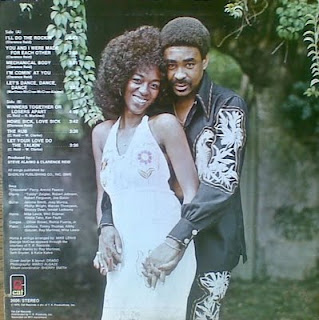
The album is co–produced (along with Steve Alaimo) by Clarence Reid who also wrote or co-wrote all but one of the tracks. Reid (who also performed X-rated material under the pseudonym Blowfly) was a singer, songwriter, producer, musician wunderkind.  
 
A little of this goes a long way, and most of it sounds the same to me. But then again we needed this type of music, if for nothing else, than to give punk a point of reference it could be antagonistic towards.
 
Tracks (best in italics)
  • I'll Do the Rockin'  – 3:42 – aaahhh sexual chocolate. Where is Eddie Murphy when you need him? Sexy vocals and sexy music. Innuendo galore but otherwise a straight 70s soul song.
  • You and I Where Made for Each Other –  3:08 – Perfunctory soul.
  • Mechanical Body  – 3:01 – yawn.
  • I'm Comin' at You  – 3:12 – More innuendo ..in its own way this is becoming stiflingly dull.
  • Let's Dance, Dance, Dance  – 3:36 – a touch of Eurodisco on this one …and like most Eurodisco entirely forgettable. There is a lift from K.C. and The Sunshine band's "That's the Way I like it " half way through. My toe is tapping on this one.
  • Winners Together or Losers Apart –  4:05 – the point of the song is in the title which is also the first lyric of the song. They should have stopped after that.
  • Home Sick, Love Sick  – 3:42 – no funk here
  • The Rub  – 3:36 – I wish someone was here to give me a rub.
  • Let Your Love Do the Talkin' –  3:36 – and your legs do the walkin …away from the stereo speakers …..
And… 

OK, this has probably been sampled into oblivion but regardless the songs are samey, stupid and just not fun. This is supposed to be sexy seventies soul music but actually it leaves one quite limp. It is the aural equivalent of a bad handjob. I'm selling. Clearly, I'm not foxy.

Chart Action
 
US
Singles
1976  Winners Together, Losers Apart  R&B Singles #44
Album
#33 R&B 1976

England
Singles
Album
––

Sounds
 
I'll Do the Rockin' 
attached

You and I Where Made for Each Other


Mechanical Body 

 
Let's Dance, Dance, Dance 

Winners Together or Losers Apart 
 
Home Sick, Love Sick  
 
The Rub  
also attached

Others
 
Review
 
Bio
 
 
Website
 
Trivia
—
 
Other Comments
—
 
Picture
 
Back sleeve ….foxy.

 
(originally posted: 19/06/2011)

Posted in Soul, Funk & Disco | Tagged | Leave a comment

BOBBY GOLDSBORO – Bobby Goldsboro – (Epic) – 1981

what Frank is listening to #213 –  BOBBY GOLDSBORO – Bobby Goldsboro – (Epic) – 1981
Way back in what Frank is listening to #31 I said:
 
As if there wouldn't be a Bobby Goldsboro LP in the pile somewhere … the guy put out a lot of albums …. and they are staples in op shops …in fact I think there are some others in the "pile"of vinyl behind me.
 
This is one of those.
 
Here Bobby has gone country ….well as country as he can go. He's sporting a moustache, wearing a cowboy hat, and has some wood panelling behind him. But is this enough?
 

Here is some meaningful wikipedia background: Goldsboro was born in Marianna, Florida. In 1941, Goldsboro's family moved 35 miles north from Marianna to Dothan, Alabama. He graduated from Dothan High School in 1959, and later enrolled at Auburn University. Goldsboro left college after his second year to pursue a musical career. He played guitar for Roy Orbison from 1962 to 1964, while releasing a few unsuccessful singles….Goldsboro's solo career picked up steam with the "Top Ten" hit "See the Funny Little Clown." The self-penned single reached No. 9 on the U.S. national charts in early 1964. It sold over one million copies, and was awarded a gold disc. It was to be the first of a string of similar awards. Goldsboro would go on to have 11 Top 40 hits on the Billboard Hot 100, and 12 on the country chart….His biggest hit was 1968's "Honey", a maudlin tear-jerker about the death of a man's young wife. The song, written by Bobby Russell, was recorded in one take. It topped the U.S. chart for four weeks, reached Number 2 in the UK Singles Chart on two separate occasions (1968 and 1975), and was a #1 single in Australia. The single sold in excess of one million copies. It also became his first country hit, and marked a career transition, as his songs became more successful on the country chart than on the pop side. Goldsboro's last "Top 40" hit on the "Hot 100" came in late 1973, but he remained a fixture in the country top 40 into the early 1980s.
 
I also said this in #31: I have nothing against Bobby but unfortunately he was the least interesting of the male soft pop country / singer-songwriters of the 60s. The music is quite bland and was intentionally so to appeal across the board… and worse still there is a fair bit of schmaltz in here. His big hit was "Honey" from 1968 and if you haven't heard it you must.( preferably on drugs with the lights out). It is the last throw of the teenage death song ( though this is an "adult" death song) which were quite popular in the late 50s / early 60s ( "Tell Laura I Love Her","Teen Angel, "Endless Sleep", "Leader Of The Pack", "Last Kiss", "Johnny Angel", "Ebony Eyes")
 
from wikipedia: His biggest hit in both fields was 1968's "Honey", a controversial tear-jerker detailing the tragic death of a man's young wife. The song, written by Jimmy Webb, was recorded in one take. The single reached Number 2 in the UK Singles Chart on two separate occasions (1968 and 1975), selling in excess of one million copies. In Australia, "Honey" also made it to #1. The track was also # 1 in the US.
 
All this from a guy who started playing guitar for Roy Orbison ( though Roy has dabbled in a fair bit of schmaltz himself). What Bobby does have is : he's not a bad songwriter and he has incredibly good taste when it comes to choosing covers. 

 
So, what do we have here? Not surprisingly … schmaltz. Albeit schmaltz with a country flavour. The country music industry is not afraid of schmaltz so Bobby would be a perfect fit I think. Maybe it's a little overdone but the 80s were not the best years for country anyway.
 
But, I will say that this is so slick that some of it is irresistible and totally pleasant like fairy floss when you are wasted. I will not be in a bar smoking cigarettes and knocking back a whiskey listening to this but I could quite happily have this playing in the background as I'm having a coffee, probably a Café Bombón,  and a shortbread biscuit …..
 
oh yes, it's as country as some of the recent alt country acts.
 
Tracks (best in italics)
  • Goodbye Marie -McDaniel,Linde – Dennis Linde is a legend (he wrote Elvis' "Burning Love" and many other great tracks) …here he hangs high also. Pop and pap but still convincing and with a quirky edge.
  • Love Ain't Never Hurt Nobody -Goldsboro- barf
  • Let The Little Bird Fly –Killen,Putman- any song with this title has to be perfectly ethereal or it will die. This one dies.
  • Just The Way Merle Travis Used To Play  – Goldsboro – Merle would never play this but full points to the homage.
  • Me And You –Gibb- nup, but  I could see Gene Pitney doing this and making a treat out of it.
  • Alice Doesn't Love Here Anymore  -Goldsboro- a reference to Scorsese's squalid contemporary Americana film from 1974 perhaps? Yes, in name only but this is a total throwback to the sickly sweet "Honey"  Bobby did so well. Not sure if it works in the 1980s.
  • Wings Of An Eagle  -Goldsboro- I was hoping for a cover of Russell Morris magnificent power ballad …..to no avail
  • I Got A Thing About You Baby -White- a great song by Tony Joe White who wrote "Polk Salad Annie" which Elvis covered. Elvis also covered this one ….and I would think Bobby is doing Elvis version, given the tempo, rather than Tony Joe's original. A good version but it's a good song.
  • Love Has Made A Woman Out Of You – Weatherly- wow …I love how country music can "PG" something when it needs to. You've become a woman since you've pulled a root. Hello. The best thing is that, apparently according to the lyrics, sex gets rid of freckles. Fair enough.
  • Green Eyed Woman, Nashville, Blues -Goldsboro- crap
And…
 
I didn't have high hopes and I wasn't let down. Still … tape a couple of congs (congs? … too many wines, I meant "songs" thank God for werdchek) and sell.
 
Chart Action
 
US
Singles
1980 "Goodbye Marie"  Country#17 
1981 "Alice Doesn't Love Here Anymore"   Country#20     
1981 "Love Ain't Never Hurt Nobody" Country#19

Album
#54 Country
 
England
Singles
Album
––

Sounds

 
Goodbye Marie

Love Ain't Never Hurt Nobody
http://www.youtube.com/watch?v=L5-sN1eGGfk
 
I Got A Thing About You Baby
attached
original
elvis cover
Love Has Made A Woman Out Of You
attached
 
Others
Honey":
 
Review
—
 
Bio
 
 
Website
 
 
Trivia
  • wikipedia: "Goodbye Marie" is a country-pop song written by Mel McDaniel and Dennis Linde. The song is about a man who has to leave his lover to head for "the lonesome highway" back to his home in Houston, Texas.Bobby Goldsboro took a version of the song to #17 on the Billboard Country chart in 1981. Kenny Rogers later covered the song on his 1979 #1 album Kenny. Although the song was not issued as a single at the time, after Kenny Rogers signed to RCA Records his former label Liberty Records issued a newly overdubbed version as a single that went to #47 in 1986.McDaniel also released the song on his I'm Countryfied album in 1981, and as the B-side of his single "I Call It Love."
Other Comments
 
what Frank is listening to #31 – BOBBY GOLDSBORO – Today – (United Artists) – 1969
 
(originally posted: 12/06/2011)

Posted in Pop Rock, Soft Rock | Tagged | Leave a comment

CHRIS HILLMAN – Clear Sailing – (Asylum) – 1977

 what Frank is listening to #212 – CHRIS HILLMAN – Clear Sailing – (Asylum) – 1977 

Anyone even remotely interested in country rock knows Chris Hillman. His PR is not as successful as many others in the genre but he was a key player in country rock and the west coast sound. He was in many groups including: The Scottsville Squirrel Barkers, The Hillmen, The Byrds, The Flying Burrito Bros, Manassas, The Souther-Hillman-Furay Band, McGuinn Clark & Hillman, Ever Call Ready, Desert Rose Band, Rice Rice Hillman & Pedersen and Chris Hillman & Herb Pedersen.
 
Look at his resume…..there is a lot going on and he is still quite active in music. Go to the links for his bio. But for the sake of placing him in context I refer to wikipedia for some short background:
 
Christopher Hillman (born December 4, 1944, Los Angeles, California) was one of the original members of The Byrds, which in 1965 included, Roger McGuinn, Gene Clark, David Crosby, and Michael Clarke.
 
Along with frequent collaborator Gram Parsons, Chris Hillman was a key figure in the development of country rock, virtually defining the genre through his seminal work in The Byrds and The Flying Burrito Brothers, and later became the leader of the country act Desert Rose Band.
 
That whole country rock genre threw up a lot of errr, cow shit, but Hillman is the real deal and perhaps a natural cornerstone of the movement having been a lad born in LA and brought up on a California ranch listening to cowboy and country music. Country stylings appear in all his music from the very earliest to the most recent.
 
Having said that it is also true that as the 70s progressed "country rock" grew increasingly slick and dull, despite or because of it's popularity. The rough regional accents were ironed out, lyrics were toned down, authentic country instruments were replaced with standard rock ones or worse, were played to fit into a MOR sound and most unfavourably of all the elation and emotion in the best of country was replace by a cool, stoned detachment. It reached it's peak with with the amazingly facile Eagles who despite their limitations managed a handful of good tracks.
 
Of course there is room for this smooth country rock but with a few exceptions it doesn't date particularly well and isn't all that memorable, though some idiots will champion it.
 
At the time country rock sold bucketloads but most musical genres gravitate to the middle to sell more records and if there ever was a genre where the good in the genre was marginalised in the music charts it would have to be this one.
 
This album unfortunately is very much of it's time …a late 70s country rock album with all the limitations described above.
 
It's a slippery slope from country rock to soft rock with country overtones …..

 
Produced, slickly, by Jim Mason who did a lot of country rock production the album also has Richard Marx on backing vocals and rhythm guitar (remember him?…the MOR rocker who hit in big in the late 80s, briefly) as well as a number of country rock session muso stalwarts in support, including Michael Clarke (former band mate and Byrd) on tambourine on one song.
 
They play well but what does give the LP character is Hillman.
 
The biggest fault and this is almost unforgivable is that music of this ilk inspired many lesser talents to imitate the sound.

 
Tracks (best in italics)
  • Nothing Gets Through -Hillman, Knobler- any country rock album that opens with a song that starts with horns, and not of the mariachi kind, makes me uneasy. Having said that the harmonising is distinctly country rock and the song isn't all that bad.
  • Fallen Favorite – Hillman, Knobler – very slick …. but persuasive in it's own way.
  • Quits-OKeefe – a cover originally done by the vastly underrated Danny O'Keefe. This is effective though at odds with the other tracks.
  • Hot Dusty Roads- Hillman, Knobler, Stills – Co-writing is added by fellow country rock traveller (and former Manassas band mate) Stephen Stills. Country rock and familiar themes.
  • Heartbreaker- Sager, Wolfert – Carole Bayer Sager and David Wolfert was a hit (#1 Country, #37 pop) for Dolly Parton in 1978. It seems that Dolly was covering Hillman. Song co-writer Wolfert also played session for Dolly on her version. Hillman's version, at least in it's album form, is clearly album material with an extended and slightly 70s trippy guitar solo. It would have been a pretty good pop country ballad without the wankery at the end.
  • Playing the Fool- Hillman, McCorison – I'm cutting Hillman a lot of slack here. This is jazzy soft rock …and not good jazzy soft rock, if there is such a thing.
  • Lucky in Love- Hillman, Knobler – hmmm
  • Rollin' and Tumblin'- Hillman – a dramatic relationship song …
  • Ain't That Peculiar -Moore, Robinson, Rogers, Tarplin – here is a cover out of left field …. the 1965 Marvin Gaye song and hit (#1 R&B, #8 pop), written by Smokey Robinson, .
  • Clear Sailin'– Hillman, Marx, Roberts – yet another slick mid tempo ballad but with some persuasive lyrics …
And…
 
Pleasant but not especially memorable ….but for the sake of completeness I'll keep it ….
 
Chart Action
 
US
Singles

—Album
#188 Billboard Top 200

 
England
Singles
Album
––
 
Sounds
 
Quits   
attached

Clear Sailin'
attached
 
Others
 
 
Review
 
 
Bio


Website
 
 
Trivia
  • co-writer on many of the tracks was Peter Knobler who was editor of US rock magazine Crawdaddy.
Other Comments
—
 
(originally posted: 05/06/2011)

Posted in Country Rock, Soft Rock | Tagged | Leave a comment

COMPTON & BATTEAU – in California – (Columbia) – 1970

 what Frank is listening to #211 – COMPTON & BATTEAU – in California – (Columbia) – 1970

I didn't know anything about this band when I bought this album. The pastoral setting on the back and front and the year it came out persuaded me to part with my money.
 
As it turns out there is precious little of Messrs Compton & Batteau. They were however in the 60s group Appaloosa, and I have at least one of their albums in the pile behind me (unlistened to).
 
The entire allmusic entry for Compton & Batteau is: Guitarist John Parker Compton and violinist Robin Batteau were playing the coffeehouse circuit together in Cambridge during the late '60s before forming the band Appaloosa. Also including bassist David Reiser and cellist Eugene Rosov, Appaloosa was signed to Columbia Records in 1969, and had an LP on the shelves before the year was out. The Cambridge folk-influenced founding duo followed up their band's self-titled album with the 1970 recording, Compton & Batteau in California, before going their separate ways; Compton recorded a solo album, To Luna, the following year, and resurfaced in the '90s with some new recordings, while Batteau went on to play in a duo with his brother David Batteau, before joining the late-'70s band Pierce Arrow, then working as a studio musician.
 
This album has taken the obvious folk rock influences, added a few spoons of baroque pop, a dash of country, a pinch of rock, a touch of classical and a whole lot of singer–songwriter. This type of stew succeeds or fails on the strength of the song writing and here it is certainly above average, even memorable. Clearly the record executives entertained a project like this because of the success of other similar duos: "Simon & Garfunkel" and "Brewer & Shipley". Those comparisons will always exist but Compton & Batteau have written some disarmingly emotionally naked songs. The baroque pop songs sit nicely together with the pastoral themed songs. If you are looking for a pigeon hole… "folk baroque" is apt. (Folk Baroque – is a mix of folk and classical music or instruments normally used in classical music….see: Donovan, The Beatles, Gordon Lightfoot, Tom Rush, Nick Drake, Bobbie Gentry, and Tim Hardin)
 
What strikes me most about this album is that it sounds so contemporary though I acknowledge the contemporary music it sounds like is quite retro at times. This music could have been created by any number of alt country / Americana artists around today. Perhaps its not cynical enough and some of the rockier sounds and in-between track snippets are a little "1970" but the rest certainly fits in with todays sound. At least to my ears.
 
Robin Batteau plays guitar, violin and provides vocals and John Parker Compton provides guitar and lead vocals. The LP also features appearances from Jim Messina of Loggins & Messina on electric lead guitar, Rusty Young of Poco on pedal steel guitar and Randy Meisner of The Eagles on bass, King Errisson (Conga), Robin Lane (Vocals), Bill Elliott (Keyboards), John London (Bass), Patrick Shanahan (Drums), John Ware (Drums). The album is produced efficiently by Abner Spector.


Tracks (best in italics)
  • Laughter Turns to Blue  – a magnificent track and very contemporary. A slight "Lou Reed goes country" feel to it.
  • Silk on Steel – nice …with effective violin ….
  • Honeysuckle   – wacka wacka Tony Joe White guitar with groovy lyrics very much like Simon and Garfunkel when they tackled uptempo rock tunes. Nothing wrong with that, though very much of it's time.
  • Elevator – magnificent melancholy song reminiscent of (my favourite) David Ackles.
  • Homesick Kid   – another good song though not as good as the ones preceding it.
  • Proposition –   again …Lou Reed goes folk or country. It's not the pitch or the tone of the voice but the phrasing.
  • Grotto Farm   – nice piano and violin,  elegant and understated …perfect with a wine.
  • Essa Vanessa   – nice harpsichord, tempo shifts, piano and organ …. you're not likely to hear anything like this today … the attention to detail is no doubt a result of Brian Wilson and The Beatles mini symphonies.
  • Zephyr   – a pleasant ballad.
  • California – a big ballad by Compton and Batteau standards and fairly standard …. a narrative song rather than a personal lament or exposition. It is pleasant but doesn't really fit in with the rest of the album.
And…
 
This is top shelf quirky folk rock ….. I'm a keepin'.
 
Chart Action
 
nothing anywhere
 
Sounds
 
Laughter Turns to Blue  

Honeysuckle
  
Elevator   
attached
 
Grotto Farm  
attached
 
Others
—
 
Review
—
 
Bio


http://www.garagehangover.com/?q=JohnCompton

 
Abner Spector
 
Website
—
 
Trivia
  • Robyn's brother David Batteau wrote many hit songs like Robert Palmer’s “Addicted to Love”
Other Comments
—
 
Picture
 
back sleeve
 

(originally posted: 29/05/2011)

Posted in Folk Rock, Sunshine Pop and Baroque | Tagged | Leave a comment

JERRY LEE LEWIS – Sometimes A Memory Ain’t Enough – (Mercury) – 1973

what Frank is listening to #210 –  JERRY LEE LEWIS – Sometimes A Memory Ain't Enough – (Mercury) – 1973
Jerry Lee Lewis,Sometimes A Memory Ain't Enough,USA,Deleted,LP RECORD,305878
 
The Killer.
 
I'm not sure where to start with any discussion on Jerry Lee Lewis.
 
So I'll start where I know I can, and where I'm most predictable.
 
Like Elvis, Jerry Lee was from the South, recorded at Sun, never wrote any of his own material, and sang like there was no tomorrow.
 
Unlike Elvis he never had the range or ambition but he certainly did have the charisma and ego and quite rightly has been described as "rock & roll's first great wild man".
 
Despite the similarities with Elvis a more apt comparison, career wise, would be his occasional verbal sparring partner Little Richard, whose career, choice of musical instrument (piano), narcissism and mind boggling vacillations between rock and religion make him and Jerry Lee look like two peas in a pod.
 
But, it was largely because of his cultural associations (the South) with Elvis that I had heard of him and so in 1978 at the Mt Gravatt Flea Market (all ugg boots and hot pants …the ones with the split up the side and the shoestring bringing the panels together) I handed over 50c for a old EP of Jerry Lee … it had all his big 50s hits on it and I was hooked. Eventually I got to see him live ….. in the late 80s.
 
Like Elvis he has suffered as a result of the ridiculous PC rock debate (rock music origins: black or white? or rock music origins: country or R&B?). But, also like Elvis he has transcended the argument (well, transcended it unless you are wholly ignorant). You would be hard pressed to find a original 50s rock act, apart from Johnny Cash, with more obvious and continuous country influences. Carl Perkins, Elvis, rock era Charlie Rich certainly all had obvious country music in their souls but Jerry Lee wore his country music on his sleeve. If there are any ignorant arguments about the origins of rock not being both white and black then a cursory listen to early Jerry Lee should settle the argument.
 
Likewise if you think country rock started with Gram Parsons, think again …go back to the 50s rockers from the South.
 
wikipedia: Jerry Lee Lewis (born September 29, 1935) is an American rock and roll and country music singer and pianist. …Lewis was born to the poor family of Elmo and Mamie Lewis in Ferriday in Concordia Parish in eastern Louisiana, and began playing piano in his youth with two cousins, Mickey Gilley and Jimmy Swaggart. His parents mortgaged their farm to buy him a piano. Influenced by a piano-playing older cousin, Carl McVoy (who later recorded with Bill Black 's Combo), the radio, and the sounds from the black juke joint across the tracks, Haney's Big House, Lewis created his style from black artists who were unable to play to white audiences, mixing rhythm and blues, boogie-woogie, gospel, and country music, as well as ideas from established "country boogie" pianists like recording artists Moon Mullican and Merrill Moore. Soon he was playing professionally.
 
By way of bio – you google – there is a lot out there on him.

 
Jerry Lee's place in the rock n roll sun only lasted a few years at Sun, err records (…harrr)  before he turned to "straight" country … well as straight as Jerry Lee can be. He swung between rock and country though you wouldn't be able to tell as his rock albums have a fair bit of country in them and vice versa. If he was 20 or 30 something today his music would certainly be called roots rock or country rock.
 
So, despite the country influences in Jerry Lee's rock 'n' roll he eventually turned to Nashville and straight country though like I have said his country was heavily influenced by honky tonk and country boogie and accordingly laced with rock 'n' roll. That and his personal life put him at odds with conservative Nashville tastemakers but he had great success with country audiences (as did some other ex–rockers from the 50s: the great Charlie Rich, Johnny Cash, Jack Scott, Conway Twitty, Crash Craddock). We, who do not reside and did not grow up in the USA,  love Jerry Lee for his rock 'n' roll but there is another entirely different generation and demographic in the US who love him for his country music. From the late 60s through most of the 70s Jerry Lee had many, many country hits.
 
As it stands his influence on his fans and on fellow musicians is immense, despite the fact there are relatively few covers of his music out there.
 
wikipedia: Lewis was inducted into the Rock and Roll Hall of Fame in 1986 and his pioneering contribution to the genre has been recognized by the Rockabilly Hall of Fame. In 2008 He was inducted into the Hit Parade Hall of Fame. In 2004, Rolling Stone Magazine ranked him number 24 on their list of the 100 Greatest Artists of All Time. In 2003, they listed his box set All Killer, No Filler: The Anthology number 242 on their list of "500 greatest albums of all time".
 
Jerry Lee is a great interpreter of song like Elvis was. They never wrote songs, though they were happy to replace, change or drop words and lines as well as change meanings and tempos sometimes rendering the song altogether different (and often better) to the original. Vandalism of songwriters work perhaps but that is what a great vocalist is – an interpreter of songs. A good vocalist can fake sincerity (and fool listeners) in a song by substituting technique for emotion. But, a great vocalist has the technique and also has the smarts to adapt the song so they can connect emotionally to it. Arguably they already have by choosing the song to cover but to personalise it they need to play around with the words and music normally. If this is "re-writing" a song then so be it. As long as the royalties go to the songwriter everyone is happy.
 
Vocally, Jerry Lee (and Little Richard is in the same boat) doesn't have the nuances that Elvis does. Elvis, vocally, could make a song sound like a brag, a innuendo, a love poem, a night on the town and many other things. Sure, like Jerry Lee, he had his vocal tricks or trademarks that are "instant Elvis" but as an interpreter he could make his voice sound to whatever the songs meaning was and that included vulnerability and uncertainty. Jerry Lee however only ever sang as if he was threatening you. He was bragging but he was willing to back it up, with violence if need be. Within those limitations (if they are indeed limitations) his voice could be evoke sincerity, reverence and love. He can sing about success and failure with a confidence that does not allow you to deny the truth (if you dare) of the narrator words. Every song he sings he sings as if they were his stories. And they may have been his stories but he certainly didn't write the lyrics. It matters not because they become Jerry Lee's stories and if you need further proof Jerry Lee has always been happy to name check himself in a song.
 
Ultimately, if you aren't convinced by Jerry Lee I suspect he would knock your block off or give you a giant "fuck you".
 
This album comes from Jerry Lee's country period and has all the traits I have referred to above. It also has some underwhelming cover art … a wistful Jerry Lee and a tree.  
 
It is one of the only Jerry Lee albums I don't have so I'm quietly excited …"quietly" because I know how patchy his 70s output can be.
 
Tracks (best in italics)
  • Sometimes a Memory Ain't Enough – Kesler – a country weepie with some typically fine piano playing from Jerry Lee …. I feel like I'm drinking a whisky in a smoky bar (albeit one with sawdust on the floor).
            I have your pictures to look at and a memory that helps me when I'm blue
            I play those old records that we used to dance to
            But these things can't take the place of you
            I need me two arms to hold me warm and tender lips that I can touch (yes I do)
            Yes I play my game but it's not the same sometimes a mem'ry just ain't enough
  • Ride Me Down Easy – Shaver – a gentle rollicking song by outlaw country legend Billy Joe Shaver. Great lyrics. Deceptively simple, lyrical and quite visual. What is it with country imagery? This song has been done by everyone: Waylon Jennings, Bobby Bare etc.
            The highway she's hotter than nine kinds of hell
            The rides,they as scarce as the rain
            When you're down to your last shove with nothin' to sell
            And too far away from the train
            Been a good month of Sundays and a guitar ago
            Had a tall drink of yesterday's wine
            Left a long string of friends,some sheets in the wind
            And some satisfied women behind
            Hey ride me down easy Lord,ride me on down
            Leave word in the dust where I lay
            Say "I'm easy come,easy go and easy to love when I stay"
            Left snow on the mountain,raised hell on the hill
            Locked horns with the devil himself
            Been a rodeo bum,a son-of-a-gun
            And a hobo with stars in my crown
            Hey ride me down easy Lord,ride me on down
            Leave word in the dust where I lay
            Say "I'm easy come,easy go and easy to love when I stay"
  • Mama's Hands – Dycus, Kingston – a familiar country weeper …much like Merle Haggard's "Mama Tried" in sentiment but with a positive outcome. Sticky sweet but sincere. George Jones did a well known version of the song. Someone has changed some of the words of the original here ….
            My daddy's hands held Three's and Two's while mom's were holding me
            And daddy's hands lost everything to a hand of Kings and Three's
            And daddy's hands they shook so bad that he turned to wine
            But mama's hands were strong and calm as they held on to mine
 
            Yes mama's hands held on to mine to guide me day and night
            And it took the sting of mama's hands to teach Jerry Lee wrong from right
            When times were bad and money's slim she'd fold her hands in fray
            Ands somehow neighbours would always make the beans hold out another day
 
            Now mama's hands they tremble when she prays
            But her voice is strong as she thanks God for the bygone days
            She looks at me and then she smiles she knows I understand
            That everything I am today I owe to mama's hands 
            Everything Jerry Lee is today I owe to mama's hands
    
  • What My Woman Can't Do – Jones, Montgomery, Sherrill – another country weepie and another song George Jones has done.
  • My Cricket and Me – Russell  – yet another country weepie – this one by the great Leon Russell.
  • I'm Left, You're Right, She's Gone – Kesler, Taylor – a cover of an old Elvis song from his Sun record days. I don't know for sure but Jerry Lee probably would have tried to record this before – he did a lot of other peoples Sun stuff. Not as good as Elvis but still a very credible version.
  • Honky Tonk Wine – Vickery  – just what the title says – also done by Mickey Gilley. A magnificent, laid back honky tonk that is country rock. Jerry Lee is on fire here, even banging the lid of his piano to the rhythm ( an old live trick of his)… the writer of this song probably played harmonica somewhere here as he did on a lot of Jerry Lee Mercury records recordings ..he also wrote Lewis immortal "Meat Man".
  • Falling to the Bottom – Holland, Leonard – another country weepie, well done but not particularly memorable.
  • Think I Need to Pray – Harrelson, Taylor – some reading from the Good Book will save this country hell raiser and sinner. It's sincere but it didn't stop Jerry Lee from re-offending.
  • Mornin' After Baby Let Me Down – Griff – by Canadian country singer Ray Griff  …. a country song title if there ever was one.
  • Keep Me from Blowing Away – Craft – also done by Linda Ronstadt (later) and others. A prayer for redemption … country style.
            Well I spent my whole lifetime
            In a world where the sunshine
            Finds excuses for not hangin' 'round
            I squandered emotions
            On the slightest of notions
            And the first easy loving I found
            But soon all the good times
            The gay times and play times
            Like colors run together and fade
            Oh Lord if you hear me
            Touch me and hold me
            And keep me from blowing away
            There's times when I trembled
 
And…
 
It's Jerry Lee …. I'm keeping it. I'd be scared not to. Lawrence Tierney from Seinfeld comes to mind.
 
Chart Action
 
US
Singles
1973  Sometimes a Memory Ain't Enough   #6 Country Singles
1974  I'm Left, You're Right, She's Gone  #21 Country Singles
Album
1974 #6 Country Charts
England
Singles
Album
you're kidding aren't you

Sounds

 
Sometimes a Memory Ain't Enough
attached
 
Ride Me Down Easy
original by Shaver
done recently
Mama's Hands
George Jones version
 
I'm Left, You're Right, She's Gone
the original
Honky Tonk Wine
attached
the original
Others
 
 
Review
—
 
Bio
 
 
Website
 
Trivia
Other Comments
—
 
Picture
 
Jam session, 1956, Memphis.
 
(originally posted: 22/05/2011)

Posted in Country, Rockabilly and Rock n Roll | Tagged | Leave a comment

ALBERT HAMMOND – When I Need You – (Epic) – 1977

 What Frank is listening to #209 – ALBERT HAMMOND – When I Need You – (Epic) – 1977

Happy Eurovision to you all!
 
I'm not sure if a Hammond tune has ever been in the Eurovision but in some ways his music perfectly represents the best (not the worst) of the Eurovision. (I can't believe Croatia didn't qualify).

 
If anyone hears this album I'm going to get a lot of shit.
 
But let me defend myself first ……
 
Refer to what Frank is listening to #169 – ALBERT HAMMOND – The Free Electric Band – (CBS) – 1973 for more detail. Amongst other things, I said this there:
 
Hammond, a Gibraltarian (born in London because his family were evacuated there during World War 2 but returning to Gibraltar immediately after) had been banging around the music scene from the early 60s and vacillated between England and Gibraltar, which probably explains his easy relocation to L.A. later. I would think L.A. resembles (climate wise)  Gibraltar more than London. Hammond has also released albums ( and recorded many of his songs) in both English and Spanish. Again, L.A. with it's sizeable Hispanic population may have appealed to him,.
 
 
A quick google gave me this:
 
A common misperception of me is… Probably where I’m from. I was born in London but raised in Gibraltar and I guess both places try to claim me. I often ask myself, ‘if I wasn’t famous, who’d want me?’ but I feel very Gibraltarian and really identify with the place. It was great to grow up there and it taught me to be instinctive – almost like a street kid. I learned to speak on the streets, both in Spanish and English.
http://www.independent.co.uk/news/people/profiles/the-five-minute-interview-albert-hammond-singer-and-songwriter-1544687.html

 
I loved that last Hammond album I commented on which was singer–songwriter pop, well done with taste and thought.
 
This album is straight MOR (middle of the road) and a lot of the cringe worthy elements of male MOR are here. Dramatic lyrics, words laden with meaning, overwrought arrangements and a distinct lack of humour. But, there is something worthwhile going on here…… sincerity and sensitivity. Hammond is like a more sensitive Tom Jones who seduces his listener rather than beats  them into submission. The other point of comparison and probably a better one would be 70s era Neil Diamond though without Neil's occasional lapses into pretension.
 
The quality of the song writing is high (including co-writes with Carol Bayer Sager and Burt Bacharach partner Hal David) but Hammond's knack is to hook the words together into catchy lines and then throw them onto equally catchy melodies. He finishes it off with some heart on the sleeve singing. Any further and he would be a caricature of the genre but his taste (and smarts I suspect) keep him on the grassy side of the paddock.
 
Still, I can see a lot of shit coming my way.
 
Tracks (best in italics)
  • Tangled Up in Tears – Hammond, Leikin-  Hammond's response to Dylan's "Tangled up in Blue"? Despite (or maybe because of) the fact this sounds like the songs in the musical interlude skits from the mid 70s Benny Hill Show this is quite catchy. But then again so was the Benny Hill Show … and it was educational to boot.
  • To All the Girls I've Loved – Hammond, David- an updated version of the same song from his 1975 album "99 Miles from L.A.". This is pure mush and undeniably well written mush. This was a big hit for Willie Nelson and Julio Iglesias in 1984 ( Country #1, Adult Contemporary #3, Billboard Hot 100 #5 ). Excellent, though …. err, incredible mush.
  • Kaleidoscope   – Hammond, David – fairly standard love and life is a confusing kaleidoscope.
  • Rivers Are for Boats -Hammond, David – an updated version of the same song from his 1975 album "99 Miles from L.A." A bouncy love song with a slight Latin carnival feel – that Benny Hill thing appears again also …. all the way down to the "la, la , la ,la" chorus. But it's catchy.
  • You and I   -Hammond, Sager – a radio friendly 70s big ballad
  • 99 Miles from L.A. -Hammond, David –  an updated version of the same song from his 1975 album "99 Miles from L.A." Pleasant.
  • When I Need You – Hammond, Sager – a big hit for Leo Sayer in 1977 (Adult Contemporary #1, Billboard Hot 100 #1,R&B Singles #94 ). It has been covered many times. A history of the song: http://en.wikipedia.org/wiki/When_I_Need_You , Catchy mush.
  • Cry, Baby -Hammond, Sager –  Filler.
  • Moonlight Lady -Hammond, Sager – a #17 Adult Hit for Julio Iglesias in 1984. Catchy
  • All Alone Am I -Altman, Hadjidakis, Ioannidis – The Brenda Lee hit from 1962 (Adult Contemporary #1, The Billboard Hot 100 #3 ). Lightly dramatic.
And…
 
I like this album … I'm keeping it.
 
Chart Action
 
US
Singles
1975  99 Miles from L.A.  Adult Contemporary #1, Billboard Hot 100 #91
Album
––
 
England
Singles
––
Album
––
 
Sounds
 
Tangled Up in Tears  
attached
To All the Girls I've Loved Before   
live

the cover
Kaleidoscope  
99 Miles from L.A.  
live
When I Need You 
the cover
attached
Cry Baby  
Moonlight Lady  
 
Others
It Never Rains in Southern California
 
Review
 
 
Bio


Website
 
 
Trivia
    • ( for you yung uns) ….Albert's son, Albert Hammond, Jr. is a successful solo musician and also a member of The Strokes.
    • In 1970 Albert produced the album "Coming From Reality" for Detroit folk-rock star and cult legend Rodriguez.
    Other Comments
     
    what Frank is listening to #169 – ALBERT HAMMOND – The Free Electric Band – (CBS) – 1973
     
    (originally posted: 15/05/2011)


    Posted in Singer Songwriter | Tagged | Leave a comment

    JOE SOUTH – Games People Play – (Capitol) – 1969

    what Frank is listening to #208 – JOE SOUTH – Games People Play – (Capitol) – 1969
    I am a big fan of the song "Walk a Mile in My Shoes" which I first heard as an Elvis cover.
     
    If you were a songwriter you would want Elvis to cover one of your songs wouldn’t you?
     
    And Elvis suits South’s music perfectly. It’s surprising that he didn’t record more Joe South tracks.
     
    Joe South wrote that tune and he also wrote most of the tunes on the compilation of his I’ve got which is a mixture of blue eyed soul (southern style) and MOR rock pop.
     
    White southern soul has always tickled my fancy partially because it knows it can’t "out funk" it’s black counterpart but as recompense it can be, and normally is more, "experimental" and, it is also more open to cross fertilisation with other musical styles, especially country and folk.
     
    The high point of the genre – and I know I am biased but it is the highpoint – is "From Elvis in Memphis" by Elvis, from 1969. Others who swam or stuck their toes in these waters include Tony Joe White, the great Bergen White and Bobbie Gentry all who have had their fair share of good tunes in the style. 
     
    Joe South was far more adventurous than any of these.
     
    South had been busy in the background of southern rock and pop in the 60s but he didn’t (mainly) participate in it as a performer till 1968.He had been a songwriter ( "Down in the Boondocks", he also wrote "(I Never Promised You a Rose Garden" later ), a session musician ( he played on Dylan’s "Blonde on Blonde" and Simon and Garfunkel’s "Sounds of Silence" amongst other things), and a producer (for Billy Joe Royal).
     
    Joe South’s background is worth a read – see links below – the guy is either "out there" or just one of the dozens of crazed talented musicians the South seemed to churn out (he was born in Atlanta Georgia 1940).
     
    Unfortunately, his performing career was short and his recorded output was equally short.
     
    By all accounts this album was a rush job to cash in on the hit single "Games People Play". Three songs that had appeared on his "Introspect" album from 1968 ("Games People Play," "Birds of a Feather," and "These Are Not My People") and three other songs ("Untie Me","Concrete Jungle","Hush" ) were South songs others had recorded . But the album does hold together with a very 1969 experimentation "vibe" – there is slight psych nods, some studio trickery, background sound snippets, a lot of societal observational lyrics, some obscure lyrics and songs that seem to overlap and clash with each other. .
     
    Yes, very 1969.
     
    But incredibly endearing and not as dated as you may think.
     
    What holds all the "experimental" aspects together and makes those aspects palatable to the mainstream is South’s voice which is akin to some sort of MOR, southern Tom Jones like crooner. Also there is a theme that more or less runs through the album …the outsider observing and trying to make sense of a mad, mad world. South wrote all the songs here and arranged and produced the album so I suspect he knew what he was looking for and what he wanted to put accross. As I’ve said before, it’s those that look relatively straight that are the most twisted …. .
     
    Certainly, the mix of southern pop, country soul, MOR psych and singer–songwriter stylings creates a kind of experimental lounge music album where the lounge is in a house in Memphis and the guy mixing cocktails is Timothy Leary.
     
    It’s hard not to get sucked up in this album, especially after a couple of vinos. It’s got balls, soulful lopsided balls.
     
    Tracks (best in italics)
    • Games People Play   –  The song that made South’s name. A nice slab of southern soul with some nicely biting lyrics. And it’s a little off kilter also. There is a lot going on here (really, a lot of sounds). I can’t really imagine a song like this appealing to the "masses" …but it did. Must have been something in the water. For all it’s worth it won the Grammy Award for Best Contemporary Song, and Song of the Year. The song has an entry if you want to check it’s influence:       http://en.wikipedia.org/wiki/Games_People_Play_(Joe_South_song)
                Oh the games people play now
                Every night and every day now
                Never meaning what they say now
                Never saying what they mean
     
                And they wile away the hours
                In their ivory towers
                Till they’re covered up with flowers
                In the back of a black limousine
                ….
     
                Look around tell me what you see
                What’s happening to you and me
                God grant me the serenity
                To remember who I am
     
                Cause you’ve given up your sanity
                For your pride and your vanity
                Turns you sad on humanity
                And you don’t give a da da da da da
    • Party People   – More southern soul with touches of blue eyed soul. Again the lyrics are gently biting. Not dissimilar (in observations) to what Ray Davies was doing. Like Davies he seemed to be the outsider looking in.
    • Untie Me   – written by South but a hit for The Tams in 1963 (#60 Top 100, #12 R&B). The song does sound like something from the pre Beatles days but the music certainly has been updated to 1969. Compelling.
    • Concrete Jungle   – another South song which had been a song recorded by someone else apparently ….. don’t know who though. This is a "straight" song and not dissimilar from a number of other white country soul singers.
    • Hole in Your Soul   – very 1969 – sitars, obscure lyrics and all sorts of background mayhem.
    • Hush  – Deep Purple (!) had a US #4 hit with this in 1968 (though they may have been inspired by the version by English singer Kris Ife). I should say this is 60s Deep Purple – a different beast to "Machine Head" age Deep Purple. A magnificent song. Ultra catchy. http://en.wikipedia.org/wiki/Hush_(Billy_Joe_Royal_song)
    • Birds of a Feather   – a mid tempo bouncy ditty, which inexplicably picks up a piece of "Games People Play" at the songs end. Later (1971) a #23 hit for Paul Revere and the Raiders.
    • Hearts Desire  – there’s a bit of The Monkees go south here and I could see Neil Diamond doing this.
    • Leanin’ on You   –  a straight pop soul track.
    • I Knew You When – more country soul …but this one is charged with a lot of emotion. Lots of organ and some surreal aspects. Southern gothic?
    • These Are Not My People   – an almost gentle soul pop number with a biting rebut on a girl of affluence which can be traced back to Elvis’ "Baby Let’s Play House", forward to Hall & Oates’ "Rich Girl" and beyond.
                well, your momma and your poppa sent ya to the finest school
                never let it be said that their little darlin was a fool.
                with a credit card and your good name
                you were drawn like a moth to a flame
                to the people of the night where you more or less lost your cool
     
                it’s been a gas but i’m gonna have to pass
                chorus
     
                these are not my people no
                these are not my people
                and it looks like the end my friend
                gotta’ get in the wind my friend
     
    And…
     
    This is pretty much a great album and it’s a pity that South isn’t more well known. He is good. I’m keeping this.
     
    Chart Action
     
    US
    Singles
    Games People Play  – #12
    Album
    —
     
    England
    Singles

    Games People Play  – #6
    Album
    ––
     
    Sounds
     
    Games People Play   
    and attached

    Party People    
    attached
     
    Untie Me 
    The Tams version
    Concrete Jungle   
    Hole in Your Soul   
    Hush   
    Deep Purple version
     
    Birds of a Feather  
    Paule Rever and the Raiders version
    Hearts Desire   
    Leanin’ on You   
     
    I Knew You When 
     
    Others
     
    Review
     
     
    Bio


    Website
     
     
    Trivia
    —
     
    Other Comments
    —
     
    (originally posted: 08/05/2011)
    Posted in Blue Eyed Soul, Pop Rock | Tagged | Leave a comment