BREWER & SHIPLEY – Down in L.A. – (A&M) – 1968

 what Frank is listening to #57- BREWER & SHIPLEY – Down in L.A. (A&M) – 1968

Brewer & Shipley are mainly known for their #10 1971 hit "One Toke Over the Line", and also for the fact that the song was banned in places due to its marijuana references.

Brewer & Shipley were both folkies from the Midwest, living in LA, who decided to join up and "electrify". The music was, perhaps, a more "harder", more counter culture version of "Simon & Garfunkel" rooted in the west-coast folk rock boom. So, they really bridged the gap between gentle folk (Simon & Garfunkel, The Mamas and the Papas) and electric folk (The Byrds, The Youngbloods, Buffalo Springfield).
 
And, they were certainly respected by their peers as they have been covered quite a bit:
 
Bio:
 
This album is their first and is a product of its times but if you don't mind the "times" then it is pleasant enough. Luckily, the utopian hippie aspects have been played down and the "cynical" folk rock has been brought forward. Perhaps, because of their folk backgrounds, the songs are more questioning of their times though certainly not pointed like Phil Ochs etc. The album is certainly well played as tBrewer & Shipley are backed by stellar L.A. session men (most of them from the group loosely known as "The Wrecking Crew"):
  • Hal Blaine – drums  – played with everyone including Elvis. 
  • Nick DeCaro – strings & horns – Johnny Cash, Gordon Lightfoot, James Taylor, etc .
  • Jim Gordon – drums –  Derek & The Dominos and session musician for The Byrds, The Beach Boys, Eric Clapton, Joe Cocker, Traffic, Frank Zappa etc.
  • Milt Holland – percussion –  Loggins & Messina, Poco, Little Feet, James Taylor, Joni Mitchell, Ringo, Art Garfunkel & others.
  • Mike Melvoin – organ – The Beach Boys (Pet Sounds & Good Vibrations), Frank Sinatra, The Jackson Five, Tony Bennett, Ray Charles, Lou Rawls, Bonnie Raitt, Peggy Lee, Joe Williams, Billy Ekstine, Barry Manilow, Pat Boone, The Four Freshmen, Jon Davidson, The Partridge Family, Tom Waits, Jim Messina – bass –  Buffalo Springfield, Poco, Loggins & Messina.
  • Joe Osborn – bass – Rick Nelson, Johnny Rivers and far too many other artists to list.
  • Lyle Ritz – bass –  session musician for far too many artists to list.
  • Leon Russell – electric piano & organ – Joe Cocker, Willie Nelson, Edgar Winter, George Harrison, Eric Clapton, Bob Dylan, Ringo Starr, John Lennon, J.J. Cale, Bruce Hornsby, B.B. King, Freddie King, Rita Coolidge, Gram Parsons, Barbra Streisand, Ike & Tina Turner, Ricky Nelson, Herb Alpert, Frank Sinatra, Aretha Franklin, Dean Martin, Marvin Gaye, Dave Mason, Steve Winwood, Delaney & Bonnie and Friends, The Monkees, The Ventures, The Beach Boys, The Byrds, Jan & Dean, Gary Lewis & The Playboys, Paul Revere & The Raiders, The Rolling Stones, The Ronettes, The Crystals, The Nitty Gritty Dirt Band, The Everly Brothers, The Righteous Brothers, The Flying Burrito Brothers, and others.
  • Lance Wakely – electric guitar & harp.
Any number of these songs could have appeared on a Byrds album (circa 1966). The instrumentation is certainly lush as well and there is little trace of the country influences that appears in their later music. This album fits in well with "Circus Maximus" and even some "Electric Prunes". The only problem is that over the course of an album the music is a bit samey … but hey, like I said that's not a problem if you are in tune (sic) with Brewer & Shipley, or the late 60s generally.
 
The best tracks:
  • Truly Right
  • She Thinks She is a Woman
  • Green Bamboo
  • Dreamin in the Shade (Down in L.A)
I think I may tape a few songs and chuck this (literally – the record barely made it to the turntable as it is that scratched) but it also actually grows on me … the maybe pile (again – groan – that pile is getting way to big)
 
Cultural references – from wikipedia: "In the first chapter of Hunter S. Thompson's novel Fear and Loathing in Las Vegas: A Savage Journey to the Heart of the American Dream, Raoul Duke's attorney, Dr. Gonzo, sings the line "One toke over the line, sweet Jesus, one toke over the line" while the two of them drive from Barstow to Las Vegas".
 
Sound:
the record is really scratchy
Green Bamboo
Dreamin in the Shade (Down in L.A)
  
 
"one toke over the line" was covered early on – on the Lawrence Welk show – it was assumed it was a "gospel/spiritual" song
original:
cover:
 
Website: (one of the most thorough fan sites I have seen)
 

(originally posted: 4/07/2009)


Posted in Folk Rock | Tagged | Leave a comment

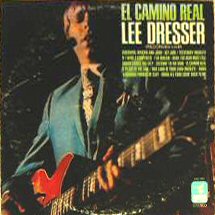
LEE DRESSER – El Camino Real – (Amos) – 1969

  what Frank is listening to #56- LEE DRESSER – El Camino Real – (Amos) – 1969 

I bought this record a long, long time ago, played it once and put it aside to have another listen, which I didn't, till now.
 
I'm not sure what to make of this record (contemporaneous notes):
  • is it a popular musician (aka Sinatra, Dean, Bing etc) doing rock material?
  • is it a rock musician doing rock music in a popular style?
  • or, is it just MOR rock?
Dresser was clearly aimed at the same (affluent) crowd as Trini Lopez and Johnny Rivers and the record was even recorded live in Hollywood.
 
Initially I though Dresser may have been picked up in one of the numerous LA clubs where middle aged hipsters (like us) went out to see the "new" acts. But, there is a energy and edginess in his voice and guitar that removes him from that AO MOR (adults only middle of the road) scene.
 
As it turns out, and I'm slightly surprised I could find anything on him,  he was in a rockabilly band out of Missouri in the late 50s, The Krazy Kats (who still play today on that small but fanatical rockabilly circuit in the US). This he did before being drafted, going to Vietnam, returning, and getting work as a guitarist and harmonica player for Danny Thomas, Dolly Parton, Merle Haggard and the Oak Ridge Boys. In the meantime he put out this, his first album.
 
This album, recorded live (like many Lopez and Rivers albums) is solid though not individual. The songs are a mixture of originals (three) and covers (nine). The covers are pretty unsurprising but they are sung with aplomb. I can't help thinking that Elvis saw this guy whilst he was in living in LA making all those films in the 1960s or, more than likely, this guy saw Elvis in Vegas in 69 (a superficial google search reveals nothing). The pacing and choice of material certainly can be linked to Elvis' first Vegas concerts in the late 60s, and, also bears more than a passing resemblance to Bobby Darin's late 60s output. In fact, I would be surprised if Dresser himself didn't do the Vegas circuits, though not the MGM International like Elvis or the Flamingo like Darin).
 
Dresser's backing band is Glen Hardin (later Elvis' pianist live and in the studio) and Jerry Allison, both from Buddy Holly's band. The record is produced by Jimmy Bowen who is no slouch (though a "rock" kid born in 1937 he acted as producer for Frank Sinatra, Dean Martin,Sammy Davis, Jr. and later did lots of country including Hank Williams, Jr., The Oak Ridge Boys, Reba McEntire, George Strait, and Garth Brooks). Bowen also owned the short lived label, Amos, that this album is on.
 
Best Tracks:
  • El Camino Real – a great finger popping number, and very evocative of time and place (or the way I think of that time and place).
  • If I were a Carpenter – the Tim Hardin number popularised by the great Bobby Darin.
  • Abraham Martin and John  – Dion's great "protest" song.
  • Baby the Rain Must Fall – Glen Yarbrough's great title song to the film of the same name.
  • A Place in the Sun /  This Land is Your Land –  a medley – the first track is the Roger Miller track whilst the latter is, of course, the Woody Guthrie song …. and it works – works in a MOR , darkly lit, nightclub in LA where everyone is trying to out-hip the next person. It is sung with enough conviction to bring some light in the difficult year that was 1969.
If you are in the right mood with the right amount of alcohol this album swings though it really should have come out in 1965 not 1969. Maybe I'll keep it and play it at the 60s themed cocktail parties I intend to have (none of you are invited).
 
Sound:
attached
 
 
Krazy Kats
 
Lee Dresser info:
  
Krazy Kats info: 
 
(originally posted: 02/07/2009)     
Posted in Pop Rock, Rockabilly and Rock n Roll | Tagged | Leave a comment

THE BLUE THINGS – Self Titled – (RCA) -1966

   what Frank is listening to #55- THE BLUE THINGS – Self Titled – (RCA) -1966 

OK, my copy of this LP is a reprint and it also cost more than $1.00 ($9.00, I think).

The Blue Things have been called, amongst other things, the great lost US band of the 1960s. This is perhaps true as this album certainly deserves to be better known than it is.
 
They were from Kansas and had a degree of regional popularity in the Midwest and Texas apparently: http://www.allmusic.com/cg/amg.dll
 
I assume they were one of the many "frat" bands that existed prior to The Beatles who incorporated musical "beat" into their style after the Beatles popularity. See my "Hullaballoos" comment (#52).
 
I first heard of The Blue Things whilst researching Val Stecklein (aka Stoecklein) , the singer and songwriter with The Blue Things. I picked up his 1968 solo album in an op shop years ago and was suitably impressed. The critics are divided on it but what I like is its single mindedness and purity of vision. That's not to say it's great but it is certainly "out there" – he sounds like a baritone Leonard Cohen meeting Glen Campbell in a dark alley.
 
A few of the tracks on that album were done originally here.
 
What is most noticeable is the song writing and voice of Stecklein. His songs weigh heavily on lost love and loneliness whilst  his baritone is slow and deliberate punctuating the lyric for maximum effect (hey look my "comments" are becoming serious and thoughtful). He sings basically at the same tempo regardless of the pace of the instruments behind him (much like some REM where Stipe sings at a tempo a lot slower to the music – though here Stecklein sings even slower still). His voice creates a melancholy feeling that pervades the entire album regardless if the tracks are ballads or rockers.
 
The album has a nice clean sound and is produced by Felton Jarvis who would later "produce" Elvis (he worked at RCA – Felton that is, well Elvis also)
 
This is certainly a distinctive effort.
 
Best Tracks:
 
Most of the album actually ..
  • "High Life"
  • "Girl of the North Country" – yes the Dylan song.
  • "Doll House" –  is about a young prostitute.
  • "La Do Da Da" – the Dale Hawkins rockabilly track.
  • "Look Homeward Angel" – British Beat with a church organ in the background.
  • "It Aint No Big Thing, Babe"
  • "Aint That Lovin You Baby"
  • "I Cant Have Yesterday" – a Phil Spectorish teen loss lament.
  • "Now's the Time"
  • "I Must Be Doing Something Wrong" – Ray Walker, the bass singer from Elvis Presley's backing group The Jordanaires sang on this track also.
  • "Honor the Hearse" – dark? What do you reckon with a title like that?
Definitely a keeper … I may have to go in search of some more music by them. I do have a double LP rock opera on Jesus' life that Stecklein was involved in  – so I will have to go dig that up … (in fact since writing this I have ordered a CD of the Blue Things)
 
Stecklein left the group in 1968 after a breakdown, possibly a result of the usual 1960s drug excesses, and recorded sporadically in subsequent years before dying (suicide?) in 1993. 
 
Sounds:
attached
 
Stecklein (solo – though this song was first done on the Blue Things LP):
 
More history:
 
(originally posted: 30/06/2009)  
Posted in Folk Rock, Garage, Surf and Frat | Tagged | Leave a comment

VARDIS – 100 M.P.H. – (7 Records) – 1980

 what Frank is listening to #54- VARDIS – 100 M.P.H. – (7 Records") – 1980

I had never heard of Vardis before I picked this up but, given the cover art, it was definitely going to be hard rock. It's just a question of what kind?
 
Vardis are from Wakefield, Yorkshire, in England's north … if you knew that and you were a betting man you would be safe to say they weren't going to be playing quirky art pop.
 
Yup, they are an English heavy metal trio. Specifically from the "New Wave English Heavy Metal" movement that came out in the late 1970s and early 1980s  in the UK and was spearheaded by Iron Maiden, Saxon, Motorhead etc. Known as NWOBHM, apparently. I'm not sure how you pronunce that.
 
New Metal was less blues based than the 1970s UK hard rock acts (Led Zeppelin, Black Sabbath, Status Quo, Uriah Heap etc) and it also broke away from some of the indulgences of the 70s UK hard rock scene … ie: extended solos to nowhere, obsessions with pixies and piccolos, Stonehenge, and "Lord of the Rings". A lot of (well, some of)  New Metal could have passed for punk if it wasn't for the usual metal chord progressions and slavish obedience to a (bad) dress code.
 
Metal of course had been around in the UK for some time and despite all the hype around "Britpop" and media interest (at the time) in "dance music" metal was always (and still is) popular with the kids in the sticks, especially as live music. And despite punk's credentials, the blue collar ethos of UK metal is just as valid, if not more so. I don't think there were any diplomat's sons in any metal bands, for instance. That doesn't make the music more palatable (to me) but it is interesting by way of sociological comment. Given all the above, it is also not surprising, then, that Vardis are from the industrial working class north.
 
The cover proudly proclaims "Guaranteed No Overdubs".
 
That is not a lie.
 
These are all live recordings from July 1980 at Slough College and London Electric ballroom. There is minimal production.
 
Now look, I admit,  this type of hard rock I am not into by and large. The surprising thing about Vardis is they are largely "not dumb" like a lot of other metal bands. The songs are played with gusto and are mainly shortish (a la punk) and, more surprisingly, it does not fall into the same traps and black holes of repetition like a lot of other metal of the time (for that alone I am thankful).The lead singer vocalist Steve Zodiac is the bands driving force. His guitar and vocal delivery certainly do reference punk and the lyrics seem to be a touch above the normal subjects. Over the course of the LP there are punk, rock 'n' roll, blues boogie, glam, and Detroit moments – all subsumed within the metal but undeniably there. It was only a hop, skip, and a jump to the speed metal which came out a few years later and to bands like Metallica and Megadeath. It's a lot more honest than say, The Darkness (who aren't particularly funny either if that's what they are trying to be) and it's a lot more proficient then the poodle bands that came out of the US slightly thereafter. And, at the end of the day, it's fun to bang your head – isn't it?
 
Apparently Zodiac and the band have been name checked by Metallica if that means anything to anyone.
 
The best tracks:
  • Situation Negative – as close to punk as metal can get.
  • Destiny – a Status Quo type rocker – Vardis where originally called "Quo Vardis".
  • The Loser – a frenzied workout with guitar pyrotechnics.
  • Living out of Touch – classic rock 'n' roll styling …. the best track on the album for me and a potential cover for a young whippersnapper.
  • 100MPH – exactly what is says.
  • Dirty Money – a fast metal blues boogie.
  • If I were King – a metal track in the style of Iron Maiden.
I'll keep a couple of tracks and sell this.
 
Sounds:

  http://www.youtube.com/watch?v=cdXPa6QVHU0

Studio not LP:
 
Bio:
 
 (originally posted: 28/06/2009)   

 (originally posted: ( 

Posted in Heavy Metal | Tagged | Leave a comment

SUPERTRAMP – Crime of the Century – (A&M) – 1975

what Frank is listening to #53- SUPERTRAMP – Crime of the Century – (A&M) – 1975

Back in the late 1970s the only thing I knew about Supertramp was that they were prog rock, they put out "Breakfast in America" (1979) which all the kids in school liked, they were English, and, I didn't think they were that great. In 2009 my knowledge prior to this review was still largely the same, though admitedly, I only knew their singles. As I write this, and listen to the music, I can say it certainly has become more palatable to me but my opinion hasn't greatly changed.

The trouble with a prog rock band is the insufferable pomposity that goes along with the music. Thank goodness that Supertramp (much like 10CC) had a couple of good songwriters who could steer the prog ambitions into "prog-pop" rather than "prog-rock".
 
Back in my review of Kansas ( what Frank is listening to #20 – for those who a cataloguing these small missives of opinion and knowledge … harr) I wrote this in regard to prog rock, and I repeat it here as my opinion hasn't changed (in the weeks) since that review:
 
Prog rock (art rock) was something typically English ..and drawn inadvertently from The Beatles (Sgt Peppers) to elevate rock music to musical credibility – hence the symphonic nature of the music, or even use of symphonies or large groups of musicians as well as pretentious bombastic lyrics. It tapped into the slightly elitist nature of English popular culture … rock is not good enough as it is, we need to sit it next to Beethoven, Brahms, Bach. It already does you knobends …. "Roll Over Beethoven". And yes I acknowledge the Germans and Dutch also put out more than their fair share of prog rock bands …. maybe you had to be a former colonial imperialist power to put out prog rock? But don't get me wrong – 10CC, Jethro Tull, King Crimson have all had good songs and even albums… but generally its lean pickings in the prog rock world (to my ears) … In any event it was music for the pretentious and self important and usually appreciated by, I assume, girlfriendless nerds  ….  the musical equivalent of people who like "2001: A Space Odyssey"… From the Beatles' small pretensions grew other bands with grander ambitions if limited ability – Moody Blues, post Syd Pink Floyd, Emerson Lake and Palmer, Genesis, Yes, Rush (Canadian) , Marillion, Camel"
 
Though, there are no songs under three minutes and most are four to seven minutes long there is enough short pop to make the album less excruciating. There is an overall feel that  Supertramp are a pop version of Pink Floyd and the songs are largely more humable than Pink Floyd (I of course refer to post-Syd Pink Floyd – which I think is largely wretched). It's also arguable that The Beatles would have become this if they had not imploded, had lasted the 70s, and had gone prog (which was on the cards).
 
Ultimately though, there isn't enough good songs on the album , it is slightly tedious, and I'm sure it would grow more tedious if I listened to it again.
 
"Breakfast in America" is in the pile behind me somewhere (as are some other Supertramp LPs)  so I should listen to that before being too critical of the band. I will say, though, that there is  certainly a lot worse prog music out there.
 
Best Tracks:
  • School – how's this for a Pink Floyd rip off?
  • Bloody Well Right – catchy Englishisms, and they take the piss – #35 US.
  • Dreamer – the hit – #13UK … and the catchiest song.
  • Rudy – a dullish song but with some good lyrics.
The album was a hit … #38 in the US and #4UK.
 
Still, punk was "invented" to do away with "prog" as much as it was invented to do away with disco. So ultimately prog proved useful as a catalyst for that.
 
I'll tape a couple of tracks and sell.
 
Sound:
if you didn't know prog was pompous before check out the live clips below:
 
Bio:
 
Website:
 
(originally posted: 27/06/2009) 
Posted in Prog Rock and Art Rock | Tagged | Leave a comment

THE HULLABALLOOS – Self Titled – (Roulette) – 1965

   what Frank is listening to #52- THE HULLABALLOOS – Self Titled – (Roulette) – 1965

However you look at it the British Invasion of American music was substantial, though admittedly, without the Beatles it would have been decidedly minor. There was a plethora of English bands making an impact on the US charts between 1964 – 1966 with The Beatles  (and to a lesser extent the Stones), who were by far and away the most important in chart results  and influence. But, the British Invasion was well and truly over by 1967 … that's not to say existing English bands didn't continue to have an impact on the charts or new acts break through, but  just, after 1966 there was no mass movement. In fact sustained commercial (Top 10) success, critical success and cultural success (in how many people they have influenced) for an English rock band hasn't existed probably since Led Zeppelin almost 40 years ago (U2 are Irish and I'll give you Coldplay if you want to claim them – though I'm not sure if either band has been really that "influential" … Oh and there was an arguable mini invasion in the early 80s) … but I digress, that last statement is another discussion altogether.

Back to the British Invasion … there were a number of US responses to the British Invasion:

  • Ignore it – and continue on your merry way (eg: Elvis, Dylan, folk , instrumental, surf, blue eyed soul, soul, psychedelica)
  • Challenge it – garage bands were largely a response to the English invasion pop. And lets face it on the rock spectrum The Beatles weren't "in your face" rock … and neither were The Searchers, The Dave Clark Five, Freddie and The Dreamers, or Herman's Hermits (who actually were the third biggest hitmakers after the Beatles and the Stones). And ultimately even in the Stones, The Who, and some of The Kinks (by far the hardest English rockers until 1965) sound positively tame when compared to the garage bands springing up all over the US. Though to be fair all of those bands learnt their song writing craft by listening to The Beatles (or the Beach Boys) pushing the song writing envelope. In any event a lot of the pre-Beatles "Frat Rock" bands mutated into "garage rock" bands (eg: anything on the Pebbles records).
  • Revert to earlier times and more "simple" rock n roll (eg: Flamin Groovies, Creedence Clearwater Revival, Bobby Fuller Four)
  • Revert to earlier times and pre rock 'n' roll (R&B: The Blues Projections, Country: The Byrds, Old Timey: The Band)
  • Embrace it – Copy some of the sounds and style (eg: Paul Revere and the Raiders, Blue Things, The Gestures, Syndicate of Sound)
  • Import a "Pom" – (eg: The Monkees)
  • Import a lot of "Poms" and ride the wave – create a English band or bring a English band over from the UK even if they have no following there and call them "England's newest singing sensations" (eg: The Hullaballoos )
"The Hullaballoos" according to the liner notes, on this, their first album, are "England's Newest Singing Sensations" and the notes go on to describe how these four blond Britishers from Hull in England (Hull – get it ? …Hullaballoos) were discovered by John Chichester-Constable squire of Burton Constable Hall (where they were living) and brought to London where American record executives from Roulette records, Hugo (Peretti) and Luigi(Creatore) , saw them and signed them up.
 
This of course is all total bullshit with the exception of Hugo and Luigi – yep real guys and quite crafty and the band were from Hull (there was a John Chichester-Constable and a Burton Constable Hall as well but as far as I can find he had no impact on rock).
 
Hugo and Luigi were were Italian cousins born in NYC (1916 and 1920 respectively) who became hitmakers in the pre-rock era and had a hand in everything music – producing (The Tokens, Jimmie Rogers), writing (they did the lyrics for Elvis' "Cant Help Falling in Love"), record executives (Roulette, Atco).
 
But, The Hullaballoos is probably their most cynical act.
 
allmusic have a succinct history: So named because they hailed from Hull, England, the Hullaballoos were arguably the most exploitative act of the first wave of the British Invasion. With their wig-like helmets of bleach-blond hair that vied with the Pretty Things and the Stones in length, they had an immediately striking visual presence. Musically it was another matter, for the Hullaballoos were actually not even stars in their homeland, but packaged for U.S. consumption by Hugo Peretti and Luigi Creatore, notorious vice presidents and A&R directors of Roulette Records. Most of their music was written by hack Brill Building songwriters, who were apparently intent on making the band sound as much like Buddy Holly as possible. Indeed, one of their small U.S. hits was a cover of Holly's "I'm Gonna Love You Too" (the other, "Did You Ever," was Holly-esque down to the hiccuping vocal). New York hacks may have devised their Buddy Holly-cum-Merseybeat sound — dominated by driving simple guitar chords and drums — in a superficial manner, but it's catchy and considerably forceful. The Hullaballoos faded almost immediately after a tiny splash in 1965, but that was probably built into the plan from the beginning.
 
The album cover with the "England's Newest Singing Sensations" and "Recorded in England" is testament to the cash-in on the British Invasion. Even more "Madison Avenue" is their name (despite the fact they were from Hull) – Hullabaloo (note the spelling) was a common word in folk music circles which was popular at the time and also the name of a popular TV Rock show that ran from 1965-66.   It seems The Hullabaloos were marketed and created down to the littlest detail.
 
So who were "The Hullaballoos"?
 
I have no idea – there is very little information on them apart from the above (I spent way too much time on this – I went through the LP twice in fact). I did find these bits though:
 
The Hullaballoos started life as 'Ricky Knight & the Crusaders about 1963,but changed their name to the 'Hullaballoos' when they began to be managed by John Chichester Constable,of Burton Constable Hall in Holderness.John Cambridge who had earlier been in the Hullaballoos with Mick Wayne, and later with Mick Ronson, replaced Steve Chapman on drums
 
or from another site:

Formed in 1963 in Hull, England, and originally known as Ricky And The Crusaders, the Hullaballoos comprised Rick Knight, Andrew Woonton, Geoffrey Mortimer and Harold Dunn. The quartet made its recording debut the following year with a version of Buddy Holly's "I'm Gonna Love You Too", but although their singles made no commercial impression in Britain, the group became popular in the USA. Adopted by producers Hugo And Luigi, they enjoyed an association with the successful Hullaballoo television show, but by the end of 1965 the lustre of their now anachronistic brand of beat had faded.
 
Musically, what they have done is taken pre-Beatles rock, added Merseybeat, and considerably sped it up …"The Searchers" on speed. Having said that it isn't half bad and to my ears is better than a lot of other British Invasion stuff.
 
Best Tracks:
  • I Couldn't Get Along Without You – haunting
  • Did You Ever – OMG – Buddy Holly is alive
  • Party Doll – the Buddy Knox rockabilly song
  • Every Night – OMG -Buddy Holly is alive, again
  • Why Do Fools Fall in Love – the great Frankie Lymon track
  • Who do you think you are foolin – Buddy Holly
  • I'm Gonna Love you Too – a actual Buddy Holly song
I may keep this – undecided.
 
Sound:
attached
 
Visuals – no sound – some legal hitch:
 
Blog spot:
 
Trivia:
  • the guitarist on their second album Mick Wayne later formed "Junior's Eyes" which became Bowie's backing band for a while, before going on to work with Steve Winwood, Ringo, Tim Hardin and Phil Collins.
  • John Cambridge (drums) had, earlier, been in the "later" Hullaballoos with Mick Wayne, and later with Mick Ronson was also in Junior's Eyes 

(originally posted: 26/06/2009) 


Posted in British Invasion | Tagged | Leave a comment

ART GARFUNKEL – Scissors Cut – (CBS) – 1981

what Frank is listening to #51 – ART GARFUNKEL – Scissors Cut – (CBS) – 1981


I don't mind Art Garfunkel.
 
I loved Simon and Garfunkel as a kid – I saw them live at Lang Park in February 1983 (with Dirt). I was about 16 and they were magnificent. I loved their sound and lyrics and they tapped into something my youth was looking for … and then a few months later I saw the Dead Kennedys and they tapped into something else my youth was looking for, and something perhaps, then, more relevant. Still, I have a fondness for Simon and Garfunkel and I put them on, especially in melancholy moments.
 
OK, so Art didn't write anything, wasn't pushing boundaries musically, and, even as a vocalist was only half of a duo (that is to say Art wasn't Paul Simon's muse because Paul could sing as well …. unlike say Townshend and Daltrey from The Who where Townshend couldn't sing and needed a vocalist). So what has Art to offer? Pleasant pop tunes chosen tastefully and done in a tasteful manner. Is that all ? Maybe that's enough.
 
Musically, Art tends to lean to the emotional, wounded and at times, maudlin. "Bright Eyes" (1979) his best (and big selling) solo song exemplifies that, it's a great track and really sets the benchmark for wounded male songs but it punches all the right buttons, in a almost familiar way(I'm surprised it hasn't been covered by any number of the recent alt country or singer-songwriters, or maybe it has). That's not here but similar sounding numbers are.
 
The playing is uniformly good on this LP with all the usual session musos of the time (for all of you who like to read the session details) : Pete Carr, Larry Knetchel, Russ Kunkel,Teo Macero, Joe Osborn, Tommy Vig etc . The production by Roy Halee and Art is starting to get very "80s" but hasn't been quite ruined yet … though I cant help feeling this would have sounded better if it was recorded in 1972.
 
It's also very New York and slightly pretentious – black and white photography on the cover and inner, French lyrics on some of the songs, and a Gustav Flaubert quote on the inner. Having said that there are some good tracks.
 
"A Heart in New York" works in spite of itself – especially if you are in a melancholy mood with a few wines, whilst the other good tracks are Jimmy Webb tracks (he used Webb on an earlier album also)  – I think I have mentioned the great Webb elsewhere, he is one of the best songwriters of the rock era … if you want to know about him … http://www.allmusic.com/cg/amg.dll?p=amg&sql=11:fpftxql5ldke~T1
 
Webb is a legend – he can write a song about anything, even the commonplace, and that's what I like about his writing … he usually uses the little things in life as the focal point of a song whilst referencing something much bigger not unlike like later Brian Wilson … for example, (and also an Elvis link) start at 2:30 mins – the hosts are annoying and should be shot. http://www.youtube.com/watch?v=i1I3OXL1_8s&feature=related.
 
Best Tracks:
  • Scissors Cut – A Jimmy Webb track – typically off beat lyrics.
  • A Heart in New York – a quite effective romantic ballad about New York in that Hollywood movie way (and very Paul Simon) … #66 pop hit.
  • In Cars –  A Jimmy Webb track (with vocals by Paul Simon where the song cuts into a Simon and Garfunkel classic in the fade out)
  • That's All I've Got to Say – A Jimmy Webb track (with piano by Webb)
Chart Placing – Album – #113 in the Pop charts
 
Sound:
 
The Webb track "Scissors Cut" songs:
 
And, for those who have forgotten:
 
Bio:
 
Website:
 
I'll tape some songs and probably sell this.
 
(originally posted: 26/06/2009) 
Posted in Pop Rock, Singer Songwriter | Tagged | Leave a comment

DENNIS LINDE – Self Titled – (Elektra) – 1973

 what Frank is listening to #50 – DENNIS LINDE – Self Titled – (Elektra) – 1973

This record I listened to about 20 years ago and then I put it into the "maybe keep" pile. I played it often … well one track I had cause to play from time to time. There was nothing wrong with the rest of the album but that one track is "Burning Love".
 
To you uninitiated heathens "Burning Love" was a big hit for Elvis in 1972  (#2US, #7UK) and it's a track I love.
 
Linde was a country singer-songwriter, but like his contemporaries John Hartford, Mickey Newbury, Billy Swan and Terry Allen, a lot of his music doesn't sound particularly country, in that he doesn't mind mixing up the genre, turning it on its head and bringing in other styles that he likes (Oddly, or perhaps not,  Elvis covered most of these guys). Linde, like many country singer-songwriters, started off as a songwriter working for a label (country is probably still the only music where a person can have a career as a non-jingle writing songwriter) and wrote hundreds of songs, though his own recorded output is quite small (six or so albums I think)
 
Notoriously reclusive and a bit nutty (like John Hartford I believe, or Jerry Jeff Walker) Linde is a magical songwriter – his songs cover all the familiar country themes (women, alcohol, infidelity) but not in familiar ways. He also tackles (like some of his contemporaries) subjects not normally covered in traditional country music – modern living, freaky individuals, alienated outsiders, and the state of the world generally. His songs rarely fail to interest and he as a singer isn't too bad either. This was his second album and released after Elvis had the hit with "Burning Love" – to cash in on some of the songs success. That's not to say the album was rushed though I suspect some of the songs had been sitting around for some time waiting to be recorded by Linde. Also, the songs on this LP aren't particularly country though they have a country feel – perhaps "alt country"?
 
As an aside, without going too far off track, the affect Elvis had on little known songwriters / performers when he covered their songs is underestimated. Even a album track on a Elvis LP, let alone a single, was worth millions to a struggling songwriter. It is often mentioned that on some occasions (certainly not always or commonly) the songwriter had to give up part of the publishing rights to have Elvis record his song, but I hasten to add Elvis wasn't involved in that. If Elvis heard a song that he wanted to cover he just passed the request down the line. If the song was brought to Elvis then I assume the publisher thought it was justified in a percentage of the rights as they plugged the song to Elvis and he otherwise wouldn't have heard it. Steve Earle tells the tale (true or not) of one of his songs which was up for recording at an Elvis date in late 77 – he was young, probably on his third wife and needed cash. The date for recording though was August 16, 1977 unfortunately … Elvis' death date. Earle had to wait another 6 years before he could scrounge enough money to record. Whether the practice of giving up partial song rights is "moral" or not is one question but the reality is if you don't want to give up any of the publishing rights more power to you, but 100% of nothing is …. nothing.
 
Listening to this album after all these years I think I "get" the rest of the album…. and it is a minor classic. This album has many strengths: great well written songs (again like a lot of country songwriters of this era the songs are "honest" – brutally at times), stellar musicians, and it's on the Elektra label (anything on Elektra in the 60s and 70s is worth a listen I reckon: David Ackles ,Tim Buckley, The Butterfield Blues Band, The Dillards ,The Doors, Jimmie Dale Gilmore , Love , MC5 , Phil Ochs , Roy Orbison ,L eon Redbone , Charlie Rich, Mark Spoelstra ,The Stooges ,Tom Waits to name a few)
 
Best tracks:
  • Hello I am Your Heart – A bouncy ditty like Jimmy Buffet on pot and alcohol (well, more pot and alcohol) (Covered by Manfred Mann's Earth Band, Nitty Gritty Dirt Band)
  • Ridin High –  a excellent love song (covered by The Everly Brothers)
  • I Had a Dream – a sad song, extremely well written (I know this song must have been covered but I cant put my finger on by who – though it sounds a little like a Ralph McTell tune)
  • The Longer You're Gone – a jokey country lament.
  • DR-31 – amazing imagery in a song that is about a spaceship, or something?
  • Some Songs – a great pop song with a "Love the One You're With" groove.
  • Burning Love – of course.
  • Just a Song – another honest love song … quite haunting.
I'm a keepin' this.
  
Trivia:
  • Elvis loved Linde's quirkiness and did three Linde songs (that they know of). Dennis Linde also did some overdub work on some Elvis stuff in the 70s and also demoed for him on an aborted 1977 session.
Sounds:
 
Burning Love
attached
 
DR-31
attached
 
Elvis's version of Burning Love
 
Bio:
 
Obituary:
 
  (originally posted: 21/06/2009)
Posted in Alt Country, Country | Tagged | Leave a comment

DAVID JOHANSEN – In Style – (Epic) – 1979

what Frank is listening to #49 – DAVID JOHANSEN – In Style – (Epic) – 1979

I suppose no musical biography of Johansen is necessary but I will copy this from allmusic.com as a chameleon like quality applies to this LP:
 
Best known for his tenure fronting the hugely influential New York Dolls, David Johansen was a true chameleon; throughout the course of a career which saw him transform from a lipstick-smeared proto-punk hero into an urbane blue-eyed soul man and finally into a tuxedo-clad lounge lizard, he remained a rock & roll original, an unpredictable iconoclast and a true cultural innovator.
 
I was particularly interested in this as I have Johansen's first solo LP and even some of the Buster Poindexter albums (which are patchy) … "In Style" was Johansen's second album and was a grab for some mainstream success which unfortunately eluded him.
 
The sound is "big" and there are punk overtones to go along with some the 70s glam excesses, both probably due, in part, to producer (the legendary) Mick Ronson (co-produced by Johansen). It's a credit to him and Johansen that they can get away with this type of stuff without falling over into mind numbing chest thumping Meatloaf / Jim Steinman territory. Regardless of the song Johansen sings in a bluesy "world weary" though very "urban street" way, despite the fact that none of the tracks are blues or punk … it's as if he was the bastard child of Iggy Pop and Tom Waits. His voice, a little frayed around the edges is more harsh than on the Dolls recordings but there is genuine affection for the material. The tracks are all written or co-written by Johansen (some with ex-Doll Sylvain).
 
The tracks:
  • Melody – very weird , very Motown, and very good.
  • She – a straight forward rocker from the New York Dolls era.
  • Big City – a big ballad with saxes – almost "uptown soul".
  • She Knew She Was Falling in Love –  a strange ditty with reggae / Caribbean beats.
  • Swaheto Woman – rock disco in the Rolling Stones "Some Girls" mould.
  • Justine – another "street" ballad (a bit Springsteen-ish, a little "Have you Ever seen the Rain", and even a little like Roky Erikson).
  • In Style – a medium tempo rocker which stands as a statement of faith.
  • You Touched Me Too – someone described it as a tribute to the girl bands of the 60s that Johansen loved … and that's very apt.
  • Wreckless Crazy – another "Dolls" style rocker.
  • Flamingo Road – a big "punk" ballad in a very Lou Reed way,  and one of the best tracks on the album.
Not one of these tracks is bad … all are well above average and a couple are great.
 
Ian Hunter from Mott the Hoople and Dan Hartman (!) are doing some guest work on the LP also.
 
A definite keeper.
 
Sounds:
 
The weird:
 
And attached:" 
 
(originally posted: 20/06/2009)

Posted in Punk and New Wave, Rock & Pop | Tagged | Leave a comment

HELEN MERRILL – Autumn Love – (Catalyst) – 1967

what Frank is listening to #48 – HELEN MERRILL – Autumn Love – (Catalyst) – 1967


I know of Helen Merrill and actually collect her records … why I got hooked on her will become apparent. Over the course of buying her albums I learnt to love her music, and she is, I think, arguably, the finest white female jazz vocalist … ever. Others may be more well known or recognizable (Peggy Lee) and others have had more crossover success (Anita O'Day, June Christy, Annie Ross, Helen O'Connell) but I would argue that Merrill out sings them all and is probably more influential. So much so that she ranks with the best of the black female vocalists.
 
I can hear people saying "well why haven't I heard of her". Well, despite the fact she has put out over forty LPs (a lot of them scarce) she never crossed over into television or film work (like Peggy Lee) and never had mainstream pop chart success like June Christy or Helen O'Connell. Her popularity was exclusively within the jazz scenes, and not the jazz scene of casual listeners sitting around New Farm or West End* smoking Gitannes and having a cappuccino but with the hard core jazz followers, who, though small in number, were extremely purist, loyal and feverishly culty.
 
Helen was born Jelena Ana Milcetic to Croatian immigrant parents in New York City, 1930. Now I know you are going to say well that's why you like her – cause she is part of the Croat Diaspora. True enough, that's how I first discovered her, but after I started listening to her I realised she was notch above the others singers regardless of shared ancestry.
 
Now it may be a big call to put her above Peggy Lee or rank her alongside some Afro-American vocalists but the proof is in the music and in her "music mates".
 
At the age of 16 she was sitting in on jam sessions with Charlie Parker, Miles Davis, and Bud Powell.
 
By the 50s she was recording with Earl Hines and was being sought out by aAro-American musicians as well as the cream of the white jazz community to vocalise on their records – Clifford Brown, Gil Evans, Dick Katz, Oscar Pettiford, Quincy Jones etc.
 
She went on to work with Stan Getz, Chet Baker, Charlie Mingus, Thad Jones, Charlie Byrd, Bill Evans.
 
Peggy Lee may have done one or two albums with jazz notables but otherwise her career tended to be one of singing reasonably "clean" white jazz with popular white bands playing in the jazz idiom rather than singing with jazz bands themselves. That's not to say she didn't have many fine recordings but when it comes to jazz vocalists Merrill was more well regarded.
 
It is also, perhaps, a result of her jazz purisms that she hasn't been as commercially successful in the US and England. The music is not easily accessible and definitely not for those looking for a swinging lounge vocalist. Merrill can swing but she also pushes the envelope in bringing all sorts of external influences to her jazz. She is well known for being a "experimenter" and has been defined probably best as a "jazz vocal modernist". Certainly she has a tendency to totally deconstruct a song and look for its emotional heart and then rebuild the song from there. Sure it sounds pretentious but that is what she does and that is what a good vocalist does. It's as hard to sing a song well as it is to write a good song despite rock music's attempts to dumb down the vocalist. Of course a good vocalist also usually knows exactly what sound they want from all the instruments around them, or who they want, and Merrill has always shown taste in her choice of collaborators. 
 
The older Merrill got the more she experimented – she even did an album of Beatles songs in 1970 (not that that was that unusual as I think Ella Fitzgerald has already attacked the Beatles repertoire) and one of her recent albums (she is still going and releasing records and touring) called "Jelena Ana Milcetic a.k.a. Helen Merrill" draws on jazz, pop, and folk as well as traditional Croatian music!  Merrill isn't afraid to attack pop tunes, soundtrack songs, contemporary songs as well as all the usual Johnny Mercer, Cole Porter, Hoagy Carmichael, George Gershwin, Sammy Cahn type stuff. Having said that she always takes the songs on her own terms and rarely interprets them in a familiar way.
 
 I have spent more than a normal length of words in discussing Merrill's influence as I don't want to be attacked for liking this album on the basis of some sort of cultural ancestral cronyism.
 
If that ain't enough then:
 
From allaboutjazz.com
"One of the most distinctive jazz singers ever"
 
From allmusic.com
"A fine singer with a warm, expressive voice, Helen Merrill's infrequent recordings tend to be quite special with plenty of surprises and chance-taking".
 
Otherwise you can do your own research.
 
Merrill also spent long periods in Japan (in the 1960s) and in Italy (In the early 1960s) where she has devout followings and recorded a number of albums. "Autumn Love" was recorded in Japan in 1967 using top notch Japanese jazz session men. The album is just about all ballads and really is the type of stuff that Peggy Lee was doing and doing very well. Merrill however is still too far out in left field to do anything straight … the songs that were upbeat are now sad and sometimes sparse and the songs that were sparse are now sparser still. The whole album is melancholy – the idea was to do an album of "Autumn Love" (late love) type songs – hence the melancholia.  In that it succeeds, though some of it is static. Still, don't listen to this when maudlin or drinking.
 
Best Tracks:
  • Someone to Watch Over Me
  • September Song
  • Autumn Leaves – the Johnny Mercer classic.
  • You'd be So Nice to come Home To – which she did back in the mid 50s quite differently to this – she has changed the mood of the song to fit the mood of the album.
  • Days of Wine and Roses – the Mancini song from the film of the same name.
Needless to say I was quite excited when I found this as Merrill's albums in Australia are scarce and … I will be keeping it.
 
Sound:
and attached
 
Early Helen:
 
Internet:
 
Biography:
 
Trivia: Mine is a reissue of the 1967 album – I have the less sexy sleeve unfortunately
 
 
More trivia: Helen Merrill's son Alan Merrill co-wrote "I Love Rock n Roll" (later covered by Joan Jett) whilst he was in the band "The Arrows".
 
A footnote on Frank and jazz : I was actually quite hostile to jazz in my youth. The trouble was I kept finding jazz records for $1 and found myself getting into it … especially when drawing the jazz line back to vocalists like Sinatra, Crosby etc whom i liked.  I then realised I wasn't actually hostile to jazz but to the jazz audience (the people who think they know jazz). I still don't revere jazz as much as my other favourite genres but I certainly have a lot of time for it (from ragtime, trad, down to bop, cool and modern) … and I still think the mainstream jazz audience are fuckwits.
 
*New Farm and West End: suburbs in Brisbane with a high percentage of superficial arty types.
(originally posted: 17/06/2009)
Posted in Jazz, Popular & Crooners | Tagged | Leave a comment