STEVIE WONDER – Hotter Than July – (Motown) – 1980

Well of course Stevie Wonder is a legend as a result of being one of the most influential acts in soul music. What I have always liked about Wonder is his inventiveness and his energy. He transcends straight soul and incorporates many styles into his music even though everything is underlined with some funky signature grooves.
 
Allmusic, "His best records were a richly eclectic brew of soul, funk, rock & roll, sophisticated Broadway/Tin Pan Alley-style pop, jazz, reggae, and African elements — and they weren't just stylistic exercises; Wonder took it all and forged it into his own personal form of expression. His range helped account for his broad-based appeal, but so did his unique, elastic voice, his peerless melodic facility, his gift for complex arrangements, and his taste for lovely, often sentimental ballads. Additionally, Wonder's pioneering use of synthesizers during the '70s changed the face of R&B; he employed a kaleidoscope of contrasting textures and voices that made him a virtual one-man band, all the while evoking a surprisingly organic warmth".
 
I wholeheartedly agree that at his best Stevie manages to merge the various styles into a unified whole which is something all the best acts do.
 
By way of background, Wikipedia, "Stevie Wonder (born Stevland Hardaway Judkins on May 13, 1950, name later changed to Stevland Hardaway Morris) is an American singer-songwriter, multi-instrumentalist, and record producer. Blind from birth, Wonder signed with Motown Records at the age of eleven, and continues to perform and record for the label".
 
I should add his first single was released in 1963.
 
Generally, his best albums are thought to be, and I would agree, "Music of My Mind" (1972), "Talking Book" (1972), "Innervisions" (1973), and "Songs in the Key of Life" (1976). The albums are fairly late in the piece though he was extremely influential in the late 60s and early 70s through his singles.
 
People usually ask "Frank have you actually heard these LPs, or are you referring to something you have read?" It depends obviously on whether I am "into" the artist, and if so then "yes". Otherwise, the answer is "a little from column A and a little from column B". Let me explain … in years of record selling and with a slavish OCD like obligation to listen to what I sell, before I sell, I can say that I have heard the albums I refer to, but some I haven't heard for decades, so I need to refer to reviews to jog my memory.
 
Back to Stevie … most of his stuff through the early 80s is listenable and thoughtful. The later stuff, from what I have heard, I find patchy.
 
At his best Wonder has the knack of mixing a message with a beat. Though he wasn't a "in your face militant" like the O'Jays, or as hip as Marvin Gaye, Wonder tackled all the 70s issues (race relations, ecology, modern living etc) in a thoughtful manner with a fair bit of style.
 
"Hotter Than July" is generally regarded as his last great album though I think it is something less than that … to me it is a half good album. Put it on in the background and there will be no complaints but only a few of the songs hit the mark. Surprisingly, given his output in the 70s, he generally, though not totally, steers away from social themes on this LP. Maybe he could see the writing on the wall in relation to the conservative 80s –  Reagan won the election in 1980 and took the presidency in 1981.
 
Musically, on this LP, he has added some disco beats and some reggae to his normal brew. Whatever you may think of those styles, Wonder, who also wrote and produced this LP, hit the mark in terms of sales and the album was certainly influential. I can certainly hear his influence on Michael Jackson as well as on a host of lesser soul artists.
 
Best Tracks
 
  • Did I Hear you Say You Love Me – a nice slice of soulful funk.
  • I Aint Gonna Stand For It – a great song about infidelity and mistrust. Only an Afro-American or country singer could get away with such lyrics …
            Don't wanna believe what they're telling me 
            Somebody's been pickin in my cherry tree 
            Don't wanna mistrust nobody by mistake 
            But I hear tell someone's been diggin round in my cake
 
            Don't wanna believe what they're telling me 
            Somebody's been pickin in my cherry tree 
            Don't wanna mistrust nobody by mistake 
            But I hear tell someone's been diggin round in my cake
  • Master Blaster (Jammin) – reggae flavoured and as close to reggae as I want to get. As a kid I remember this track was everywhere. And it's hard not to like it.
  • Happy Birthday – a tribute to Martin Luther King (Stevie was trying to get King's birthday passed as a national holiday – I think he picked the wrong decade for that ….)
And …
 
Yo, I'm gonna tape a few songs and sell the LP. Whatever. See, I talk the talk.

Chart Action

The album was a big hit

The Album:
1980  Hotter Than July  R&B Albums #1
1980  Hotter Than July  The Billboard 200 #3

The Singles:
1980  Master Blaster (Jammin')   Dance Music/Club Play Singles 10
1980  Master Blaster (Jammin')   R&B Singles 1
1980  Master Blaster (Jammin')   The Billboard Hot 100 5
1981  Did I Hear You Say You Love Me   R&B Singles 74
1981  I Ain't Gonna Stand For It   R&B Singles 4
1981  I Ain't Gonna Stand For It   The Billboard Hot 100 11
1981  Lately   R&B Singles 29
1981  Lately   The Billboard Hot 100 64
 

Sounds
Did I Hear you Say You Love Me (live 1990)
 
I Aint Gonna Stand For It
 
Master Blaster (Jammin)
LP
Live 1980
 
Happy Birthday
Posted in Soul, Funk & Disco | Tagged | Leave a comment

GENE PITNEY – Only Love Can Break a Heart – (UA) – 1963

I have reviewed a later Gene LP before and said "Everyone has a favourite Gene Pitney song , don't they? If they don't they don't have a heart".
 
I also said, "Gene was a consummate (if occasionally melodramatic) vocalist. What he did do was take any song and not always make it his but certainly imprint it so you cant mistake it for someone else. His operatic pop ballads are "classics" of the genre and define a lot of 60s pop. Having said that, operatic pop up-tempo ballads weren't novel (think Elvis' "Its Now or Never" from 1960 or "Surrender" from 1961) but Gene made a career out of it. The emotion is worn on his sleeve and he created some of the most divine pop tunes of the 1960s. And as I have said before (elsewhere)  if you are going to do pop you cant look for a better era than the 60s".
 
That all still applies.
 
This is a great 1960s pop album.
 
The album is produced by Schroeder and Gold. Aaron Schroeder also co-wrote two of the songs (he wrote some 500 songs and he wrote seventeen songs for Elvis Presley including five that reached number one). Burt Bacharach (no bio necessary – google him if you want to be impressed) co-wrote four other songs on the LP. So we are dealing with some high powered writers …
 
This is his third album and the familiar Gene histrionics are present though a little more low key. There are a few different "sounds" in here as the arrangers fumble around trying to find Gene's "sound" (there are three arrangers working individually on each of the tracks). So, in a way, it's a blessing and a curse – you get a little more diversity than the normal Gene album but you don't get that full on Gene Pitney sound we all know. Still, its a good album and I've played it a few times already. My only advice, if you are having love woes, is that this and a bottle of wine could do some real damage.
 
Of the 12 songs on this album only one does not deal with love in any of its permutations.  Just look at the song titles below if you need proof as to the contents of the album.
 
The Tracks (the best in italics)
 
  • True Love Never Runs Smooth – a magnificent up-tempo ballad from Bacharach-David
  • Tower Tall
  • The Man Who Shot Liberty Valance – the only non "love" song. People assume this is from the film (probably my favourite movie of all time … it would be hard to pick between this and "The Searchers"), but it was not in the movie and was actually written afterwards to cash in on the film (or may have been rejected for inclusion in the film). It certainly doesn't fit the mood of the film though it summarises the obvious elements of the plot in its lyrics.
  • Little Betty Falling Star –  Another lush romantic ballad with Gene in an even more gentle mood.  
  • If I Didn't Have a Dime (To Play the Jukebox) – a bouncy mid-tempo tune with a good lyric
                If I didn't have a dime,and I didn't take the time
                To play the juke box
                O-o-o Saturday night would have been a
                sad and lonely night for me
  • Going to Church on Sunday  – a bit too much old school schmaltz – though the "prayer" songs were quite popular in the early 60s.
  • Half Heaven Half Heartache –  pseudo operatic, overwrought and totally enjoyable.
  • Cry Your Eyes Out –  a mish mash though a banjo gives it an up-tempo Stephen Foster feel …
  • Only Love Can Break a Heart – another broken hearted ballad … it's addictive.
  • Donna Means Heartbreak     
  • I Should Try to Forget (But I Keep Forgetting to Try) –  a country flavoured weepie.
  • My Heart Your Heart – a early 60s mid tempo rocker.

And …

I'm keeping this

Sounds

True Love Nervier Runs Smooth

http://www.youtube.com/watch?v=lBijZqQ6KMU

The Man Who Shot Liberty Valance

 
Little Betty Falling Star
 
Half Heaven half Heartache
 
Only Love can Break a Heart
 
Bio
 
 
Website
 
 
(Originally posted: 28/10/2009)


Posted in Pop Rock | Tagged | Leave a comment

RICK NELSON – Perspective – (Decca) – 1968

This is quite an exciting moment for me as this is a rare Rick Nelson (he ceased the "Ricky" in 1961) album (though it has been released on CD) and it is the only Nelson album I don't have.
 
Also my copy is signed by Ricky … apparently … it only cost $9.99 on auction … so I have my reservations on the authenticity of that autograph.
 
It is also from a "genre" of music I like … the genre being: former rock and pop stars from the 50s recording more "meaningful", introspective and experimental music in the late 60s. Link Wray, Del Shannon, Dion, Elvis, Jerry Lee, Bobby Darin, Johnny Cash, Bobby Vee, Lou Christie, The Everly Brothers, Pat Boone and Gene Vincent all put out fine records in this style in the late 60s which were largely ignored by the record buying public.
 
It was  a hard slog for most of them – they had to ditch their pop star status, contemporize their sound, make good music, and win over a new more cynical audience in a pretty packed field. Most of them could do the first three but very few could do the last. The exceptions were Elvis, Johnny Cash and Dion.
 
It's a pity.
 
from wikipedia: "Eric Hilliard "Ricky" Nelson, later known as Rick Nelson (May 8, 1940 – December 31, 1985), was an American singer, musician and actor. He placed 53 songs on the Billboard Hot 100 between 1957 and 1973, including 19 top-ten hits. Nelson was inducted into the Rock and Roll Hall of Fame in 1987….Born in Teaneck, New Jersey, he was the youngest son of Ozzie Nelson, the leader of a big band, and Harriet Hilliard Nelson, the band's singer. Along with brother David, the family starred in the long-running radio and television series The Adventures of Ozzie and Harriet from 1944 to 1954 on the radio, and 1952 to 1966 on television".
 
Rick was a avid Elvis fan and used his parents "Ozzie and Harriet" television show to promote his songs. The majority of his early records were Elvis covers or songs done in the Elvis style. He devleoped a laid back, otherworldly, soft rock sound which was, perhaps, a result of his locale (Rick was "Hollywood bred" where everything is slicker and less regional) and perhaps because he didn't have a great vocal range (so the producers and engineers worked overtime creating mood). He also had great musician sidekicks including James Burton who co-incidentally would later become Elvis's guitarist.
 
Rick's early music hit with the public and had significant impact on future musicians like The Cramps, Robert Gordon, Jimmie Dale Gilmore, Chris Isaak, John Fogerty and apparently even Bob Dylan (according to his bio). He has also become something of a cult icon: qv: "Johnny Suede" etc. Also, not surprisingly, due to the fact he came from an acting background he was the only rock artist, apart from Elvis, to have a reasonable film career.
 
This album is from the "after the boom" period and is not what you would expect from Ricky Nelson and despite the fact that it is well played, sung, and generally a great late night soft rock folky album it sank without a trace. The change in style wasn't however a surprise. Nelson's hits had dried up by about 1965 and he had subsequently released a series (three albums) of slick (though enjoyable) country folkish rock albums between 1966 and 1967.
 
"Perspective" was released in February 1969 but had been recorded in mid 1967 or early 68 (apparently the record label had, quite rightly, little faith in it's chartability) and it generally follows the folkish theme of the album that came before it but strips back the polish a little and steps up the introspection a little.
 
In any event the record is not as slick as the ones immediately preceding it and it does lead nicely into Rick's comeback in country rock with the Stone Canyon Band in the early 1970s which put him at the forefront of the "California Sound" of country rock. That sound was slicker than its regional relatives and with emphasis on harmonies it was more radio friendly as evidenced by other acts like The Eagles, Linda Ronstadt etc.
 
What is most surprising is Rick's readings of other peoples songs (only one song is co-written by him – Rick was never a big writer) and his choice of material. He (or his producer) almost re-write the melodies of some songs which doesn't always work but at least shows they weren't just trying to do straight covers. Rick ultimately, apparently, wasn't happy with the results as he didn't think he put enough of himself in it. Also, a lot of the writers were relatively unknown here but became well know subsequently.
 
from allmusic, "Nelson did have good taste in selecting material, covering songs by Paul Simon, Richie Havens, Harry Nilsson, and Randy Newman, all of whom (except Simon) were little known by most of the public in 1967; indeed, Nelson covers five Newman songs in a row to end the album, creating the effect of an aborted Nelson Sings Newman concept record".
 
I assume his producer, John Boylan, had a bit of influence over Rick (or vice versa) as he ended up producing  a lot of California country rock bands like The Pure Prairie League and cult country favourites The Dillards and Commander Cody as well as "creating" The Eagles . His brother is Terence Boylan (who I commented on … #41 ).
 
It's a pity this LP is not better known as it is a pleasant introspective MOR 60s pop rock album with folky overtones . Now that's a mouthful.
 
Tracks (best in italics)
  • When the Sun's Shined Its Face on Me – Whitelaw – scrap what I said – this is an up-tempo soul song starts the album … it's the only up-tempo song on the the album though.   
  • Without Her  – Nilsson – the great song by Flash Harry Nilsson. Rick sings it in a lower register than normal and though it's not as ethereal as the Harry version it's one of the best versions of the song.
  • The Lady Stayed With Me  – Boylan – written by the producer this is a very California pop folk tune akin to PF Sloan or a poppier Tim Hardin. I like both Sloan and Hardin. A winner.     
  • Three Day Eternity – Havens – the Richie Havens song – doesn't really do it for me.
  • For Emily, Whenever I May Find Her – Simon – another great cover. A good song to start with. Rick turns in a version where the narrator is definitely more pained. Arrangements are by the great Jimmie Haskell.
  • Stop by My Window  – Boylan –  pleasant but …   
  • Hello to the Wind (Bonjour le Vent)  – Boylan, Nelson –  a electric torch song … modern instruments, a bit of fuzzy guitar, smouldering lyrics, and a spoken French interlude. Definitely "out there" MOR. Turn out the lights, have a drink and turn this up. It works.
  • Wait Till Next Year  – Newman –  The first of four Randy Newman songs – Rick's voice is too clean for Newman songs, well at least for this one.
  • Love Story  – Newman –  This is Newman at his most weird … and that's saying something. Actually this one works on me.
  • Medley: So Long Dad/Love Story (Reprise)  – Newman –  again , you need a Randy Newman type voice.  
  • I Think It's Gonna Rain Today – Newman  –  one of Newman's best songs and a great MOR "protest" song. Nelson puts in a credible version. The trouble is the there are many comparisons because the song as has been recorded by everyone. I like this version though my favourite is the Bobby Darin version. From wikipedia on "I Think It's Gonna Rain Today", "It has been performed by Cass Elliot, Eric Burdon, Joe Cocker, Katie Melua, Dusty Springfield, Nina Simone, UB40, Norah Jones, Bette Midler, Neil Diamond, Judy Collins, Bobby Darin, Barbara Dickson, Chris Farlowe, Joel Grey, Pete York, Rick Nelson, Leonard Nimoy, Jools Holland, David Lasley, Cleo Laine, Mama Cass, Lyle Lovett, Helen Reddy, Houston Person, Tony Rice, Madeleine Peyroux , Kenny Burrell, Julie Christensen, Françoise Hardy, Sidsel Endresen and many others".
And …
 
Not the holy grail of Rick Nelson LPs but pleasant, and it grows on me. As if I wouldn't keep it anyway.

Forgive the bit-iness of the comments … it's very late

Sounds
 
For Emily, Whenever I May Find Her   
attached
Hello to the Wind (Bonjour le Vent) 
attached
 
Other sounds:
 
Bio
 
 
Review
 
 
Website
 
 
Trivia
  • I have seen a lot of 50s acts but I never saw Rick Nelson. He played at the Twin Towns Country Club in about 1985. No one wanted to come and see him with me – probably because The Trilobites or Huxton Creepers were playing. In any event I didn't go. Five months later he was dead in a plane crash. I have since gone our of my way to see all those 50s acts. The lesson, don't depend on others.
  • Not that it counts for shit but in 2004, Rolling Stone ranked Nelson #91 on their list of the 100 Greatest Artists of All Time.
(Originally posted: 25/10/2009)
Posted in Rockabilly and Rock n Roll | Tagged | Leave a comment

MARVIN GAYE – Moods of Marvin Gaye – (Tamla Motown) – 1966

Of course I know who Marvin Gaye is … one of my compatriots is a big Marvin fan.
 
Generally I do not lean to 60s soul as I said back in "What Frank is listening to #60": "I am not big soul music aficionado. I do have a few greatest hits compilations and other albums that tickle my fancy. 70s soul was of course inevitably funky or disco-y. There was a time when I was listening to a lot of the O'Jays music which was alternatively funk or disco but always very socially relevant like a lot of Philly soul. Berry Gordy of course is second only to Phil Spector in dictatorial habits ( and not as talented IMHO) with his artists at Tamla Motown. As I have said to some of you in the past … the sheer volume of Tamla hits speak for themselves … but so does the volume of non-hits. His "hitmaking style" was getting his roster of artists to put out a "soul" album in every genre and seeing what hits ( seriously they all, just about, put out straight soul, R&B, standards, Christmas, psychedelic, duet, live, and even country albums). On top of that Gordy had his artists cover the same songs over and over. Still, he did have good writers (including himself), session men and talented acts but a lot of it was very "cookie cutter" like"
 
That is still the case.
 
In true prolific Motown fashion this is Marvin's seventh album in five years. There are a couple of surprises on this album but I preface that by saying that Marvin's strength was always the purity of his voice. Stevie Wonder may have been been more creative, Smokey Robinson may have had more vision, James Brown may have been more funkier, and the Four Tops or Temptations may have been more toe tapping but Marvin probably had the best voice of the lot – he can sing with the angels. In soul there are fewer better singers … perhaps Sam Cooke ( who was Marvin's hero btw) or Jackie Wilson. Though his voice is lower, if the great Nat King Cole had of sung soul in the 60s he would have sounded something like Marvin. (Cole was another of Marvin's heroes).
 
But what about this album? Well, the musicians are spot on, the production is good (Smokey Robinson produced some of it) and Marvin sings great but it is still a little "cookie cutter" like. Marvin's artistic triumph and pinnacle of his disillusionment with Motown "What's Going On" was still  five years off and Marvin's previous two albums, a tribute to Broadway in 1964, and an album of Nat King Cole songs in 1965 were less distinctive even though I like Broadway and Nat King Cole … yes, I have heard them. Marvin, either wanted to or was pushed by Gordy into being an all round entertainer – he even made some films (with less  than spectacular results – I have seen them and yes, Elvis is much better, though Marvin is probably better than Bowie 🙂 ). On this album Marvin sticks to what he knows, though the second side is heavy on "soul torch songs" if there is such a thing (he even does the Sinatra tune "One for My Baby (and one more for the road)").  The album is schizophrenic between the mid-tempo soul on side one and MOR pop on side two –  aaahh nothing like Berry Gordy hedging his bets yet again … and I mean that in a good way. So, it is pleasant whilst on the turntable but (with a couple of exceptions) not memorable. This album is certainly no worse or better than the best of Motown's product in 1966 …
 
Best Tracks
  • Take This Heart of Mine – totally infectious.
  • Aint That Peculiar – a good soul song – nothing more nothing less.
  • Night Life – a beautiful soulful reading of the Willie Nelson written classic. A hit in 1963 for Ray Price and one of the most covered of all country songs.
  • Your Unchanging Love – a slightly cynical soul song written by the great Holland-Dozier-Holland sung perfectly by Marvin.
And …
 
I'll tape a few tracks and give this away … are there any Marvin Gaye fans out there?

Chart Action


The punters loved it:
 
US Charts
Singles:
1965   Ain't That Peculiar   Black Singles 1
1965   Ain't That Peculiar   Pop Singles 8
1965   I'll Be Doggone   Black Singles 1
1965   I'll Be Doggone   Pop Singles 8
1966  Little Darling, I Need You   Pop Singles 47
1966   One More Heartache   Black Singles 4
1966   One More Heartache   Pop Singles 29
1966   Take This Heart Of Mine   Black Singles 16
1966   Take This Heart Of Mine   Pop Singles 44
 
The album
1966   Moods Of Marvin Gaye  Black Albums 8
1966   Moods Of Marvin Gaye  Pop Albums 118
 
Sounds
 
I'll Be Doggone
 
Little Darling (I Need You)
 
One More Heartache
 
Aint That Peculiar
Aint That Peculiar – live
 
Night Life
 
Your unchanging Love
 
Review
 
 
Bio
 
 
Website
 
 
(Originally posted: 24/10/2009)
Posted in Soul, Funk & Disco | Tagged | Leave a comment

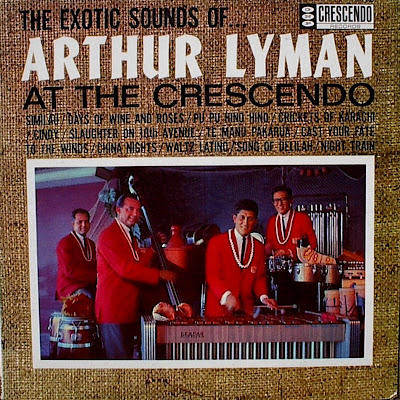
ARTHUR LYMAN – At the Crescendo – (GNP Crescendo) – 1963


I love Arthur Lyman (refer back to "What Frank is listening to #67") and I have long been devoted to exotica (refer to my "What Frank is listening to #21" where I discussed Martin Denny and exotica).
 
For those who are to lazy I said this back in #67, "To some this is "exotica", to others it is "lounge music", "popular", "muzak", "mood music", "background music", "easy listening", "instrumentals" – these are all terms which can be applied, though those terms also define specific and distinct styles under the general banner of "lounge music". The term "Exotica" is best applied to Denny as most of his career he spent re-interpreting native ( Polynesian, African, Hawaiian, Caribbean etc sounds) ….. it's not folk music as it is distinctly western with a hint of jazz but what Denny did was take the "mood" of those "exotic" sounds and fuse them in with his western upbringing. To enhance the effect ( or mood)  he would use "strange" instruments or sound effects.
 
The same applies to Lyman though Lyman stuck mainly to all things Hawaiian and exotic as he was born and bred there ( native, Portuguese, French etc).
 
Hawaii was the perfect launching pad fro Lyman and  the cacophony of nature sounds ( the birds, winds, sea etc) that make up a lot of "exotica". Those natural sounds really must have impressed Lyman's ears from his childhood on, and better than most he manages to tap into the feel of the islands. Having said that he never looses the 50s slightly cool jazz and even adds a touch of Latin which was starting its ascent to popularity in 1959 ( as well as a little Caribbean – which was popular then too). The other thing I like is the sense of "drama" he brings to a tune, there is danger out there in the wilds amongst the wonder. Where's my Stones Green Ginger wine ….."
 
There is no change here with the exception that this album is, apparently, recorded live before an audience at the Crescendo on Sunset Strip in Hollywood … "The applause was later deleted to preserve the exotic mood!". I don't know if this is or true or not but I will say that with the exception of some sound effects (birds, dogs etc … which incidentally appear on this album) Lyman tended to record live anyway.
 
It matters not as this album is solidly played  and wildly exotic though not as inventive as his earlier material. Also, if the liner notes are correct then maybe he was playing it safe with the "movie colony" crowd who came to see him as there are quite a few familiar movie songs covered. I do note that on this album he also traverses the world for exotica inspiration rather than sticking to the one (or two) usual locales.
 
Tracks (best in italics)
  • Similau – exotica with the kitchen sink thrown in – lots of bird calls and maybe a monkey or two. A little bit Polynesian and a little bit African. You've got to love it. Possibly the best track.
  • The Days Of Wine And Roses – the Henry Mancini-Johnny Mercer classic from the film of the same name – a film about alcoholism. Do you love the irony … a song from a film about alcoholism on a exotica album – the perfect music to drink to.
  • Te Manu Pakarua – from the film "Mutiny on the Bounty" – some sort of crazy Irish goes troppo exotica jig.
  • Waltz Latino – it's in the title
  • China Nights – again the title says it all
  • Night Train – a big band swing done as exotica
  • Pu Pu Hino Hino – a gentle romantic lullaby … though for all I know "Pu Pu Hino Hino" could be some German-Polynesian sex act.
  • Crickets of Karachi – lots of cricket sounds in this song, not surprisingly.
  • Cindy Oh Cindy – a slight calypso feel.
  • Cast Your Fate to the Wind – a early version of a song by Vince Guaraldi that became a jazz standard … lyrics were subsequently added and the song was covered by many pop bands (We Five, The James Gang)
  • Song Of Delilah – from the film "Samson & Delilah" – sound effects run rampant but I'm not sure what birds of paradise were doing in in the ancient Philistine Canaan of the middle east.
  • Slaughter On Tenth Avenue – another film track and despite the instrumentation nothing is added to the otherwise well known versions. In any event I tend to associate the song with an urban setting …
And …
Not the best Lyman but with enough joys to make it a keeper.


Chart Action

No chart action whatsoever here.

Sounds

Similau

Crickets of Karachi

attached 
 
more live Arthur:
 
Review
 
 
Bio
 
 
Trivia
  • The material was later released on LP again under the title "Cast your Fate to the Wind"(1965)
(Originally posted: 21/10/2009)
Posted in Lounge & Exotica | Tagged | Leave a comment

JOHN SEBASTIAN – John B. Sebastian – (MGM) – 1970

I, like may of my generation, know Sebastian through the wonderfully evocative theme song to the hugely popular and yet misunderstood sitcom "Welcome Back Kotter" (one of the best of the 70s).
 
It was only later that I found the many pleasures of The Lovin' Spoonful for which he was the main songwriter and singer (actually I got all the original albums in the great foolish UQ music library sell off of 1988). The "Spoonful", at their best, were one of the best bands of the 60s and chartwise they were one of the US bands that broke the British Invasion … in 1965/66 they had five top 10s and one #1.
 
Having said all that, from the Sebastian solo albums I already have I think he is patchy.None of the solo albums reach any of the heights of the "Spoonful" albums. That, however, is not to say they are "patchy bad" but rather "patchy good". Even the weak songs are usually pretty good, whilst the best ones are great. But as albums there hasn't been one (thus far) that has knocked me over from the first track to the last.
 
This album is his first solo album and it is a weird thing. It was released on two labels (Reprise and MGM) with the same tracks but different artwork because of a contractual dispute which wasn't settled till after the release. Sebastian had signed to Reprise (Warner Brothers) but Karma Sutra (who put out the Lovin Spoonful) thought he owed them an album. So parent company, MGM, released this using second generation master tapes. It sounds fine to me but apparently the Reprise version has better sound … but I haven't heard it so I cant say.
 
Sebastian left "Loving Spoonful" in 1968 and this album, lyrically, isn't so much a new direction as an extension of where he was going. As required by a singer-songwriter album this album is more personal in tone but the ties and links to his work in "Lovin Spoonful" are clear … he even "re-does" a "Spoonful" track – "You're a Big Boy Now". There is also some hippie crap (hey it was 1970 and he did appear at Woodstock and he was at the time fond of some natural substances) but they never overpower any song.
 
However, sound wise, he has moved away from the folky jug band rock 'n' roll of the "Lovin Spoonful" (though those elements are still present) to a more laid back, urban, country, folky, singer-songwriter style, though with hints of Latin, pop balladry and R&B. The album is certainly more eclectic and diverse than any "Lovin Spoonful" album but that doesn't necessarily mean it's better (in fact form what I have heard, most of Sebastian's albums lack a cohesive "sound". Just because you are a multi-instrumentalist comfortable in many styles doesn't mean you should employ them all on one album). A review somewhere compared it in diversity and "new found freedom" to Paul McCartney's first solo album which also came out shortly after this in  1970 … and I would agree. It's as if Sebastian and McCartney could experiment with everything they had wanted to, but couldn't before in a group setting.
 
Putting aside any issues in relation to the master tapes the album was produced by the legendary Paul Rothchild. He produced the first five albums by The Doors as well as Joni Mitchell, Tom Rush, Neil Young, Tom Paxton, Fred Neil, The Paul Butterfield Blues Band, The Lovin' Spoonful, Love, Tim Buckley, Janis Joplin and many others. Musicians on the album include Stephen Stills, Graham Nash, David Crosby (at one point Sebastian was asked to join the band that actually became Crosby, Stills and Nash), The Ikettes, pedal steel legend Bobby Emmons, Bruce Langthorne, Dallas Taylor, Danny Weiss (from Iron Butterfly), Harvey Brooke (from Electric Flag). Sebastian himself is no slouch (harmonica, guitar, piano ) and he has backed Dylan in the 60s, The Doors, The Everly Brothers, Dolly Parton, John Prine and many others. Given all this you know the musicianship is never going to be less than good.
 
The Tracks (the best in Italics)
  • Red-Eye Express – the opening chords sound strangely like the opening to Elvis's "Money Honey"  … otherwise a good country R&B shuffle.
  • She's a Lady  – a great song – gentle and subtle (and obviously not the Tom Jones song of the same name). This was a single with "Room Nobody" below on the B side released in 1969 in Sebastian's transitional period between "Spoonful" and solo. #84 US charts in 1969.
            She`s a lady
            And I chanced to meet her
            In my scufflin days
            She`s a lady
            Hypnotized me there that day
            I came to play in my usual way, hey
  • What She Thinks About  – a gentle rocker with an emphasis on horns.
  • Magical Connection  – a gentle samba type song which would be perfect with a glass of red.
  • You're a Big Boy Now –  a tune originally record by The Lovin Spoonful for the soundtrack of the Coppola film of the same name. The song was good and this stripped down version does it no harm.
  • Rainbows All Over Your Blues  – a straight country, slightly humorous, positive statement
            Let's go for a bounce
            on my trampoline
            I can show you the prettiest mountains
            that you've ever seen
            You better run to your closet
            and fish out your blue suede shoes
            I'll paint rainbows all over your blues
  • How Have You Been  – a gentle ballad with some nifty lyrics
            Here is a turtle from a Long Island Expressway.
            Says that his home has been covered with tar.
            So I gave him a ride on the back of my suitcase.
            And he wants to stay here in your yard,
            at long his life won't be quite so hard.
  • Baby, Don't Ya Get Crazy  –  a gently funky singer songwriter R&B … which actually works up a groove and reminds me, slightly, of "Welcome Back"
  • The Room Nobody Lives In – performed with a harmonium and a bass only.
  • Fa-Fana-Fa – an instrumental with something called a wretch horn which sounds like a kazoo. The song recalls the novelty jug band type music across the south and Midwest … and what John Sebastian played in his youth.
  • I Had a Dream – Sebastian  is well known for this song – as he did an impromptu unscheduled version of it and a couple of others at Woodstock in 1969. It opens the triple LP set. The usual counter-culture lyrics … but hey …
And …

The album is certainly well above average …. and probably the best of the Sebastian solo albums I have so I'm keeping this.
 
Chart Action
 
The album (for Reprise) reached #20 in the charts.

Sound

She's a Lady – Live ( and check out Groucho)

http://www.youtube.com/watch?v=8JEnXWK5-HU
 
Rainbows All Over Your Blues   – Live 

 
How Have You Been      
attached
 
Other sounds:
Sebastian at Woodstock
Welcome Back Kotter
 
Website
 
 
Other
 
Trivia
  • from wikipedia: As a songwriter, Sebastian's songs have been covered by Elvis Costello ("The Room Nobody Lives In"), Dolly Parton, Del McCoury, Helen Reddy, Brenda Lee, Johnny Cash, Bobby Darin, Slade, Joe Cocker and Jimmy Buffett ("Stories We Could Tell").
(Originally posted: 18/10/2009)
Posted in Folk Rock, Singer Songwriter | Tagged | Leave a comment

LOU CHRISTIE – Self Titled – (Roulette) – 1963

I have commented on a Lou Christie LP before – "What Frank is listening to #15"

I am partial to this era of rock because it's, just, fun. The era I refer to is the "post Elvis – pre Beatles" era (though as I have said somewhere "post Elvis" is a bit inaccurate as Elvis had well over a dozen hits in the 1960 – 64 period). The period was a period of musical emotional excess with the happy songs being truly joyous and the songs of heartache being worn on the sleeve.
 
Christie who had started in the late 1950s was a perfect example of this style of music and even transcended it as he wrote many of his own songs and later became more introspective in music and attitude. Here, though, he was the king of the falsetto … even more than Frankie Valli Christie's voice anchors (or sends off) all the music around him.
 
Allmusic had this to say, "While Lou Christie's shrieking falsetto was among the most distinctive voices in all of pop music, he was also one of the first solo performers of the rock era to compose his own material, generating some of the biggest and most memorable hits of the mid-1960s".
 
And on this, his first album, the falsetto is played up on just about every song. Interestingly, unlike Christie's next album, this LP (mostly but not all) still owes as much to the black vocal groups (especially the "vocal pop" bands as well as the doo wop bands) and white Italo-American street corner singers of the late 50s as it does to any progression in pop music in the 60s. So, unlike someone like Roy Orbison who updated his pop music for the 60s, Christie,on this LP, remains firmly anchored in the vocal groups of his youth.
 
There is nothing wrong with that and of course that style was still popular in 1963.
 
If you don't like falsetto and near operatic caterwauling then give this a miss. I do, if for no other reason than its downright eccentric. The voice is used to convey the emotions that weren't allowed to be described in the lyrics of the time. Lust, foreplay, intercourse where all obliquely referred to in the lyric but it was the voice which had to emotionalise it for the listener so you knew exactly what they were referring to. It's music, not for the brain, but rather for the heart or loins (as sappy as that sounds).
 
Christie though also represents the darker, more complex and depressing side of bubblegum music. He doesn't indulge in the "teen death song" or "teen tragedy songs" popular at about the same time but a lot of his songs are about broken, unrequited or lost love. In that way he is much like Leonard Cohen, though that is probably lost on the "tastemakers". Look at the song titles if you need confirmation of the lyrical content: "Two Faces Have I", "All that Glitters Isn't Gold", "The Gypsy Cried", "How Many Teardrops","Tears On My Pillow".
 
The LP sounds it was recorded in my bathroom as it's not a sophisticated recording but it's the music that keeps it all together and it's pretty surprising given that Lou was only 20 years old here.
 
Best Tracks
  • Two Faces Have I – #11 black singles, #6 pop. Co-written by Christie this is perfect example of this type of pop … and very Del Shannon sounding also.        
  • To Be Loved – a good example of the influence of black vocal pop group sounds on Christie – this could have been something by The Platters.
  • The Gypsy Cried – #24 pop. Great lyrics. Teen tribulations in two minutes.
        I had some trouble with my baby 
        So I had my fortune read 
        I had some trouble with my baby 
        And this is what the gypsy said
 
        The gypsy cried, she cried
 
        Gypsy, oh tell me, what is in your crystal ball 
        Gypsy, oh tell me, will my tears fall
 
        She cried, she cried and said
 
        Watch your step, oooh she'll hurt you yet 
        Oh no no no no no no no 
        Watch your step, oooh she'll hurt you yet 
        Oh no no no no no no no
 
        Gypsy, oh tell me, does she want to marry me 
        Gypsy, oh tell me, when the wedding's gonna be
 
        She cried, she cried
 
        Listen to what the gypsy said 
        Oh no no no no no no no 
        Listen to what the gypsy said 
        Oh no no no no no no no
 
        Gypsy, say it isn't true 
        Watch out, oooh she doesn't love you 
        Watch out, oooh she doesn't love you 
        Gypsy, say it isn't true
 
  • How Many Teardrops – a song that could have come from the late 50s
  • Stay – a cover of the great Maurice Williams song. Not as good but not bad.
And …
 

Not as good as some later Lou LPs but still a keeper.

This is pop … near perfect pop of its time …

 
Chart Action
 
The album reached #124 on the charts.
 

Sounds

Two Faces Have I

 
Mr Tenor Man
 
All That Glitters Isn't Gold
 
The Gypsy Cried
 
How Many Teardrops
 
Tears on My Pillow
 
live -in the 80s?:
 
a 25 year old Lou in 1969
 
Website
 
 
Pictures
 
Here's Lou meeting Princess Margaret in 1969 – there are some other tools (just kidding) waiting in line …
 
(Originally posted: 17/10/2009)
 
Posted in Pop Rock | Tagged | Leave a comment

JIMMY CURTISS – Life – (Perception) – 1969

 
I bought this on a $16.49 whim … well I actually won it of eBay for that amount. The whim was mainly based on the fact that I had already won an album from the seller so I thought buy more and save on postage!
 
So, after I read up on Curtiss, I decided I would have a go.
 
Curtiss was most famous for being the lead singer of the late 1960s psych pop / sunshine pop / folk rock  band The Hobbits who put out a series of Tolkien referenced albums (that alone would normally throw me off … you can't totally trust anyone who reads Tolkien, can you?). He had been a singer prior to that and he returned to the solo world with this one (and only) obscure solo album.
 
And in listening to it … I must say it has substantial joys.
 
Curtiss' career is a good example of "obscure" by our standards though actually and reasonably substantial in his day. I'm always fascinated by these "footnotes" in pop/rock history who have been forgotten with the passing of time. For all I know he could be the old guy next door … well he could be if I was in San Francisco – his last known whereabouts.
 
Curtiss never had mainstream success though he plugged away and left a body of work which is not insubstantial.
 
Allmusic:"Born and raised in Queens, New York, Curtis first surfaced in 1959 as a member of the doo wop combo the Enjays. He issued his solo debut, "Without You," on United Artists in 1961 — the label attempted to position him as a teen crooner in the mold of Bobby Vee or Paul Anka, although original and distinctive efforts like 1962's "Five Smooth Stones" (a pop retelling of the David and Goliath story) not surprisingly failed to make a commercial impact. Stripped of his record contract, Curtis sold songs to Bobby Darin and Ellie Greenwich, and even worked for a time in advertising — he returned to music full-time in 1965, assembling a doo wop backing group dubbed the Regents and signing to Laurie Records to issue "Not for You." "The Girl From the Land of 1,000 Dances" followed later that same year, but then Curtis again disappeared from sight — he returned in 1967 with the bubblegum cult classic "Psychedelic Situation," a major hit in Germany that attracted little attention at home. Curtis then signed to Decca, collaborating with producers Jerry Vance and Terry Phillips on a studio group called the Hobbits… after rechristening the group the New Hobbits, Curtis released 1969's Back From Middle Earth essentially a solo effort — later that year, he also issued an official solo LP, Life".
 
He also co-wrote "Child of Clay" which was a #31 hit in 1967 for Jimmie Rodgers and formed the "Perception" record label which had a couple of hit acts including Australian band "King Harvest", Dizzy Gillespie and Astrud Gilberto.
 
This album is an introspective folky singer-songwriter album. A lot of former pop stars were taking Dylan's cue and putting out introspective albums ... Dion, Johnny Rivers, Bobby Darin and Lou Christie all put out successful albums in that style.  What distinguishes this album (and some of the other introspective "pop" star albums) is the range of influences. Those stars usually had their own styles before taking Dylan's lead in folky self examination as opposed to hearing Dylan and following him into music. The distinction is subtle but I think you can hear it on occasion and it distinguishes it from the regular Dylan wannabes. Also, usually, the former "pop" stars can actually sing.
 
Curtiss' songs are strong (and have all the usual themes of the counter-culture) and are different enough to a lot of other singer-songwriter albums of the time. Certainly this LP is a lot quirkier than the singer-songwriter stuff that came out in the early 70s. The most obvious comparison is a poppier Tim Buckley,Tim Hardin, or Bob Lind.
 
Curtiss apparently  likes obscurity – hence the the album artist is "J.C." … which he preferred to be known by … and he is not doing himself any "commercial" favours with the nudity on the LP's front sleeve (it's 1969) or songs like "Lack 'o' Testicle Blues".
 
Tracks (best in Italics)
  • Child of Clay – (Jimmy Curtiss – Ernie Maresca) – The song which was a hit for Jimmie Rodgers. A catchy, questioning (the 60s remember), non-confrontational protest song.
  • Where Can I Hide–  (Jimmy Curtiss – Green – Marcia Hillman) – This sounds like something I know but I can't put my finger on it. A excellent song anyway.
  • Francesca  – (Jimmy Curtiss – Wexler – Marcia Hillman) – very Tim Buckley without the trippy overtones, or very Tim Hardin. A great "ode to" ballad with a good sense of mood (though the strings lend themselves to the "ode to women" songs).
  • San Francisco Do You Remember Me – (Pollock – Jimmy Curtiss) – how many "San Francisco" songs were there in the late 60s?
  • Lack 'o' Testicle Blues – (Sell – Jimmy Curtiss) – the sleeve has a 'not for programming' warning. The song is very much of it's era … anti-Vietnam, and very "Country Joe & the Fish". Interestingly Curtiss casts an accusing voice on society also. As per the title this is a blues but done as a comedic blues. Obvious, but entertaining:
                Hey Mum, please send my balls
                I think you'll find them in the closet down the hall
 
  • Sunday Son – (Jimmy Curtiss) – almost a demo. Low key but obviously intended to be a "big power ballad". I could see Elvis, Tom Jones or Bill Medley doing this. I'm a sucker for this type of ballad…as sentimental as it may be. Think "Don't Cry Daddy" or "My Boy".
  • You Can't Tell a Man By the Song He Sings – (Jimmy Curtiss – Marcia Hillman) – a great tune with its whacka whacka funky guitar intro … which goes on a bit to long but I found my toe tapping.
  • Johnny Get Your Gun – (Pollock – Jimmy Curtiss) – another anti-Vietnam protest song which again is obvious but well done. I can hear a touch of Donovan in there somewhere. The phrase was also used in the George M. Cohen patriotic song "Over There" which was a mammoth seller in the late teens of the 20th century, so much so that it became a rallying cry to encourage young Americans to enlist and fight in WW1. Dalton Trumbo adapted the title for his phenomenal anti-war novel "Johnny Got His Gun" which was published in 1940 and which had been suppressed for many years and became popular again in the late 60s … co-incidentally used for this song, or maybe not.
  • He was My Father – (Jimmy Curtiss – Marcia Hillman) – another broken family song (like "Sunday Son" above) about a father and a son … it is very "Cat's in the Cradle" though well before the Chapin song.
And …
 
Sometimes the album is a little too "late 60s" and I'm not sure of its point of view … but I like it enough to keep it. In fact it is great. It is is ripe for rediscovery.

Sounds


Where can I Hide
attached
 
Sunday Son
attached
 
 
(originally posted: 14/10/2009)
Posted in Singer Songwriter | Tagged | Leave a comment

DION – Ruby Baby – (CBS) – 1963

 
Dion is a legend. No lesser a luminary that Lou Reed has sung his praises … and given Reed's temperament, that is saying something.
 
A small portion of Lou's speech for Dion's induction into the Rock and Roll Hall of Fame in 1989, "It's been my pleasure to get to know Dion over the years and even, my idea of heaven,singing occasional backup for him. He has the chops, and he practically invented the attitude."Ruby Baby," "Donna the Prima Donna," "Runaround Sue," & "The Wanderer" … "I'll tear open my shirt and show her 'Rosie' on my chest," a line so good that twenty-odd years later I couldn't resist doing a variant on it for one of my own albums".
 
Allmusic: Bridging the era between late-'50s rock and the British Invasion, Dion DiMucci (born July 18, 1939) was one of the top white rock singers of his time, blending the best elements of doo wop, teen idol, and R&B styles. Some revisionists have tried to cast him as a sort of early blue-eyed soul figure, although he was probably more aligned with pop/rock, at first as the lead singer of the Belmonts, and then as a solo star. Drug problems slowed him down in the mid-'60s, yet he made some surprisingly interesting progressions into blues-rock and folk-rock as the decade wore on, culminating in a successful comeback in the late '60s
 
So why Dion?
 
He was very street. In his early period he rarely wrote material. That came later in the late 60s and early 70s. And when he wrote, he wrote quite well. What he does bring to his early stuff with Dion and the Belmonts, but more specifically in his early to mid 60s solo material, is the sound of a kid from the Bronx. Specifically an Italian–American kid, but generally, any poor kid from the wrong side of the tracks. Of all the teen vocalists from New York in the late 50s and early 60s only Bobby Darin and Dion transcended their material and brought magnificent individual voices to their music.
 
That era was rife with urban working class Italians like Dion belting out tunes: Frankie Valli, Lou Christie, Johnny Restivo, Bobby Darin, Fabian, Frankie Avalon, Jack Scott, Freddy Cannon, Johnny Rivers, Bobby Rydell, Bob Gaudio, James Darren (half of em are bona fide legends – IMHO) … and they generally sang about what they knew about ... their neighbourhoods and the people in them.
 
Listening to it now it may not sound like much, but at the time Dion's music was the sound of the street. And at its best his music beats with that sound ... at least it does with a couple of wines, with your eyes closed. It sounds like a wank but, truly, within the simple pop structure he has incorporated the cultures that made New York such a melting pot : Afro American R&B and doo wop, Jewish tin pan alley, early rock 'n' roll and Italian street corner singing. He also incorporated the vocalists he loved into his style … Skip James, Hank Williams, Frank Sinatra and Elvis Presley. Later he would incorporate Greenwich Village folk, Bob Dylan and singer songwriter into his style.
 
He, in many ways epitomised New York rock and pop. And with his heart on his sleeve he travelled all the familiar roads of rock 'n' roll excess before it was fashionable … heroin addiction in the 1960s is the stuff of Burroughs not The Rolling Stones. He even left his Catholic faith and became an evangelical Christian in the late 70s … he returned and is now a practicing Catholic (once a Catholic always a Catholic).
 
I have seen him interviewed and he is a quietly soft spoken man, and quite thoughtful (and I saw him live in 1995 and he was like that live). I have seen Henry Rollins talk about him in admiration and being quite surprised at himself for doing so. What attracts such different people to him is his humour, his street wise knowledge and his music. Much like Elvis in the South in the early 50s Dion soaked up all the sounds of New York in the mid to late 1950s and injects that into the music. Though of course it helps that he can sing. So even though this album may be teen idol pop stuff, if you care to listen behind or between the lyrics, you can hear a kid from New York singing it as authentic as it comes. And I am not surprised that Reed is a fan and I wouldnt be surprised it David Johansen, Suicide and other New Yawkers weren't fans also.
 
This is New York's folk music.
 
This was Dion's first album after leaving the Laurie label, and Columbia wanted to change his image to that of an "adult" entertainer. Dion too was starting to flex his song writing talents here (and over the last couple of albums) and his songs are good (and occasionally great) though they aren't as consistent as the mini masterworks he would be writing in four or five years. Like most of his albums of this period the album is a mix of ballads and oldies punctuated by an up-tempo number. In a move away from Dion's rock roots the songs are pretty heavily orchestrated also – which was normal when trying to make a teen star into an "adult" entertainer. It was also the trend at the time in music. Side Two doesn't hold up as well as side one with and emphasis on ballads. Regardless, as I have said above, Dion has managed to squeeze the sounds of the New York across the album. And of course, he can sing.
 
Best Tracks (In Italics)
  • Ruby Baby – The Wanderer may be Dion's signature song but this comes a close second. Written by Leiber-Stoller, two of the greatest songwriters in rock history. And forever associated with New York or Elvis.
  • The End Of The World – a gentle low key, almost acapella ballad.
  • Go Away Little Girl – the great Goffin-King song which was a hit for Steve Lawrence (#1, 1962) but everyone has done it. And this version is as good as any of the best.
  • Gonna Make It Alone – a Dion original and a New York "street" song – a touch of R&B, a touch of street corner singing, but transcending both. You don't think Lou Reed was listening to this?
  • Fever – the much covered Little Willie John song, though the lack of instrumentation (bongos only) makes it sound more like the Elvis version from 1960 (which was done with finger snaps only, and the occasional drum roll) rather than the Little Willie John version.
  • My Mammy – I have always loved this song by Al Jolson. Well, ever since I saw "The Jolson Story" as a kid in the 70s. One of the fist albums I bought with my own money back in the early 80s was "The Best of Al Jolson" … but that's another story. Dion slows it down and whilst the song is not the over the top thumper like Jolson's version it still has enough singability in it to make it good … and he has taken out some of the schmaltz. The song is well covered.
  • Will Love Ever Come My Way – a Dion original. A nice ballad.
  • The Loneliest Man In The World – another Dion original. Fairly imitative of the ballads of the time.
  • You Made Me Love You (I Didn't Want To Do It) – Another Al Jolson – though not as distinguished as "Mammy", I'm a sucker for this.
  • He'll Only Hurt You – another Dion song and another love ballad for the chicks, with a touch of Roy Orbison.
  • You're Nobody 'Til Somebody Loves You – the subsequent Dean Martin classic (from 1965) – here it's a pretty tune – though one can't help thinking of Dino when listening to it.
  • Unloved, Unwanted Me – a strange song – wailing vocals and bass drums(?).
And …
 

Dion's best album? No.

But good enough to be a keeper.


Sounds
 
Ruby Baby
    live
Gonna Make It Alone
attached
 
Fever
Will Love Ever Come My Way
He'll Only Hurt You
Unloved, Unwanted Me
 
Bio
 
A very good critical biography of Dion and rock n roll by Dave Marsh. A must if you want to understand this aspect of "rock" …
 
Website
 
Pictures
 
Dion (300)
Dion recently
 
(originally posted: 11/10/2009)
Posted in Rockabilly and Rock n Roll | Tagged | Leave a comment

THE DELLS – There Is – (Cadet) – 1968

I didn't know much about the Dells except they were a soul group.
 
From allmusic:The Dells are one of the finest and longest-lived R&B vocal groups in history, and what's most amazing is that they've done it with nearly all the same members — they haven't changed personnel since 1960. They were one of the very few doo wop outfits to successfully update their sound, finding their strongest commercial niche in the late '60s and '70s as a polished smooth soul harmony group.
 
In actual fact they started in 1953 in Chicago and are still around today … now that's a job.
 
Though not a big soul fan I do like the music in dribs and drabs and I have always liked the non–Motown stuff as I found Motown a bit too clean and "white" at times. It's only later when Motown acts started experimenting  that it became a bit more interesting for me.
 
This LP certainly isn't clean or white and  the Dells aren't making any new sounds here but every track oozes old school soul. There are songs which show The Dells doo wop roots ("Love is so Simple") and there are a couple of tracks which wouldn't be out of place in 1960 ("Please Don't Change Me Now", "O-O I Love You"). They also largely avoid, rightly or wrongly, any topical issues for a record released in 1968., which is odd. Even Elvis released some topical songs in 1968 ("If I Can Dream", "Clean Up Your Own Backyard").
 
Very few (one?) of the songs are written by the Dells (which is fairly commonplace in soul) but it's the "singer" not the "song" that counts. And these songs are sung well … and ultimately fun.
 
Best Tracks
  • There is – pretty funky
  • Stay in My Corner – a slow ballad – that goes for 6:10 minutes! 
  • Wear it on Our Face – big band MOR and very Motown  – great harmonies
  • Higher and Higher – a great song – never done better than by the great Jackie Wilson (probably my favourite soul artist) but this version (which I believe is earlier) is good also.
  • Love is so Simple – straight doo wop … you gotta love doo wop.
 And …
Not enough to be a keeper but there are certainly a few songs I will tape.

Chart Action

The album:

went to #4 on the "Black" album charts, #29 on the Pop charts.

The singles:

Stay In My Corner   Black Singles #1 
Stay In My Corner   Pop Singles #10 
There Is   Black Singles #11 
There Is   Pop Singles #20 
Wear It On Our Face   Black Singles #27 
Wear It On Our Face   Pop Singles #44
 
Sounds
 
There Is
attached (sorry the LP I have is pretty scratchy)
a recent clip of them doing "There is"
 
Stay in My Corner
 
Wear it on Our Face
 
Love is so Simple
 
Bio
(If you like Marvin Gaye read this)
 
Website
 
(originally posted: 10/10/2009)
Posted in Soul, Funk & Disco | Tagged | Leave a comment