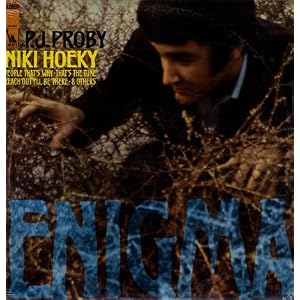
P.J. PROBY – Enigma – (Liberty)- 1967

what Frank is listening to #87 – P.J. PROBY – Enigma – (Liberty)- 1967
How can anyone not like P.J. Proby?
 
He was old school rock adapted for the 60s and a genuine eccentric. There are many stories about Proby – so many I don't know what is true or not. Certainly, if he were to write a bio it would make Motley Crue seem perfectly pre-schoolish in comparison.
 
By way of bio – from allmusic: Born and mostly raised in Texas, rock & roller P.J. Proby never really hit it big in his homeland, but his trouser-busting stage antics helped make him a genuine pop star in England at the height of the British Invasion. Proby was born James Marcus Smith in Houston on November 6, 1938, and grew up listening to country and black gospel; later on, he became fascinated by rockabilly, and his stepsister even dated the young Elvis Presley. After graduating from military school in 1957, he moved to Hollywood hoping to make it in the music business. Through his boyhood friend, teen-idol singer Tommy Sands, Smith made some connections that included songwriter Sharon Sheeley (who was dating Eddie Cochran and had written "Poor Little Fool" for Rick Nelson), and he soon began recording singles under the name Jett Powers, with little success. In the meantime, he worked as a demo singer and also did a bit of acting, appearing in several Westerns and an episode of Gunsmoke.Finally, in late 1963, Proby met British producer Jack Good, who happened to be putting together a TV special on the Beatles that was to feature several other up-and-coming artists. Proby's demo tape impressed Beatles manager Brian Epstein enough for him to make the cut, and Good outfitted Proby as an aristocratic fop, complete with ponytail, frilly shirt, tight velvet pants, and buckled shoes. After the special aired worldwide, Proby's first British single, "Hold Me" — a rocked-up rearrangement of a 1939-vintage pop ballad associated with Dick Haymes — rocketed into the U.K. Top Five in early 1964.
 
He had 4 Top 10s and 2 Top 20s in 1964-65 in Britain.
 
The funny thing is, of course, that during the British Invasion of the US there was a smaller but successful invasion of the UK by American acts. There were two fronts to this invasion – one being the old rockers from the US whose popularity had been eclipsed in the US but still had a loyal fan base of greasers and rockers in England, Germany and Europe generally and who practically lived in the England for a while. qv: The Everly Brothers, Chuck Berry, Little Richard, Roy Orbison, Bill Haley, Gene Vincent. All of them had hits in England and successful tours. The second front was from the artists who hadn't made it in the USA and found themselves a fashionable novelty in England – The Walker Brothers, Julie Felix, Jimi Hendrix, Shawn Phillips, Jackson C Frank (folk), and P.J. Proby. These actually did live in the England though only Hendrix had any large scale success in his native land.
 
This album was Proby's attempt to enter the American market. It was his 4th album in 3 years but his first studio album to be recorded in the USA and features collaborations with the legendary Jack "Lonely Surfer" Nitzsche. It also contains Proby's most successful US hit single "Niki Hoeky" which went up to #23 (his only US chart placing). The album failed to chart. Proby returned to England and continued to have minor hits as well as runs playing Elvis and Roy Orbison on the West End stage. He also put out a series of albums and tracks that became more idiosyncratic to say the least (Led Zeppelin even backed him on one LP and he did an album with Dutch prog rockers Focus, and another with Marc Almond of Soft Cell). He still tours today.
 
This album is certainly ballsy – the musicians are uniformly tight and have the funk. It's well recorded with an ear to the market at the time – there are some rockers, ballads, soul and British Invasion covers. I suppose the predominant style, especially on the first side, is one of blue eyed soul (white rocky soul – see my Len Barry comment #43) with a little more rock rather than soul. The second side leans more towards the power ballad. If Tom Jones had come from the US and had leaned toward rock he probably would have sounded something like this.
 
Best Tracks
  • Niki Hoeky – a excellent single – co-written by Pat and Lolly Vegas (Native American Indians famous later for the underrated "Redbone").
  • Reach Out (I'll Be There) – the Four Tops hit by Holland-Dozier-Holland.
  • Out of Time – a muscular if slightly MOR version of the Rolling Stones classic. Still fun though.
  • Don't Forget About Me  – a good up-tempo Goffin & King song.
  • I'm Twenty Eight  – a weird ballad – part Dylan and part baroque pop – a lament about being aged 28 (which Proby was) and sage advice for prospective rock n rollers. It looks to be written by Graham Goldman later of 10CC.
  • Angelica  – a great Mann & Weill ballad which is a bit overwrought here and very Gene Pitney. Elvis was actually due to record this in 1969 but gave the song to his hero (the magnificent) Roy Hamilton who was recording next door. Roy cut perhaps the definitive version.
And …
 
I like Proby and I'm keeping this.
 
Sound
 
Niki Hokey
 
Reach Out
 
Out of Time
 
I'm Twenty Eight
attached
 
Niki Hokey
By Redbone ( the authors of the song but recorded later)
and a great cover by Bobbie "grrrr" Gentry
 
Bio
 
 
Website
 
 
(originally posted:13/09/2009)
Posted in Rock & Pop | Tagged | Leave a comment

THE COWSILLS – On My Side – (London) – 1971

what Frank is listening to #86 – THE COWSILLS – On My Side – (London) – 1971
I bought this "way back when" and I am pretty sure I have even sold a copy of it once before at a record fair. The Cowsills were quite popular in the US (they had a couple of tTp 10 hits in 1967 and 1969, and even a prime time TV special, as well as many TV appearances) but they never really hit anywhere else.
 
For those who don't know: from allmusic.com: The real-life inspiration behind the hit television series The Partridge Family, the Cowsills — comprised of teen siblings Bill, Bob, Barry, John, Susan, and Paul in tandem with mother Barbara — were one of the biggest pop acts of the late '60s, scoring a series of hits including "The Rain, the Park and Other Things" and "Hair" with their angelic harmonies and sun-kissed melodies.
 
The Cowsills (there were seven of them – five brothers, one sister and a mother), not surprisingly maybe, given the music, are from Rhode Island, one of the richest states in the USA. They played bubblegum pop (with a bit of sunshine pop and straight pop in the mix) much like The Archies except that they were a real life family as opposed to a studio recording band. The concept of a family band was not (and still isn't) that uncommon in the US: The Osmonds, The Jackson 5, The Isley Brothers, The Everly Brothers, The Carter Family, Hanson, The Jonas Brothers, Kings of Leon.
 
The Cowsills have always been a proper group despite being related. By that I mean they play their own instruments, write their own songs (vocals were shared between the family members), and usually arrange their own material. This album was produced by Bob and Barry Cowsill.
 
Bubblegum pop is underrated but the pop is pleasant and easy on the ears, and, as I've said (many times) before – if you are going to pick any MOR pop, pick it from the 60s (though bubble gum was going strong in the early 70s also). The Cowsills though may have seen the writing on the wall and decided to become a bit more "serious" on this their 7th album (in 4 years). There is a tendency to "meaning" in the lyrics as well as overall mood of pessimism, which is quite jarring given the band made their name with up-beat pop. Even so, the whole album is infused with the spirit of  late 60s Beatles, and maybe a bit of the the late 60s Hollies. There are some country overtones also which is not surprising given the rise of urban country in the early 70s and even mainstream acts like the Beatles had adopted some country sounds (especially Ringo in his "Beaucoups of Blues" album from 1970). That aside, there is no better way (or easier way) to increase melancholia, or the "dark" in a music, than through introducing country overtones. All it takes is a twang and you know there will be some tale of woe.
 
There are quite a few pleasant songs on the album (and quite a few duff ones), but the public may not have been keen on a melancholy Cowsills … this album made #200 on the US Charts. It was their last album.
 
Best Tracks
  • On My Side – co- written by Waddy Watchel (who must have done session work on this album – link below).
  • Contact Mae – a "dirge"on growing old – backward guitar and everything. 
  • Heather Says  – another song co- written by Waddy Watchel. Very Beatles – a bit of "Penny Lane" – in its reminiscing type structure  though this is about a school bully. Sung by Susan Cowsill who was 12 at the time.
  • Cheatin' on Me – a country lament done in deadpan style – reminiscent of some of Ringo Starr's country tunes.
And …
 
Its hard to dislike this LP – but I'm not sure if I will keep it … maybe but probably not?
 
Sounds
 
On My Side
 
Heather Says
attached
 
Other clips:
and you can see Susan seeing with the legendary Buddy Ebsen here at about 4.00min
a good clip:
 
 
Review
 
 
Trivia
  • Subsequent to the disbandment of the Cowsills ( ust after this album in 1971) – allmusic:   Bill Cowsill (who was briefly considered to replace Brian Wilson in the Beach Boys' touring lineup) issued a solo LP, Nervous Breakthrough, but otherwise the siblings were musically inactive for much of the decade. In the late '70s, Bob, John, Susan, and Paul recorded a batch of original material with producer Chuck Plotkin, but the sessions were never unreleased. Barbara Cowsill died on January 31, 1985, and her children spent the '90s in regaining some of their former musical prominence. Barry mounted a solo career, Bill founded the country group the Blue Shadows, and Susan joined the Continental Drifters, an all-star New Orleans-via-Los Angeles combo also featuring her husband, ex-dB Peter Holsapple, and onetime Bangle Vicki Peterson. In 1994, the "core four" — Bob, John, Susan, and Paul — contributed a newly recorded Cowsills track, "Is It Any Wonder," to the Yellow Pills, Vol. 1 pop compilation. A new studio album, Global, followed in 1998.
  • Susan has also made guest appearances on many albums, including Hootie and the Blowfish's 2003 self titled release, Paul Sanchez's 2008 album Exit to Mystery Street, Giant Sand's 1992 release Glum, and A Fragile Tomorrow's 2008 release Beautiful Noise
  • Cowsill deaths: In January 1985, Barbara Cowsill died of emphysema while living in Arizona. Bud, the father of the Cowsill children, died of leukaemia in September 1992, while living in Mexico. Barry Cowsill was living in New Orleans when Hurricane Katrina struck on August 29, 2005. Susan survived whilst Barry's badly decomposed body was recovered from waters on December 28. Sister Susan was also living in New Orleans at the time – she survived. Bill Cowsill died on February 17, 2006 in Calgary from emphysema, osteoporosis and Cushing syndrome, associated with drug and alcohol abuse.
(originally posted:12/09/2009)
Posted in Pop Rock | Tagged | Leave a comment

THE TURTLES – It Aint Me Babe – (White Whale) – 1965

what Frank is listening to #85 – THE TURTLES – It Aint Me Babe – (White Whale) – 1965

Well of course I know The Turtles but up till now all I had was a compilation LP and their 1969, underrated (but patchy), LP "Turtle Soup" which I got because Ray Davies from The Kinks produced it. Apparently, they got Ray after they heard the Kinks LP "Village Green" which was a big underground hit in the US even though it is thematically a very English album (one of the most English of all albums). It sold less than nothing in the UK – yes that observation is a dig at Anglophiles.
 
The Turtles were one of the California bands that emerged in the wake of The Byrds success (in fact they were originally called The Tyrtles … get it?) which explains why this album is all 12 string guitar and harmonies with a number of Dylan covers ( just like the early Byrds).
 
Give the kids a break – they were in their late teens in 1965 and they do well capturing all the influences of the time. They are also the link between more "serious" California bands like The Byrds and the pop of Jan and Dean, The Fantastic Baggys , Dino Desi and Billy, and early Beach Boys etc. There is no more evidence of that than the choice of covers – Dylan on the one side and PF Sloan, Mann & Weill on the other. What is surprising is amongst all the covers there are some well written, if derivative, originals. And better still – they play really well.
 
The Turtles may be covering all bases, on this, their first album – garage, surf, protest, MOR, folk and rock, all done to a Byrds back beat – original it aint – but fun it is.
 
The Tracks
  • Wanderin' Kind – Kaylan – a well written original.
  • It Was a Very Good Year – Drake – I love this song when Sinatra did it, because its an older mans song – apparently Sinatra heard it here though I have reservations on that, because  it is such an old mans song. Having a bunch of 17 year olds sing "When I was 17 it was a very good year" makes you think if they were taking the piss.
  • Your Maw Said You Cried – Glazer, Schlaks –  a garage type stomper.
  • Eve of Destruction – Sloan – a less apocalyptic cover of Barry McGuire's hit – a magnificent song and here still a great song.
  • Glitter and Gold – Mann, Weil – Great 60s AM pop with a nod to British beat.
  • Let me Be – P.F. Sloan – this song is so PF Sloan you can pick it a mile away. He was always a pop version of Dylan and he is a minor genius … #29 on the charts.
  • Let the Cold Winds Blow – Kaylan –  another garagy ballad … and quite catchy.
  • It Ain't Me Babe – Dylan –  the great Dylan song – and a magnificent Byrds like cover – this made their (The Turtles) name – #8 on the national charts.
  • A Walk in the Sun – Kaylan – surf music themes on a speed frenzy – the songs narrator is obviously suffering some sort of paranoia.
  • Last Laugh – Garfield, Kaylan – another nod to British beat with a bit of  renaissance like ivory tinkling.
  • Love Minus Zero/No Limit – Dylan – a great Dylan song – again given the straight Byrds treatment
  • Like a Rolling Stone – Dylan – another straight Byrds treatment – one of the greatest songs of all time – can anyone fuck this up?
And …
 
California in the 60s – could there have been a better place on the face of the planet?
 
Me thinks not.
 
This is a keeper
 
Chart Action
 
The album went to #98.
 
Sounds

Let Me Be

 
It Aint Me babe
 
Like a Rolling Stone
attached
 
Their big #1 hit from 1967:
Happy Together
 
Bio
 
 
Website
 
 
Trivia
  • The Turtles appeared in the beach movie "Out of Sight" in 1966 – http://www.youtube.com/watch?v=VL2gKfIgeNs
  • Before the end of 1970 Kaylan, Volman and Pons from The Turtles joined Frank Zappa's early-'70s edition of the Mothers of Invention. Kaylan and Volmans became the satirical cult pop act "Flo and Eddie"

(originally posted:09/09/2009)

Posted in Folk Rock, Rock & Pop | Tagged | Leave a comment

NEAL FORD & THE FANATICS – Self Titled – (Hickory) – 1967

what Frank is listening to #84 – NEAL FORD & THE FANATICS – Self Titled – (Hickory) – 1967
I paid way more than $1 for this but I had heard a couple of tracks and I had to have it.
 
Neal Ford & The Fanatics were a garage band from Houston, Texas who had been in various band incarnations going back to 1963.
 
From their fansite:
 
NEAL FORD & THE FANATICS were a 1960's rock band from Houston, Texas. They released one LP on the Hickory label, along with a number of singles on Hickory and other labels. Their songs were strong and the band was tight, playing regularly at skating rinks, shopping malls and night clubs like The Catacombs and The Living Eye. 
 
The band were a product of their time. Like many other bands they started out playing garage rock or frat rock in the early to mid 60s. "Garage", as I have said somewhere before (in the Hullabaloos – what Frank is listening to #52) was an American response to the British invasion. It is fair to assume that many garage bands were inspired by the rockier side of the British invasion – The Stones, The Kinks and The Who though the truth is, also, that many of these bands had been "frat rock" bands anyway and just incorporated elements of the new British R&B/rock to their sounds, and then – partly because of poor equipment but more so because they wanted to beat the British invasion bands at their own game – they developed a sound that was infinitely more raw and rockier (much like a lot of Australian bands in the 60s).
 
Likewise, of the literally hundreds (if not thousands) of garage bands that sprung up in the 60s most did not spring up in the cultural capitals but in the regions like the Midwest, the south, and the South West. Maybe the relative isolation from "what was happening" made them explore their own influences or hone what they were doing whilst bands from the big smoke were bouncing ideas of each other more quickly and "keeping up with the times". At the time this was a career limiting move but with time such single mindedness has become one of the most endearing things about garage rock.
 
The other thing which is rarely referred to when discussing garage bands is that they were "working bands" which menas they played all the time. They were the rock brothers of all the equally hard working blue eyed soul singers from the cities and sometimes the styles even crossed over (for example, Mitch Ryder and the Detroit Wheels).
 
Neal Ford & the Fanatics were certainly a working band and by 1967 the golden era of garage was practically over. When the time came for Neal Ford & The Fanatics to record an album, like any number of working bands facing a practical reality, they hedged their bets. This album certainly is not all "garage". There are garage tunes, ballads, slight psychedelica, British beat, and even a cabaret number. Half this stuff is jarring in 1967 but I am sure there were many working bands who played wedding, parties, bar mitzvahs etc who had to cover all the bases to keep their paying audience happy.
 
However, despite that, behind every track on this LP you can hear something left of centre – a garage band in hiding. And that is what I love about this album. It's a snapshot of its time and is fun on that level. Otherwise, the playing is tight and really cant be faulted though the recording is obviously low(er) budget.
 
Tracks
  • Gonna Be My Girl – a magnificent song – straddling a number of genres, British beat , garage and with great keyboards.
  • Nothing Left to Do – a strange "head" type ballad – part New York art and part California cheese.
  • Bitter Bells – British Beat with distinct California movie soundtrack keyboards. Excellent.
  • That Girl of Mine – keyboard driven poppy mid-tempo ballad.
  • Get Together with Me – a crazy lightweight ballad in the style of The Lovin Spoonful. "Kooky" lyrics and harmonies and a slight carnival atmosphere.
  • Get in the Rhythm – a MOR radio friendly ballad – with horns and big vocals.
  • One Times One Ain't Two – a nice mid-tempo garage number – surprisingly written by Mickey Newbury who would later assemble "An American Trilogy" which became an Elvis signature tune in the 1970s. The only song not written by the band.
  • Contrary Mary – a nonsense tune – one for the kids?
  • (I've Got A) Brand New Girl – A great mid-tempo garage tune. With all the right lyrics and right amount of sneer.
  • Wait for Me – this would be just another late 60s ballad except the keyboards which sound positively casio (before casio) which put it into the just plain "weird" category.
  • I Have Thoughts of You – a trippy ballad. Their version of what they thought was happening in New York, perhaps?
And …
 
A keeper.
 
Sounds
 
Gonna Be My Girl
attached
 
I have thoughts of You
 
Not on this album
pure garage:
I Cant Believe ( which is actually the Rod Argent song "Woman" as done by the greatly underrated "The Zombies")
 
Website
 
a great fansite with many song clips, pics ertc – check it out
 
Background
 
Garage in wikipedia
 
Trivia
 
I think I paid $30US for it when our dollar was good. Still its out here if you want it:
 
(originally posted:06/09/2009)
Posted in Garage, Surf and Frat | Tagged | Leave a comment

THE EVERLY BROTHERS – Beat & Soul – (Warner Brothers) – 1965

what Frank is listening to #83 – THE EVERLY BROTHERS – Beat & Soul – (Warner Brothers) – 1965

Back in "what Frank is listening to # 65" I said the following about the Everly's album "Rock 'n Soul":

I was quite excited about getting this even though it cost $5US – in a batch of records I bought from a guy in the US ( I also got the companion album "Beat 'n Soul"). Still the anal obsessive in me was happy as I have about 20 Everly Brothers albums ( most of their material) so I need to complete out (sic) the collection. You can get into trouble doing that though ( my Lou Reed and Dylan collecting are examples).
 
The influence of the Everly's cant be underestimated – their twin harmonies influenced the Beatles, Beach Boys, Hollies, Simon and Garfunkel etc. They also were not afraid to mix it up a bit and put some straight country on rock albums and vice versa and really pioneered ( in the mid to late 60s) what became known as "country rock" … about the same time if not before Gram added his magic touch to the same..
 
As biographies go … they had the usual problems of good ol southern boys (Kentuckians) … pills, broads etc.
 
The beauty however is in their voices and arrangements which by and large they orchestrated. Their early hits are well known and their voices fully soar in epic teen mini operas. By the mid 60s their hits had dried up in the US but they were still big stars in the UK. The beauty is though that their 60s albums, though of variable quality, were unpredictable – beat, roots country, rock, ballads – they really vacillated between albums, even though everything was centered and grounded on their harmonies. You can always tell a Everly Brother record.
 
All of that still applies.
 
Like "Rock 'n Soul" most of the tracks on this album are "oldies", though here they are more recent "oldies" and not exclusively rock "oldies". It is a companion album in every way to "Beat 'n Soul", that is, the sessions were about six months apart, it was aimed for the English market and many of the same musicians played on both albums. I waxed lyrical in the earlier review over James Burton and his guitar and the same applies here (read the other review for the Burton rundown). The additional bonus on this LP is the magnificent Glen Campbell (see the Glen Campbell comment – "what Frank is listening to # 76" ). If that's not enough we have Sonny Curtis (guitar also), Lawrence 'Larry' Knechtel (bass), Jim Gordon (drums), Billy Preston (keyboards), Leon Russell (keyboards), Al Casey (guitar), Lou Morell (guitar), Arthur Wright (guitar), Chuck Berghofer (bass), Lyle Ritz (bass) and Gene P. Estes (percussion/mallets). If you haven't heard of these guys google them and be prepared to wade trough lists of legends they have played with.
 
Also like the earlier album the sound is contemporary (1965) on this album and the brothers and the session guys really swing. The album probably holds together a little better than "Rock 'n Soul" and is definitely worthy. The Everly Brothers harmonies are the perfect tonic for early morning blues.
 
The tracks – the best in italics:
  • Love Is Strange – (Baker, Robinson, Smith) – originally a rock 'n' calypso hit for Mickey & Sylvia in 1957. The Everlys do a great mournful version, and  it was a #11 hit for the Everlys in Britain in late 1965.
  • Money – (Bradford, Gordy) – a magnificently muscular version of the track and to my ear better than the Beatles caterwauling version or the Stones version.
  • What Am I Living For? – (Harris, Jay) – the Chuck Willis hit. A nice slow bluesy lament.
  • Hi Heel Sneakers – (Higginbotham) – The well recorded Tommy Tucker song. Its been recorded by Carl Perkins, Elvis, Jerry Lee Lewis, Chuck Berry, Stevie Wonder, Paul McCartney, Sammy Davis Jr., Janis Joplin, Jose Feliciano,Buddy Guy & Junior Wells, Tom Jones, John Lee Hooker, Cleo Laine, Pharoah Sanders, Jerry Garcia and The Grateful Dead, Ramsey Lewis, The Searchers, Zsa Zsa Gabor, The Mummies, The Beatles, The Rolling Stones, The Faces, Sting and many more. Another respectable version – if there hadn't been so many other versions to compare this with you would think this a classic. Some great (I assume) Burton guitar on the this (It certainly sounds like him as opposed to Campbell).
  • C.C. Rider – (Rainey) – done by everyone (Jerry Lee Lewis, Charlie Rich, Janis Joplin, The Grateful Dead etc). Chuck Willis had the first hit with it in 1957 and later it became identified as the opening track to Elvis' show throughout the 70s. Here the Everly's do a respectable version with a lot of fuzz guitar .
  • Lonely Avenue – (Pomus) – written by the great Doc Pomus and recorded by Ray Charles in 1956.
  • Man With Money – (Everly, Everly) – a great track and the only original on this LP. The music is certainly cotemporary and the lyrics are well smart. The Everly Brothers wrote great songs but like many others of their generation seemed to be happy to also cover whatever "moved" them. "Man with Money" made a little splash in England  where it was covered by the obscure bands "The Eyes" and "The Wild Uncertainty". It was also cut by "The Who" in 1966, though that was unreleased until 1995.
  • People Get Ready – (Mayfield) – Hardly an oldie. Here they cover the Curtis Mayfield and the Impression master track … and what a great version it is … it's done as a gentle country wail.
  • My Babe (Dixon) – the Willie Dixon classic later done by everyone – Elvis Presley, Dale Hawkins, Chuck Berry, Bo Diddley, Narvel Felts, Sonny Burgess, Cliff Richard, Mickey Gilley, Ricky Nelson, Peter & Gordon, Gerry and the Pacemakers, Ronnie Milsap, Conway Twitty, Ramsey Lewis, Grant Green, Mississippi Fred McDowell, Coleman Hawkins, Gene Ammons, The Animals, the Steve Miller Band, Lou Rawls, Ike & Tina Turner, and many others.
  • Walking the Dog – (Thomas) – the Rufus Thomas hit from 1963 and covered by the Rolling Stones in 1964. Great guitar work.
  • I Almost Lost My Mind – (Hunter) – The Ivory Joe Hunter track (an Elvis writer) who had a hit with it as did Pat Boone. A sad lullaby about loss.
  • The Girl Can't Help It – (Troup) – The Little Richard hit written by Bobby Troup. The best of the rock songs on this LP. Captures some of the franticness of Little Richards definitive version … and again some great guitar work.
And …
 
I'm a keepin this
 
Sounds
 
Love is Strange
 
Money
attached
 
Man with Money
attached
 
People Get ready
 
The Girl cant Help It
 
Website
 
 
(originally posted: 05/09/2009)
Posted in Rockabilly and Rock n Roll | Tagged | Leave a comment

ROGER DALTREY – Daltrey – (MCA) – 1973

what Frank is listening to #82 – ROGER DALTREY – Daltrey – (MCA) – 1973
OK, I have been a Who “baiter“ from way back – the 80s in fact. I hate sacred cows. My recent tactic was to refer to this, lead singer Daltrey’s first solo album, as better than any of The Who albums … that works as bait but in any event to my ears … it is a better album anyway.
Daltrey was an exceptional vocalist and those wankers who think The Who could have made it on Townshend’s vocal abilities are well … wankers. At times Townshend supporters will say that Daltrey needed Townshend‘s song writing abilities, and I agree with that if I assume he was going to sing in The Who. It is clear, though,  that Daltrey could have had a career outside of the Who – either solo or in another group.
The music to Who fans, and even non-fans (because Daltrey’s vocals are so individual you know it‘s him) on this album are quite jarring … there are none of the loud, sonic excesses of the Who, none of the screech, none of the pomposity, none of the noise for noise sake. And there is nothing wrong with that. The songs here are for the most part ballads, country rock, or carnival like ruminations … mainly pop rather than rock … several tracks are just piano and strings arrangements. Daltrey does rock out on number of tracks but it’s really the emotional depth of the songs on this album as sung by Daltrey that are impressive.
Daltrey doesn’t write anything on this album (he’s a singer and an interpreter) – all the tracks are either written by (or in combinations of) Dave Courtney, Adam Faith (yes that one), or Leo Sayer (yes that one !!!!). Leo was unknown at the time and co-writes 10 of the 12 tracks here much in the style that Leo became famous for. I can also hear some David Essex in the songs, as well as Elton John and the Beatles (in their later rootsy incarnations).  The songs are introspective, revolving around themes of loneliness and alienation, with a lot of lost innocence, lost love, and world weariness in mood (Leo did really write a lot of songs like that). There is the potential for this to be another self absorbed pretentious wank, or bad melodrama, but again its Daltrey who keeps it from sliding down that path … a less forceful voice could have let it slide. Regardless of what you think of the album (and I really like it) Daltrey never sounded like this on any of The Who records. His full voice is used and there is a level of pathos and feeling rarely heard on The Who albums. He turns out to be quite the sensitive vocalist.
This album certainly isn’t ground breaking but it can sit well with anything by the Ian Matthews Band, Steeleye Span, Ralph McTell and even Fairport Convention in their poppier moments. And what’s more, a lot of it is pretty contemporary … you could see any number of alt-country acts covering these tunes.
The album was produced by UK rocker Adam Faith and the backing band are:
  • Dave Courtney – piano  (ex Patches with Leo Sayer, and also part of Faith’s backing band)
  • Russ Ballard – ( ex Unit 4 Plus 2, Argent)
  • Bob Henrit – drums ( ex Unit 4 Plus 2, Argent and future Kink)
  • B.J. Cole – steel guitar (a legend :  http://en.wikipedia.org/wiki/B.J._Cole)
  • Dave Arbus – violin (ex East of Eden and Fiddlers Dram)
  • Dave Wintour – bass guitar
  • Del Newman – string arrangements
Best Tracks
  • One Man Band – could have been used in a Fellini film. Sayer recorded the song subsequently and is identified with it.
  • The Way of the World – a nice rumination on fame etc.
  • You are Yourself – a powerful ballad.
  • Thinking – Townshend could never write a ballad like this. It is very Ray Davies though. I love the steel guitar. Maybe the best song on the album.
  • Hard Life – a vocal tour de force.
  • Giving it all Away – I don’t think I have heard Daltrey sing with such naked emotion before.
  • When the Music Stops – a great ballad with some excellent violin work – yes that’s right Who fans … violin.
And …
A minor classic and a definite addition to my Who collection (which is one compilation album)


Chart Action

Singles
“Giving It All Away” #5 in the UK, #83 in the US
“Thinking” did not chart in UK or US.
The Album
 #45US
#6 UK
Sounds
One Man Band
The way of the World
Thinking
Giving it all Away
Hard Life
Reasons
Other Daltrey:
Review
with the fitting line “Daltrey portrays its maker in colours that the Who could never have emulated — a sometimes horrifying shock for die-hard fans, but a pleasant surprise for anyone tired of hearing him voice the increasingly dictatorial Townshend’s self-aggrandizement”
Bio
Some may ask how am I reviewing this as I already own it and have extolled it’s virtues over a beer or three. The answer is simple : This is relatively new to the pile, I had the CD of this album in the past so I feel I can comment on this “new” acquisition on vinyl.
(originally posted: 02/09/2009)
Posted in Rock & Pop | Tagged | Leave a comment

JOHNNY RESTIVO – Oh Johnny! – (RCA) – 1959

what Frank is listening to #81 – JOHNNY RESTIVO – Oh Johnny! – (RCA) – 1959
Johnny was very much the mould for the second generation rock stars:
  • he was from the north (New York);
  • he was very young (15 – born in 1943), and;
  • he had a minor hit ("The Shape I'm In" – 1959 – #80) and then virtually disappeared (there were 2 albums and a handful of singles to his career).
He was also obviously Italian-American – and he kept his name (oddly). Italian Americans loomed large in late 50s / early 60s rock – Dion (Dion DiMucci), Bobby Darin (Walden Robert Cassotto), Fabian (Fabian Forte), Bobby Rydell ( Robert Louis Ridarelli), Frankie Avalon (Francis Thomas Avallone), James Darren (James William Ercolani), Jack Scott (Giovanni Dominico Scafone Jr.), Lou Christie (Lugee Alfredo Giovanni Sacco), Frankie Valli (Francesco Stephen Castelluccio), Johnny Rivers (John Henry Ramistella).
 
Johnny was one of any number of Elvis clones that came in his wake (he was even on Elvis' label RCA) though he tended to concentrate on the more pop and ballad parts of Elvis' career rather than the rock.
 
His rocky hit "The Shape I'm In" isn't on this album and isn't necessarily an indication of the material on this album from late 1959.
 
1959 was a pivotal year for rock:
  • It was the year that "raw" rock 'n roll was forced underground (it still existed in the early 60s but not in such quantities in the national charts);
  • Regional accents, also, were forced underground (everyone started to sound like a middle class white boy from the north);
  • All the rough edges were smoothed out, the sexually suggestive lyrics were removed, the commonness of the music was put aside, and any threat was negatived.
Conspiracy theorists would have a field day. Within a year of 1959, either way, the first generation of rock was marginalised:
  • Elvis was drafted into the army;
  • Jerry Lee Lewis was banned (for marrying his 13 year old second cousin which was reasonably commonplace at that time in the South);
  • Chuck Berry was jailed;
  • Buddy Holly was killed in a plane crash, as were The Big Bopper and Ritchie Valens;
  • Johnny Cash had pill problems;
  • Little Richard gave up rock and turned to God (he vacillated backwards and forwards between the two over the years);
  • Alan Freed – the DJ behind breaking a lot of rock acts – was investigated for payola and his career ended;
  • others fled in England where they were killed (Eddie Cochran) or otherwise psychologically scarred as a result of accidents(Gene Vincent);
  • many record stations were predicting that the "rock n roll fad" was over.
In this environment record companies weren't sure how to market up and coming rock singers. They tended to cover all bases – rock, pop and ballads. Much like the template that Elvis had set with his first long players in 1956. The difference is that with Elvis he was backed by a rock band whereas a lot of the late 50s acts were backed by orchestras – so while the music rolls it sometimes doesn't rock – ha ha.
 
This album is a good example of that:
  • Most of the tracks are pop;
  • The ballads are sweet;
  • There are a number of non-rock songs included ("Last Night on the Back Porch" is a cha cha cha, "The Thing" is a Mitch Miller style ballad);
  • The songs are slightly and innocently suggestive about chasing and kissing girls – certainly none of the catching and fucking as implied in Elvis's rock;
  • There are sweet female backing vocals;
  • The backing is an orchestra (Ray Martin and His Orchestra)
This isn't a big problem. As long as the tunes are good the music can be appreciated on its own merits rather that in comparison to first generation rock. The easiest 1959 comparisons are with Fabian and Cliff Richard – Johnny probably sings better than Fabian though Fabian had better material, and he probably sings as good as Cliff but again without the material.
 
Best Tracks
  • Come Closer – a nice little rocker.
  • I Wanna Play House – the eternal 50s theme about playing house with a chick – playing house was a euphemism for rooting wasn't it?
  • Boy Crazy -very early 60s pop. It could have come from an Elvis soundtrack .
  • I Like Girls – just what the title says.
  • Dear Someone – a ballad about singer responding to a female fan who had written to him – very weird – and very exploitive.
  • Love- another good little rocker.
  • Free – a pleasant ballad and written by Johnny.
And …
 
To keep or not to keep – it's pleasant enough – I might keep it though it is tempting to sell for the resale value:
 
Sounds
 
I Like Girls
 
Dear Someone
 
Love
 
Free
The hit:
The Shape I'm In
 
Bio
 
 
(originally posted: 29/08/2009)
Posted in Rockabilly and Rock n Roll | Tagged | Leave a comment

DAVID ESSEX – Gold & Ivory – (CBS) – 1977

   what Frank is listening to #80 – DAVID ESSEX – Gold & Ivory (CBS) – 1977 

I like David Essex. A dirty little secret? No ! 

Essex is one of the few contemporary artists I recollect liking in he 70s and his albums were remarkably easy to find in op shops in the 80s. I assume that is because they were bought by kids who out grew them quickly, which is a pity as most of his 70s albums have redeeming features and "Rock On"(1973), "David Essex" (1974) and "All the Fun of the Fair"(1975) are great. It was some of the best stuff coming out of England in the 70s prior to punk. There I've said it. 

Essex was born David Albert Cook in 1947 in Essex,  England. It seems some form of the performing arts was always going to be part of him – his mother was a pianist (and an Irish traveller – ie: gypsy), he recorded his first single in 1963, appeared in British films, was the lead in the English production of Godspell (much better that Jesus Christ Superstar, though my opinions on this issue are well known), starred in a couple of the best English films of the 70s – That'll be the Day, Stardust), had TV shows, had a top 10 in the US – "Rock On" #5, had 23 top 30s in the UK). 
 
Mid-70s England was awash with Essex-mania. He was that popular.
 
Despite his teen idol status Essex had loftier ambitions … he wrote most of his albums and displays quite a bit of cynicism (though sometimes obvious), darkness, and alienated detachment.  There is also a lot of melancholia, sentimentality, and loss in his songs. Also, many of the songs seem to refer thematically to the fall of the British Empire, or "Empire lost" possibly taking a leaf out of the Ray Davies songbook, given that the 70s in England was not the place to be writing odes to palm trees and sunshine type songs – strikes, unemployment, bombings, urban decay being the norm. But, musically, there is quite a bit of pop in there – so is it "lightly dark" music? Essex's voice is never really extended and it's almost as if he is singing "in character" … as if his own persona was a character like some sort of alienated Ziggy Stardust teen idol.
 
Maybe this is the real David Essex?
 
The 70s Essex  albums have many strengths and only some minor liabilities. Essex writes well enough in the aforementioned lightly dark style and is not above pinching some choice phrases (he can see for "miles and miles" on new Horizon, "Once upon a time she dress so fine" on "Lend Me your Comb"). Essex also can be quite quirky – I gather he didn't like his teen idol status and was always trying to avoid pigeonholing. This is to his advantage as it mixes the albums up and keeps them interesting. Crucial to Essex's sound is Jeff Wayne (of "War of the Worlds" fame – incidentally he is an American). There are echoes of  glam, singer songwriter, pop and old fashioned rock 'n' roll but all are subsumed under Jeff Wayne's lush and multi layered musical soundscapes.  In the fashion of US white doo wop bands (maybe not accidentally given that Wayne was from New York) the mood and narrative of the song is important and it doesn't matter if the theme is teen tragedy, teen disenfranchisement, lost love, drab modern living … everything becomes a mini rock opera.
 
Essex's first three albums have at times always been on high rotation at my place. I play one then I play the next – the sound is fairly consistent across all three as it is on this LP. Those first three were produced by Jeff Wayne but this album is produced by Essex himself, for Jeff Wayne productions, whatever that means. I suspect Jeff Wayne was too busy on "War of the Worlds" which came out in 1978. It doesn't matter as there is no great discernable difference in sound. Essex was always the consummate showman and I'm sure he learnt well from his mentors even when he was adopting bits and pieces of other successful acts.
 

This formula suited Essex well in the 70s and I haven't heard much of his post-80s stuff but what I have heard is not too flash. Certainly the formula can still deliver the goods but is probably wearing thin by this album. The best songs have been done, Jeff Wayne had really done the same instrumentation over three albums already, and it is 1977 – the dawn of UK punk.
 
Best Tracks
  • New Horizon
  • Lend Me Your Comb
  • Back Street Crawler –
  • Cool Out Tonight – #23UK.
  • Britannia
  • Gold & Ivory
And …
 
l'll keep this as I have the other three and there are some good songs on it.
 
Chart Action
 
The album went to #29 in the UK
 
Sounds
 
Cool Out Tonight
 
Gold & Ivory
attached
 
Other hits:
 
Other bits:
 
Bio
 
 
Website
 
 
(originally posted: 26/08/2009)


Posted in Pop Rock | Tagged | Leave a comment

MICKEY NEWBURY – His Eye is on the Sparrow – (Hickory Records) – 1978

  what Frank is listening to #79 – MICKEY NEWBURY – His Eye is on the Sparrow – (Hickory Records) – 1978

Every serious Elvis fan knows Mickey Newbury as does every serious "progressive country" fan.
 
For Elvis fans he arranged the three traditional American songs, "Dixieland", "Battle Hymn of the Republic" and "All My Trials" into the epic "An American Trilogy". He released that in 1970 and it went to #26 in the US in 1972. Elvis promptly covered it and it became a emotive highlight of his live shows. His live version was released as a single and went to #66 in 1972. Constant exposure to the song through many live albums and live concert and documentary footage ensured that it subsequently became associated with Elvis … especially after Elvis sang it as the emotional highlight of the "Aloha from Hawaii" concert in 1973. That concert was the first live music broadcast via satellite around the world. It went to 40 countries across Asia and Europe and was watched by over 1 billion people (yes … billion … about 1.5 billion they reckon). I remember it, even though I was a little bitty boy. Elvis' version of the song has none of the subtlety of Newbury's (Elvis' live shows in the 70s were not known for their subtlety – though there was lot more going on than meets the eye) whilst Newbury doesn't have the emotive, and indeed iconic power of Elvis' version (afterall, An American Trilogy IS Elvis).
 
It is Newbury's subtlety and thought that put him at the forefront of "progressive country". "Progressive Country's" roots lie in traditional country, roots music, folk, Americana, regional rock 'n' roll and was largely comprised of younger country songwriters writing country music with naked honesty, which is no mean feat as country music generally is "nakedly honest" (think Hank Williams, Patsy Cline). What they did do was write incredibly personal songs much like their "singer-songwriter" relatives in the pop field though with an ear to the past. The other thing they did was sing their own material regardless of the quality of the voice. Consequently, they have put out many albums and are well respected but their songs are often associated with other singers. Think Townes Van Zandt, Danny O'Keefe, Kris Kristofferson, Willie Nelson, Terry Allen, John Hartford, Billy Joe Shaver, Butch Hancock, Gene Clark, Tom T. Hall, John Prine, Jimmie Dale Gilmore, Guy Clark,  Dennis Linde, etc. Some of those artists moved into the more up-tempo "outlaw country" whilst the rest continued on and eventually became the cornerstones of "alt country" in the 80s and 90s.
 
I discovered Newbury because of Elvis. In the country world of today (and even in the 70s) he is and was regarded a minor artist. He may be minor in sales but he certainly is major in contribution to the genre. The discovery of Newbury via Elvis is not so odd, as there are other Elvis fans who have also said that they discovered American music through Elvis. The thirst for everything Elvis was so great that once his catalogue was owned then fans would start trawling the books and song writing credits looking for Elvis influences. This is how I discovered country, R&B, blues, Brill building, singer songwriter, popular, and Neapolitan opera. (Similarly, through Elvis I discovered punk … think Suicide, The Saints, The Dead Kennedy's, The Gun Club, The Cramps, The Soft Boys … google them and "Elvis" if you don't know the links).
 
In any event, the discovery of Newbury was a not insubstantial joy. His music is consistently interesting and quite "intellectual". Though up till now I had only heard (and have) his "Frisco Mabel Joy" LP from 1971. Better late than never.
 
Newbury, born 1940 in Houston Texas (D: 2002) put out his first album in 1968. This was his fifth.
 
The album is everything I have described above – deeply personal and intimate songs, with instrumentation that is not "obviously country" but "country" nevertheless. There is an underlying sadness to all the songs and the mood of the album is an abandoned loneliness. He does use some sound effects – rain, tinkling etc – which can be a bit hokey but I think work in the context of the songs … though I would have preferred it a little stripped down. This is one of his most commercial albums I am led to believe but even here there is enough quirkiness here to keep it off the MOR path.
 
Best Tracks:
 
they are all good … seriously … but the best are in italics:
  • Juble Lee's Revival – a lament on loneliness.
  • Westphalia Texas Waltz – a beautifully sad country waltz.
            He said to her my little darlin' 
            Why you're as lovely as I did recall 
            Her eyes brightly sparkled like diamonds 
            As the tears started slowly to fall
 
            Oh yes I can clearly remember 
            He said in a slow Texas drawl 
            And she cried as she softly surrendered 
            To the strains of the Westphalia Waltz
  • Wish I Was –  the instrumentation lens itself to schmaltz (it is 1978) but the lyrics are superb. I could see EP doing this.
  • His Eye is on the Sparrow – a traditional gospel song in the public domain which is quite haunting.
  • The Dragon and the Mouse – a metaphorical  lullaby … like a gentler version of Dylan.
  • Gone to Alabama – a country stomper – with a jaw / mouth harp in there somewhere – which changes tempo and mood half way through. Remembrances of past happy days that turn to one of regret – all in two verses!
            Ships are in the harbor sittin' on the sunset 
            Sittin' on the sunset like a water color picture 
            Life was mighty good in the year of '47 
            It will be like Heaven in the year of '48
 
            Oh ain't it funny how we always said in times of leaving 
            Said in times of leaving we'd be coming back some day 
            How we now find in our time of grieving 
            What was really leaving was not us but Mobile Bay
  • It Don't Matter Anymore– one of the best songs on the album and one of the most accessible – it's less country and more like Nilsson … and that's not a bad thing.
            My, it's been a long, long time 
            Funny things I once treasured in my mind 
            Be like the closing of the door 
            It just don't matter anymore
 
            All the friends I thought I knew 
            They dwindled down now to a precious few 
            I feel like an aging LA boy 
            It just don't matter anymore
 
            Taking it in 
            I'm watching a willow freely 
            Bend in the wind 
            Turning so ever slowly
 
            I mean in the end 
            honey don't no one know me 
            Not the way that you do
 
            My it's been a long, long time 
            Funny thing how you could 
            always read my mind
 
            So turn out the light 
            and close the door.. 
            cause it just don't matter anymore 
            It just don't matter anymore
  • I Don't Know What They Wanted Me to Say – a straight country weepie (strings, backing angelic voices) with some great lyrics …
            I think it is time for me to lay it down 
            Close the door and never turn around 
            All the good in life is free 
            All I have paid for was not good to me
  • Saint Cecelia – a secular gospel song with particularly tasty crescendo.
            Saint Cecelias is in her garden 
            Singin' come into the fold 
            But all her little children now 
            Would rather rock and roll
 
            Singing blessed be what used to be 
            Away with all thats old 
            Oh the silence is golden 
            But the loneliness is so cold
  • Juble Lee's Revival Shout – a sort of reprise of the first track – not a particularly optimistic way to end an album.
The album didn't chart and "Gone to Alabama" went to #94 in the country charts.
 
A keeper.
 
Sounds:
Wish I Was
a stripped down version recorded live later in 1991
 
Gone to Alabama
attached
 
It Don't Matter Anymore
attached
 
Mickey's most famous song:
"An American Trilogy"
MN
EP
Hawaii
or, given the recent anniversary of Elvis' passing
 
Website:
 
Bio:
 
The guy has been well covered:
 
Kenny Rogers and the First edition covered one of his best songs " Just Dropped In" (To see what condition my condition was in) … youtube it.

 (originally posted: 23/08/2009)

Posted in Alt Country, Country | Tagged | Leave a comment

SHAWN PHILLIPS – Collaboration – (A&M) – 1971

what Frank is listening to #78 – SHAWN PHILLIPS – Collaboration – (A&M) – 1971

[shawn+phillips+collaboration.jpg]

I hadn't heard of Shawn Phillips though I have three or so of his albums sitting in the pile. The sleeves to those LPs, including this one, indicated some bad–hippie-solo singing-droning. On reading about him, though, it seems there may be some bad hippie elements but otherwise he is an "out there" singer songwriter. Bear in mind I am typing this whilst listening.
 
Born in Texas in 1943, it seems that as a kid Phillips travelled the globe with his family and was exposed to all sorts of music. He then made his mark in the US folk boom of the early 60s. He followed that up with a stint in London – working with Donovan (who subsequently may have musically ripped him off) – before putting out a series of singer songwriter albums. Today, he still tours, has an avid (though small) fan base, lives in South Africa and otherwise works as a paramedic, fire-fighter and navigator for air sea rescue. See the bio link below – it makes for interesting reading.
 
Singer songwriters generally live or die on the catchiness and humability of their tunes. Phillips, though, isn't concerned with catchy tunes. There are hooks in his songs but he is more concerned with an aural "landscape" over the course of the album. And this is especially difficult given that he manages to create this atmosphere while playing songs in a variety of idioms – there is folk, singer songwriter, r&b, rock, baroque, classical, ye olde worlde,  and some jazz.  Even all that would be palatable to the mainstream if he remained within conventional lines but he eschews the verse chorus verse format and switches tempos and tones half way through a song (a song may start off as straight folk before going electric and orchestral) …  so the sing-along-ability of the songs is near on impossible. On top of that his songs never end where you think they will.
 
Is this good or a wank. Both possibly but it's irresistible. 
 
Lyrically, the music could lend itself to piccolos, dancing gnomes and singing pigs and other assorted absurdities of English prog rock and art rock but maybe because he's an American he avoids such metaphors … the lyrics are reasonably direct and "realistic" despite being somewhat obscure. Some of the tracks are very "ye olde worlde English" but he seems to be into music of times past. Also, there is obviously a touch of Dylan in Phillips lyrics but without Dylan's narrative. Phillips seems to favour a stream of consciousness.
 
Lyrics to "Coming Down Soft & Easy":

Tell a tale of married men
Of simple shells and curried zen
Falling through the world of when
Today
Serpent coils and hydrofoils
You don't believe what he does with oils
Speaking words that he said once
Yesterday
Peaches are predominant
Peace has got no counterpoint
Peter said he had to go nowhere
Away
 
But could it be a grand joke
A puff of smoke
Yes it's but a great day
To know the way
Don't you see the huge clouds go flying by
Don't you know
Deep down we all are butterflies
Just you take another look round
What you been seeing
What's been running through your mind
Is all we have at all
Have you been to the tinkers' ball
Waiting for the light to come again
Yes, we was sitting on a rooftop
Looking at the planets
Have you looked out there?
Today is like tomorrow then
A little scared of the affairs of men
Everybody also knows that they're been afraid
'Cause they are frightened by a love life with everybody
Terrified by the thought of
Unity is probable
Vanity is escapable
Violence, the workings of a tortured mind
Waterbeds are really fun
Sleeping in the baking sun
Debbie's disappointed
But I think she knows it's right
Jellyfish are dangerous
Politics are perilous
And I'm really glad that I'm not Richard's friend
'Cause I say sexual repression can make a lot of trouble
It can only lead to
Craziness
Is in the head
The heart is short of being dead
Have you got a reason for survival in the fall
Oh look at blood-soaked Charlie on a silk-stained bedsheet
Can you tell me do you really want to
Die in all your false belief?
I tell you now that there is no relief
Oh, you really gotta grow again
Psychosomatic delusions of euphoria
Better dig it now
Before the coming in memoriam
 
Could it be a grand joke
A puff of smoke
Yes it's but a great day
To know the way
Don't you see the huge clouds go flying by
Don't you know
Deep down we all are butterflies


Yes indeed, we are all butterflies. Some of the themes and lyrics are dated and if this was done straight, on conventional electric instruments it would be be prog rock or art rock. It should be pretentious but it isn't  … its just twisted singer songwriter.
 
Best Tracks:
  • Moonshine – a nice folk rap.
  • What's Happening Jim – what starts out as a Dylanish folk song ends with Phillips singing in falsetto as if in some celestial choir – what the fuck?
  • Armed – I'm not sure what is going on here.
  • Spaceman- perhaps the straightest song on the album … and maybe the best.
  • Times of a Madman Trials of a Thief – either Donovan ripped him off or he ripped off Donovan but this could be a Donovan outtake.
  • Coming Down Soft and Easy – hypnotic.
This record is a collaboration (hence the title) by Shawn Phillips (guitars and vocals) with Paul Buckmaster (cello and orchestral arrangements of "Us We Are" and "Armed") and Peter Robinson (piano and organ).
 
Not surprisingly, there was no chart action on this.
 
I suspect this guy is influential as I can hear all sorts of things in here in acts that post date this album – Jethro Tull, Jeff Wayne, David Essex, Ralph McTell, Pentangle, mid-70s Donovan.
 
I am sure his fans will be knob ends though.
 
I don't know what Phillips' other LPs are like but this has worked its way under my skin. I'm keeping it. His fan base has grown by one.
 
One knob end?
 
Sound:
Moonshine (live recently)
Coming Down Soft and Easy
attached
 
Other Shawn:
 
Bio:
 
Website:
 
(originally posted: 22/08/2009)
Posted in Singer Songwriter | Tagged | Leave a comment